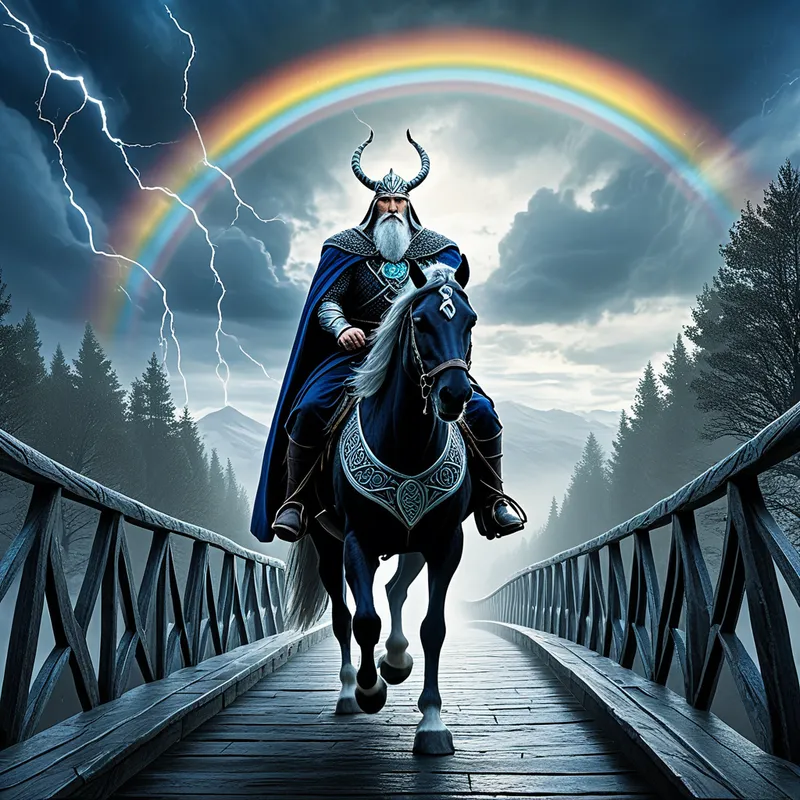
Odin on Sleipnir Myth Meaning & Symbolism
The All-Father rides his spectral steed across the worlds, a master of magic and memory, paying the price for wisdom that shapes and shatters fate.
The Tale of Odin on Sleipnir
Hear now of the rider between the worlds, where the ash tree’s roots drink from wells of memory and mist. [The wind](/myths/the-wind “Myth from Various culture.”/) on the high branches of [Yggdrasil](/myths/yggdrasil “Myth from Global/Universal culture.”/) does not whisper; it chants the names of things that were and are yet to be. And through this chant comes a sound like thunder from no cloud—the drumbeat of eight hooves on the rainbow road, on the black earth, on the very fabric of dream.
He is Odin, the Hooded One, the God of the Hanged. His face is a landscape of storm and quiet, marked by the terrible price of sight: one eye, a well of darkness, the other a piercing blue that has seen the birth of stars and the gnawing of serpents. He does not ride for glory or for battle-play. He rides because he must, because the hunger in him is a yawning gulf no feast can fill. It is the hunger to know.
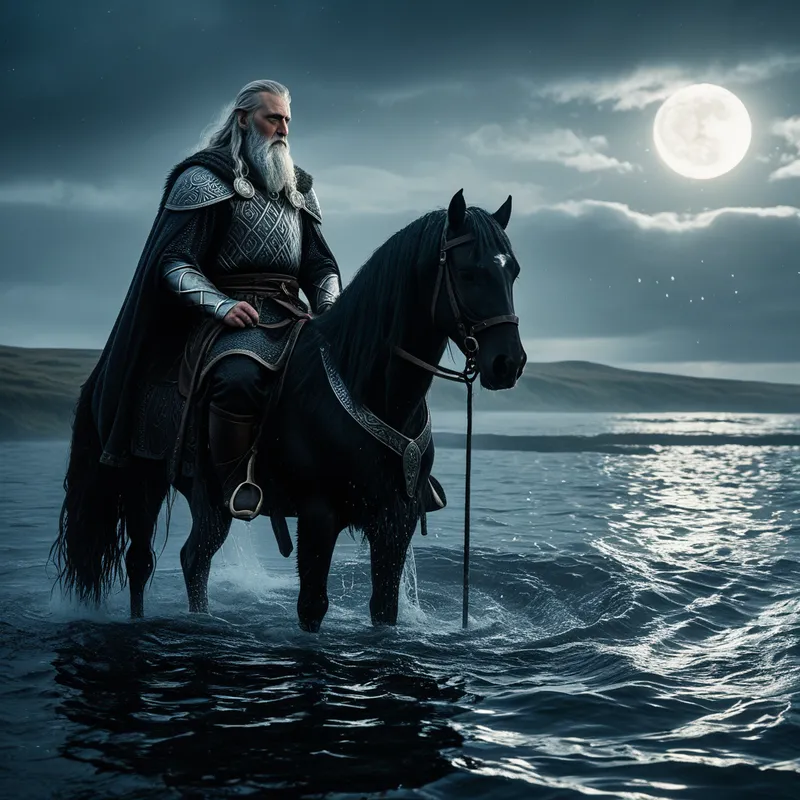
His steed is [Sleipnir](/myths/sleipnir “Myth from Norse culture.”/), foal of trickery and power, born of a god’s deceit and a stallion’s strength. No creature of mere flesh is this. His coat is the grey of mountain mist before dawn, his mane the black of a starless gap between worlds. Eight legs he has, moving with a rhythm that is not a gallop but a fluid, impossible flowing—a gait that can traverse air, earth, fire, and the deep waters of Hel itself. He is speed given form, the bridge between the solid and the unseen.
Tonight, the ride is to the roots. Down from the high halls of Asgard, across the trembling bridge of Bifröst, and into the murk of [Midgard](/myths/midgard “Myth from Norse culture.”/), where men sleep fitfully, sensing the passage of something vast overhead. Down further, to the cold, wet dark where the great root of [the World Tree](/myths/the-world-tree “Myth from Celtic culture.”/) is coiled about by the ancient, hate-filled serpent, [Nidhogg](/myths/nidhogg “Myth from Norse culture.”/). Here lies the Well of Urd, its waters black and still, holding all memory, all pattern, all that is decreed.
Odin dismounts. Sleipnir stands silent, a statue of watchful shadow. The god approaches the well, where the three [Norns](/myths/norns “Myth from Nordic culture.”/)—Urd, Verdandi, [Skuld](/myths/skuld “Myth from Norse culture.”/)—etch [runes](/myths/runes “Myth from Norse culture.”/) of past, present, and future into the tree’s bark. He does not speak to them. Their work is their own. His quest is for the waters themselves, for the wisdom that lies sunk in that liquid dark, a wisdom that requires not a question, but a sacrifice.
He draws his spear, [Gungnir](/myths/gungnir “Myth from Norse culture.”/). Not to fight, but to offer. In a motion that is both brutal and sacred, he turns the point upon himself. He hangs himself upon the branch of Yggdrasil, a sacrifice of himself to himself. For nine nights, pierced by the spear, denied the comfort of mead or bread, he stares into the well’s abyss. The winds scour him. [The runes](/myths/the-runes “Myth from Norse culture.”/), hidden in the depths, begin to swirl and rise. On the ninth night, with a cry that is both agony and ecstasy, he sees. He reaches down, his fingers breaking the surface of the [water](/myths/water “Myth from Chinese culture.”/), and seizes the runes—the secret shapes of the universe.
With the runes screaming their knowledge into his soul, he cuts himself down. Weak, transformed, he staggers to his faithful steed. Sleipnir, who has waited without moving, lowers his great head. Odin pulls himself into the saddle, the new wisdom a fire and an ice in his veins. And together, they ride back up the [World Tree](/myths/world-tree “Myth from Global culture.”/), from the realm of primal memory to the realm of conscious action, the god now forever changed, carrying the tools of creation and destruction back to the worlds of gods and men. The ride is endless. The quest is never done.
Cultural Origins & Context
This mythic pattern of Odin’s journey is not a single, tidy story from a book, but a tapestry woven from fragments across the Poetic Edda and Prose Edda. It was the province of skalds (poets) and seers, told in [feasting halls](/myths/feasting-halls “Myth from Celtic culture.”/) where the firelight danced like Sleipnir’s hooves. In a culture that valued practical skill, courage, and fate (wyrd), Odin’s pursuit was a profound paradox: he sought the very secrets of the fate that bound him.
The myth served multiple societal functions. For the warrior elite, it modeled a different kind of courage—not just physical bravery, but the terrifying courage of the spirit, of seeking knowledge even at the cost of [the self](/myths/the-self “Myth from Jungian culture.”/). For the culture’s magical and religious practitioners, it was the archetypal [shamanic journey](/myths/shamanic-journey “Myth from Siberian culture.”/): the god-king becomes [the shaman](/myths/the-shaman “Myth from Siberian culture.”/), undertaking a perilous voyage (aided by his spirit-horse/familiar) to [the underworld](/myths/the-underworld “Myth from Greek culture.”/)/[otherworld](/myths/otherworld “Myth from Celtic culture.”/) to retrieve vital knowledge for his people. Sleipnir is the ultimate shamanic vehicle, enabling this transit between cosmic realms. The myth legitimized the practices of seiðr (magic) and divination, framing them as a terrifying, costly, but necessary engagement with the hidden architecture of reality.
Symbolic Architecture
At its core, this myth is an elaborate map of [consciousness](/symbols/consciousness “Symbol: Consciousness represents the state of awareness and perception, encompassing thoughts, feelings, and experiences.”/) seeking to know its own origins and limits. Odin represents the inquiring, sovereign mind—[the ego](/myths/the-ego “Myth from Jungian culture.”/) or conscious self driven to understand the larger [psyche](/myths/psyche “Myth from Greek culture.”/) ([the Well of Urd](/myths/the-well-of-urd “Myth from Norse culture.”/)) in which it is embedded.
The sacrifice of the eye is the first bargain: trading focused, worldly perception for panoramic, inner sight. The hanging is the second: sacrificing the comfort of the known self to be reborn into a wider understanding.
Sleipnir is the crucial symbolic linchpin. The eight [legs](/symbols/legs “Symbol: Legs in dreams often symbolize movement, freedom, and the ability to progress in life, representing both physical and emotional support.”/) suggest a mobility beyond the four directions of the earthly [plane](/symbols/plane “Symbol: Dreaming of a plane often symbolizes a desire for freedom, adventure, and new possibilities, as well as transitions in life.”/); they symbolize the [ability](/symbols/ability “Symbol: In dreams, ‘ability’ often denotes a recognition of skills or potential that one possesses, whether acknowledged or suppressed.”/) to move through all states of being—conscious, unconscious, living, dead, past, future. He is the function of the psyche itself that connects disparate realms. He is [intuition](/symbols/intuition “Symbol: The immediate, non-rational understanding of truth or insight, often described as a ‘gut feeling’ or inner knowing that bypasses conscious reasoning.”/), the transcendent function, the libido (psychic [energy](/symbols/energy “Symbol: Energy symbolizes vitality, motivation, and the drive that fuels actions and ambitions.”/)) that carries the questing consciousness on its [journey](/symbols/journey “Symbol: A journey in dreams typically signifies adventure, growth, or a significant life transition.”/). He is born of Loki, the chaotic, shape-shifting principle, indicating that this connective [capacity](/symbols/capacity “Symbol: A measure of one’s potential, limits, or ability to contain, process, or achieve something, often reflecting self-assessment or external demands.”/) arises from the fluid, ambiguous, and often troubling parts of the psyche.
The Well of Urd is the [collective unconscious](/symbols/collective-unconscious “Symbol: The Collective Unconscious refers to the part of the unconscious mind shared among beings of the same species, embodying universal experiences and archetypes.”/), the vast [reservoir](/symbols/reservoir “Symbol: A contained body of water representing stored resources, emotions, or potential, often signifying controlled or suppressed aspects of the self.”/) of ancestral [memory](/symbols/memory “Symbol: Memory symbolizes the past, lessons learned, and the narratives we construct about our identities.”/), archetypal patterns, and impersonal [fate](/symbols/fate “Symbol: Fate represents the belief in predetermined outcomes, suggesting that some aspects of life are beyond human control.”/). The runes are the fundamental patterns or codes of psychic [reality](/symbols/reality “Symbol: Reality signifies the state of existence and perception, often reflecting one’s understanding of truth and life experiences.”/)—the archetypes in their pure, dynamic form. To gain them, the conscious self (Odin) must surrender its position of control and [dominance](/symbols/dominance “Symbol: A state of power, control, or influence over others, often reflecting hierarchical structures, authority, or social positioning.”/), experiencing a symbolic [death](/symbols/death “Symbol: Symbolizes transformation, endings, and new beginnings; often associated with fear of the unknown.”/) (the hanging) to be rewired by a deeper [truth](/symbols/truth “Symbol: Truth represents authenticity, honesty, and the quest for knowledge beyond mere appearances.”/).
The Dreamer’s Resonance
When this mythic pattern stirs in modern dreams, it often signals a profound shift in the dreamer’s psychological orientation. It is not a call to literal sacrifice, but to a deep, interior process of reorientation.
Dreaming of a powerful, strange horse (especially one with unusual features) that you must ride on an urgent, unknown journey may reflect the awakening of the transcendent function—a new psychic energy carrying you toward necessary but uncharted inner territory. The horse may feel frightening, uncontrollable, or magnificently potent. Dreaming of a solitary, wise, or wounded figure (like a one-eyed man) offering guidance or demanding a price can represent the emerging archetype of the Senex, the inner sage, who requires the dreamer to relinquish a cherished, one-sided viewpoint for greater wisdom.
Somatically, this process can feel like a “dark night of the soul”—a period of depression, anxiety, or dissociation that is, in fact, the psyche’s necessary descent. The dreamer may feel “hung on their own tree,” suspended in a painful limbo where old identities are dying. The myth assures us this is not pathology, but the prelude to a radical re-knowing. The ride on Sleipnir is the felt sense of being propelled by a force greater than one’s will through this transformative ordeal.
Alchemical Translation
The alchemical process mirrored here is the [Nigredo](/myths/nigredo “Myth from Alchemical culture.”/)—the blackening, the dissolution of the old, rigidified conscious attitude. Odin’s journey is a precise model for the modern individuation process, where one must venture into the darkest, most rejected parts of the self to retrieve the “gold” of wholeness.
The modern individual’s “Sleipnir” is that inner capacity—often born from our own tricksterish, adaptive chaos (Loki)—to hold the tension of opposites and travel into our personal underworld: our trauma, our shadow, our forgotten memories.
First, we must make the initial sacrifice (the eye): giving up our most relied-upon, partial way of seeing [the world](/myths/the-world “Myth from Tarot culture.”/). Then, we must undertake the hanging: a voluntary, painful engagement with the unconscious, allowing our ego to be pierced by insights that dismantle it. This is the therapeutic or introspective journey, the “nine nights” of confronting what lies in our personal Well of Urd.
The retrieval of the runes is the integration. The raw, chaotic material of the unconscious is shaped into usable knowledge—a personal “runic” alphabet of symbols, patterns, and truths that give new meaning to our life. We then must, like Odin, “ride back” to our daily life, carrying this wisdom into our relationships, work, and creativity. The god does not stay at the well; he returns to the world, now armed. So too must we bring our hard-won self-knowledge back into engagement with reality.
The myth ultimately teaches that wisdom is not a passive acquisition but an active, relentless, and costly journey. The Self (Odin) must be in perpetual motion (on Sleipnir), forever negotiating the distance between the heights of aspiration and the depths of origin, because to know the whole story is to participate in its endless, riding telling.
Associated Symbols
Explore related symbols from the CaleaDream lexicon: