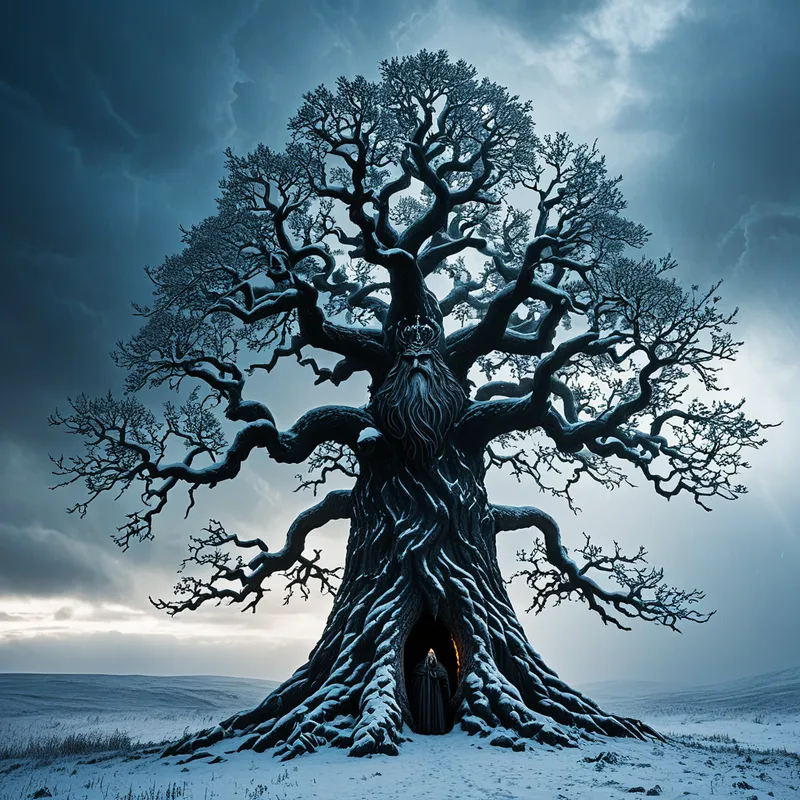
Odin hanging on Yggdrasil Myth Meaning & Symbolism
The Allfather hangs himself on the World Tree for nine nights, pierced by his own spear, to win the runes of cosmic knowledge.
The Tale of Odin hanging on Yggdrasil
Listen. The wind does not whisper here; it keens. This is the place where the worlds meet, where the root delves into the dark and the branch scrapes the cold stars. Here stands Yggdrasil, the Ash, axis of all that is. And upon it, a shadow hangs.
He is Odin, the Allfather, the Hooded One. He who has traded an eye for a drink from Mimir’s Well now finds that draught insufficient. A deeper thirst gnaws at him—a hunger for the bones of reality, for the secret names of things, for the power to shape fate itself. This knowledge is not given. It must be taken, and the price is everything.
He strips himself of his cloak, of his kingship. With his own hand, he takes Gungnir, the spear that has decided the fates of armies, and turns it against himself. He drives it deep into his own side. Then, with a will of iron and desperation, he hoists his own body onto a gnarled, wind-lashed limb of the great Tree. He is not bound by rope or chain, but by his own oath, his own terrible intent. He hangs.
Nine winds, sharp as knives, scour his flesh. Nine nights, long as ages, stretch before him. He is a offering to himself. The cold seeps into his marrow. The pain is a fire that consumes all thought, until there is only the void, the great Ginnungagap from which the worlds were born, echoing inside him. He stares into the abyss below, where the Norns weave at the root. He gazes upward, where the eagle screams. He is the bridge, the point of tension between heaven and hell, consciousness and the primal dark.
On the final, fading edge of the ninth night, when his life is a guttering candle-flame, a vision tears through the agony. From the depths, the runes—the secret, singing shapes of power—rise. They do not come gently. They rush up like a torrent, blazing with a cold, terrible light. They sear themselves into his being. With the last of his strength, a cry is torn from him, and he reaches out. He grasps them. He knows them.
The spell is broken. He falls, a dead weight, from the branch. But he does not die. He is reborn, heavier with wisdom, forever marked. He has paid with his blood, his suffering, his very self, and has won the keys to the universe. He rises, no longer just a king of gods, but their master of magic, the lord of the hanged.
Cultural Origins & Context
This stark narrative is found in the Old Norse poem Hávamál (“The Sayings of the High One”), a collection of wisdom verses attributed to Odin himself, preserved in the 13th-century Poetic Edda. It was not a tale for children or a simple fireside story. It was esoteric knowledge, passed down by skalds and practitioners of seiðr (magic), likely within initiatory or deeply religious contexts.
In the warrior-centric society of the Norse, this myth presented a paradoxical model of power. True strength was not found solely in brute force, but in the terrifying, solitary courage required for a journey into the self. The myth functioned as a foundational mystery, explaining the origin of the runes—the cultural technology for divination, magic, and memorial—and legitimizing Odin’s role as the patron of poets, mystics, and outcasts. It framed the pursuit of ultimate wisdom as the ultimate ordeal, a transaction with the cosmos where the currency was one’s own life.
Symbolic Architecture
The myth is a perfect mandala of initiation. Odin is both the sacrificer and the sacrificed, the question and the answer. The Yggdrasil is the cosmic axis, the structure of reality and the psyche. To hang upon it is to be suspended at the crux of all opposites: life and death, order and chaos, knowing and not-knowing.
The seeker must become the scaffold upon which their old self is dismantled.
The spear, Gungnir, represents focused will and intentional self-wounding. It is the instrument of conscious suffering, the act of piercing one’s own illusions and defenses. The nine nights signify a gestation in the womb of the unconscious, a complete cycle of dissolution. The runes that finally appear are not mere letters; they are the archetypal patterns of energy, the fundamental code of existence, won only after the ego has been utterly humbled and offered up.
The Dreamer’s Resonance
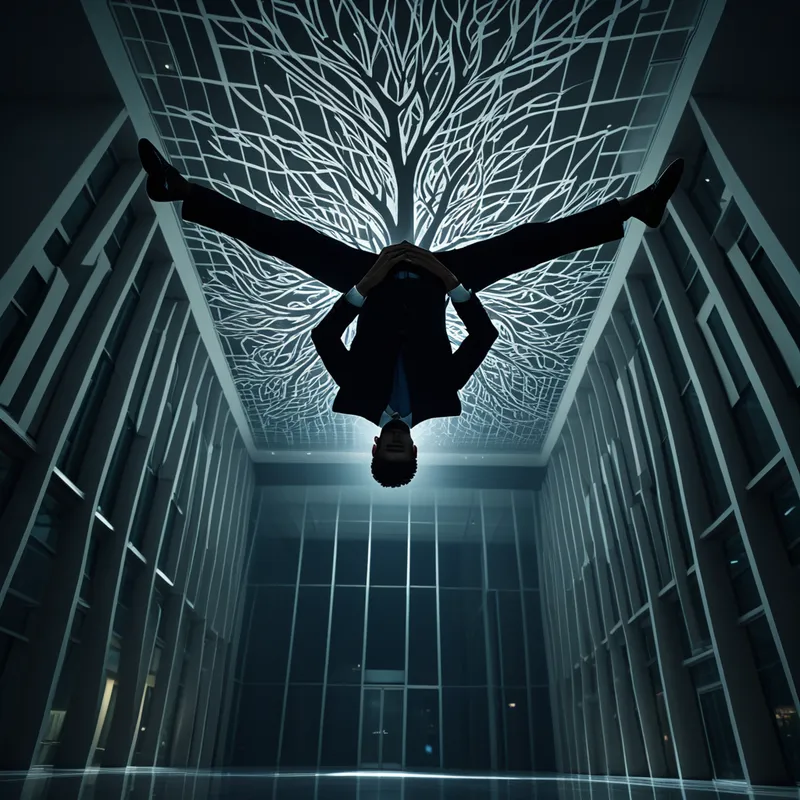
When this pattern stirs in the modern dreamer, it often manifests as dreams of suspension: being stuck on a ledge, hanging from a cliff, or floating in a void. There is a profound somatic sense of being in-between—between jobs, relationships, identities, or stages of life. The dream ego is powerless, yet crucially, it is not falling. It is held in a terrible, necessary limbo.
Psychologically, this is the psyche’s enactment of a critical initiation. The conscious mind has pursued a goal—knowledge, transformation, healing—to a point where its usual tools fail. The dream signals that the process must now be surrendered to a deeper, autonomous psychic process. It is the feeling of being on the therapist’s couch, in the midst of a creative block, or in the dark night of the soul, where all one can do is endure. The hanging is the suffering that precedes a breakthrough, the death of an old attitude that must occur for a new consciousness to be born.
Alchemical Translation
For the individual on the path of individuation, Odin’s ordeal is the blueprint for transmutation. The prima materia—the raw, unconscious content of the psyche—is the seeker’s own unexamined life. The first step is the sacrificium intellectus, the sacrifice of the intellect: the proud, one-eyed knowing of the ego must be surrendered.
The gold of wisdom is found not in adding to the self, but in the courageous dissolution of it.
The hanging is the nigredo, the blackening, the state of despair and putrefaction where all seems lost. The nine nights are the slow, patient work of introspection, where one “hangs” with a problem, a memory, or a complex, allowing it to reveal its depths without fleeing into distraction. The piercing spear is the painful but precise insight that wounds the ego’s defenses. Finally, the grasping of the runes is the illuminatio, the sudden integration of this processed material into a new, more complex understanding—a personal “rune” or symbol of meaning that grants genuine power over one’s inner world. One does not return from this journey “healed” in a simple sense, but forever changed, bearing the scars and the hard-won keys to one’s own destiny.
Associated Symbols
Explore related symbols from the CaleaDream lexicon: