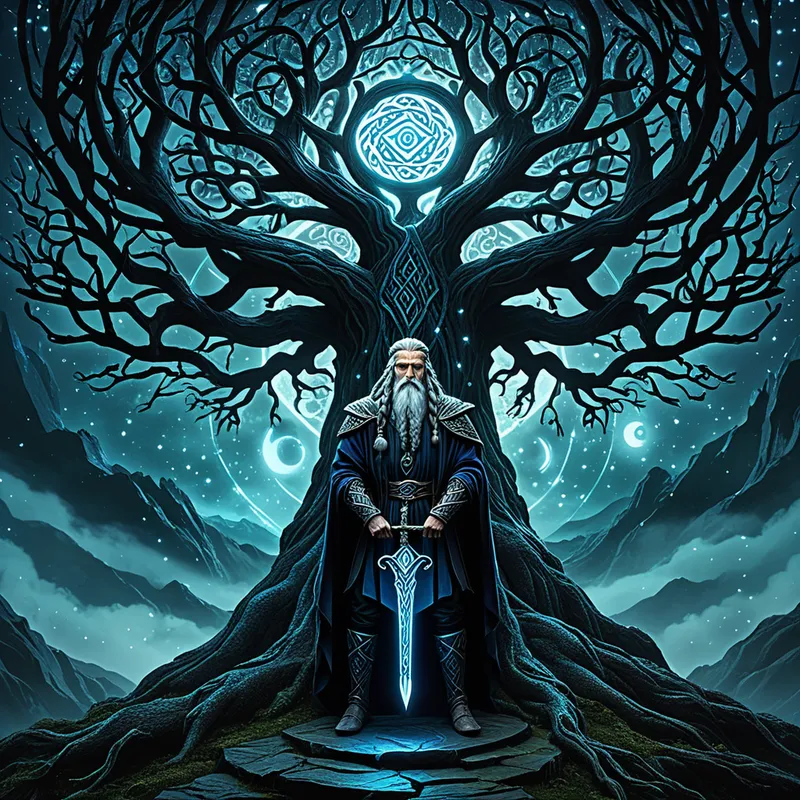
Odin and the Runes Myth Meaning & Symbolism
The Allfather hangs himself on the World Tree, pierced by his own spear, to gain the secret of the runes and the power to shape destiny.
The Tale of Odin and the Runes
Listen. In the time before time was counted, when the mists of Ginnungagap still clung to the roots of things, there was a hunger. It was not a hunger of the belly, but of the mind and soul. It belonged to Odin, the Allfather, whose single eye saw much but knew it saw far less than all.
He wandered the nine worlds, from the glittering heights of Asgard to the frozen depths of Jotunheim, seeking the wellspring of all wisdom. His ravens, Huginn and Muninn, brought him whispers, but whispers were not enough. He drank from Mimir’s Well and paid an eye for a draught of foresight, yet still a deeper secret eluded him. The secret of the runes. These were not mere letters, but the hidden bones of reality, the patterns sung into being at the dawn of creation. To know them was to know the weave of fate itself, to speak to the substance of the world.
Driven by this terrible yearning, Odin journeyed to the center of all things. To the Yggdrasil, the great ash whose branches hold the heavens and whose roots delve into the wells of past, present, and future. There, at the tree that was also a gallows, he made his choice. He took his own spear, Gungnir, and with a cry that was both agony and invocation, he pierced his own side. He offered himself to himself.
For nine nights and nine days, a sacred and terrible number, the god hung. The winds of the worlds lashed him. The cold of Niflheim bit into his bones. The weight of the cosmos pulled at his limbs. He was a sacrifice suspended between the realms, denied the comfort of the earth below or the sky above. He stared into the seething waters of the well at the tree’s root, where the Norns carved destiny. He descended into the darkness of his own ordeal, peering into the abyss of non-being.
On the final, desperate night, as his consciousness frayed at the edges of death, a great roaring filled his being. It was not sound, but meaning. The veil tore. From the depths, the runes surged upward. They were not seen, but known—a flash of lightning in the soul, a pattern etched directly upon his spirit. With a final, gasping effort, he reached down with his mind and seized them. He took them, and in that taking, he fell.
He fell from the tree, reborn, gasping on the cold ground. But he was not as he was. The runes were now within him, a living, breathing knowledge. He could now carve them, sing them, and with them, bind and unbind, heal and harm, awaken the dead and quiet the living. The price was absolute, but the power was real. The Allfather had won the secret of the roots of the world.
Cultural Origins & Context
This myth is preserved primarily in the Old Norse poem Hávamál (“The Sayings of the High One”), a collection of wisdom verses attributed to Odin himself, found within the Poetic Edda. It was not a story for children, but for initiates—seers (völur), poets (skalds), and warriors seeking magical edge. The telling was likely ritualistic, a recitation that paralleled the ordeal it described, meant to transmit not just a story but a state of mind.
In the pragmatic and fatalistic worldview of the Norse, knowledge was not a passive commodity but an active, hard-won force. The myth functioned as a foundational charter for the practice of seiðr and runic magic. It established that the highest wisdom (Óðr, from which Odin’s name derives, meaning frenzy or inspiration) comes not from casual study, but from a radical act of self-surrender and confrontation with the limits of one’s being. It was a cultural acknowledgment that true power—over fate, over poetry, over the hidden layers of battle—requires a payment of the self.
Symbolic Architecture
At its core, this is not a myth about acquiring a tool, but about undergoing a transformation of consciousness. The Yggdrasil is the axis of all realities, the structure of the psyche itself. Odin’s hanging is the ultimate act of ego suspension—the conscious self is strung up, rendered helpless, to make space for a knowledge that comes from beyond it.
The sacrifice is not to an external god, but to the deeper Self. One must be pierced by one’s own spear—confronted by one’s own will and purpose—to be opened to the numinous.
The runes represent the archetypal patterns of existence, the fundamental code of the universe that lies beneath the surface of appearances. They are the language of the unconscious, the primal forms from which all thoughts, things, and destinies coalesce. Gaining them is not learning, but remembering; not adding, but awakening to what is already latent within the structure of the world and the soul. The nine nights signify a gestation, a death and rebirth within the womb of the World Tree.
The Dreamer’s Resonance
When this myth stirs in the modern dreamer, it often manifests as dreams of suspension, piercing, or cryptic symbols. You may dream of hanging from a great tree or being pinned by a beam of light or a personal object. You may see glowing, unfamiliar glyphs on walls, skin, or in the sky. There is a somatic quality of pressure, of being stretched between opposing forces, or of a profound, isolating ordeal.
Psychologically, this signals a critical initiation into a deeper layer of the psyche. The ego is in a state of crisis, being forced to relinquish control. The “spear” is often a core truth about oneself that one has been avoiding—a trauma, a gift, a responsibility—that must finally be faced and integrated. The dreamer is, like Odin, at the threshold where personal will meets transpersonal pattern. The process is one of surrender to meaning, where the conscious mind must endure a period of helplessness and confusion to allow a more authentic, archetypal knowledge to emerge from the depths.
Alchemical Translation
The alchemical journey mirrored in Odin’s ordeal is the nigredo—the blackening, the dissolution, the descent into the primal matter. The proud, seeking ego (Odin the wanderer) must willingly submit to its own undoing on the tree of life. This is the darkest phase of individuation, where all former identities and certainties are sacrificed.
The runes are the lapis philosophorum, the philosopher’s stone—not a physical object, but the achieved state of consciousness that can perceive and participate in the fundamental ordering principles of reality.
The triumph is not in escaping the ordeal, but in being fundamentally altered by it. The modern individual undergoing this psychic transmutation moves from seeking power over their life (through force of will) to seeking alignment with the deeper patterns of their destiny. They learn to “read the runes” of their own soul—to interpret synchronicities, heed intuitive flashes, and understand their struggles not as random suffering, but as the necessary carving of a more authentic form. They become, in a sense, their own Norn, able to consciously engage with the material of their own fate, having paid the ultimate price of looking into its depths without flinching. The wisdom gained is not for domination, but for a more profound and responsible participation in the weaving of the world.
Associated Symbols
Explore related symbols from the CaleaDream lexicon: