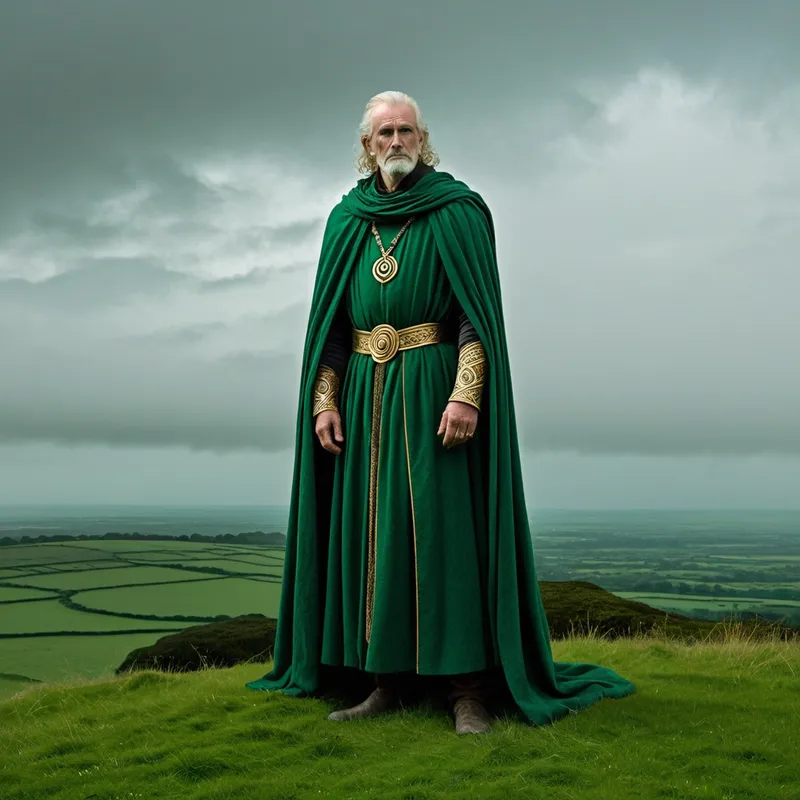
Nuada Myth Meaning & Symbolism
A king loses his hand and his throne, finding a path back to power not through force, but through a profound sacrifice and a silvered restoration.
The Tale of Nuada
Hear now the tale of the king who was whole, then was not, and then became whole again in a way no one could foresee.
In the time of the mists, when the world was younger and magic flowed like water, the Tuatha Dé Danann came to the shores of Éire. They came in clouds of fog, landing on its mountains, and their king was Nuada. He was fair and just, a warrior whose arm was strong and whose judgment was swift. Under his rule, the land prospered. But the Fir Bolg held the island, and battle was inevitable.
The two peoples met on the plain of Mag Tuired. The air was thick with the scent of crushed grass and iron. Spears sang, and shields groaned. In the heart of the fray, Nuada faced the Fir Bolg champion, Sreng. Their clash was thunder. But in a flash of cruel fortune, Sreng’s blade found its mark. Not a killing blow, but a defining one. It sheared through Nuada’s right arm at the wrist. The king’s sword, and his hand, fell to the earth together.
Though the Tuatha Dé Danann were victorious, a shadow fell over their triumph. A king must be physically whole, flawless, a perfect vessel for the land’s sovereignty. A maimed king could not rule. With a heart heavy as stone, Nuada stepped down from the high seat at Tara. The kingship passed to Bres, whose reign brought blight and misery upon the people.
Nuada wandered, a king in exile within his own realm. He felt the phantom ache of his lost hand, a constant echo of his severed sovereignty. For seven years, the land suffered under Bres’s tyranny, and the people longed for their true king.
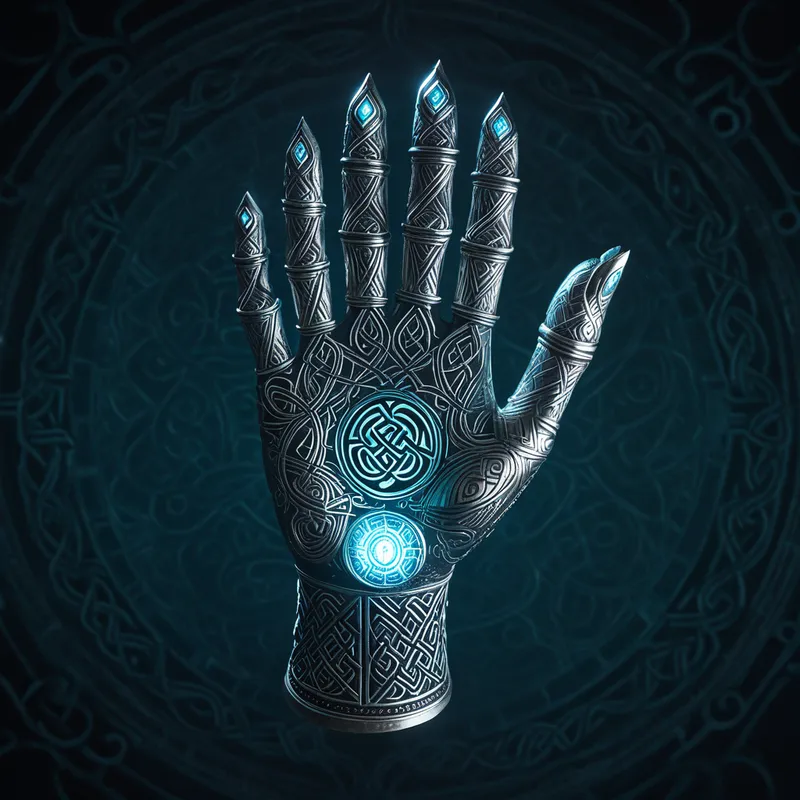
But hope was forged in a hidden smithy. The great physician and craftsman, Dian Cécht, and his son Miach, undertook a work of wonder. They did not simply make a tool for Nuada. With artistry beyond mortal ken, they fashioned a hand of purest silver. But this was no mere prosthesis. It was alive with craft-magic, jointed and nimble, capable of gripping a sword, feeling the chill of a goblet, and administering justice. It was attached, and flesh and silver fused as one.
Nuada flexed the silver fingers. They moved with a whisper of metal, a testament to loss and transcendent restoration. He was now Nuada Airgetlám, the Silver-Handed. Wholeness was restored, but it was a new kind of wholeness—forged in sacrifice, tempered by exile. With this sign, the people rose, Bres was cast out, and Nuada reclaimed the high seat. His reign returned, but the king who sat upon the throne was not the same man who had left it. He ruled with the wisdom of one who knows the price of a hand, and the true weight of a crown.
Cultural Origins & Context
The myth of Nuada is preserved primarily in the medieval Irish text, the Lebor Gabála Érenn (The Book of Invasions), and the epic Cath Maige Tuired. These manuscripts were compiled by Christian monks, who transcribed older oral traditions. Thus, the tales of the Tuatha Dé Danann sit at a crossroads: ancient Indo-European divine lore filtered through a Gaelic lens and then recorded by a scholarly, monastic culture.
Nuada’s story functioned as a foundational sovereignty myth. The king and the land were one. His physical perfection was not vanity but a prerequisite for cosmic order; his flaw meant the land’s fertility and the people’s fortune were at risk. This reflects a deep, pre-feudal concept of sacred kingship, where the ruler is a direct conduit of divine power and responsibility. The myth also served as an etiological tale, explaining the rise and fall of kingship cycles and justifying the rule of the Tuatha Dé Danann as the rightful, if complex, stewards of Ireland.
Symbolic Architecture
At its core, Nuada’s myth is an archetypal drama of the wounded sovereign. The loss of the hand is not merely a physical injury; it is the loss of agency, potency, and legitimate authority. The hand is the instrument of action, the symbol of giving and receiving, of grasping power and administering touch. Its severance represents a catastrophic rupture in the individual’s—and by extension, the culture’s—ability to interact with the world effectively.
The wound that de-thrones is the very crack through which a deeper, more conscious sovereignty must emerge.
The silver hand is the pivotal symbol. Silver is lunar, reflective, associated with intuition, the subconscious, and the world of artifice and craft. It is not the original, solar, flesh-and-blood hand of instinctual power. The new hand is a conscious creation, a fusion of nature (the body) and culture (the smith’s art). It represents an integration of the wound into the identity. Nuada does not hide his loss; he wears it, transformed into a shining badge of resilience and hard-won wisdom. His wholeness is now inclusive of his brokenness.
The seven-year exile under the oppressive Bres signifies a necessary descent. The old, unreflective power must fall away so that the new, conscious authority can be forged in the dark fires of experience and limitation.
The Dreamer’s Resonance
When this myth pattern stirs in the modern psyche, it often manifests in dreams of maiming or loss of function—a paralyzed arm, a missing hand, a broken tool essential to one’s work or identity. Somaticly, one might experience unexplained numbness, weakness, or pain in the hands or arms, signaling a disconnect between will and action.
Psychologically, this dream points to a profound crisis of personal sovereignty. The dreamer may feel they have lost their “right” to lead their own life, their agency crippled by a past trauma, a failure, or an imposed limitation (a “Bres” figure, internal or external). It is the feeling of being fundamentally unfit to rule one’s own domain. The dream asks: What part of your capacity to act in the world have you sacrificed or lost? Where do you feel illegitimate in your own power?
Alchemical Translation
The journey of Nuada is a precise map for the alchemical process of individuation—becoming the conscious ruler of one’s own inner kingdom. The initial state is the unconscious sovereignty of the intact king, ruling by innate right but untested by deep loss.
The maiming is the nigredo, the blackening, the necessary humiliation and dissolution of the ego’s perfect self-image. It is the career-ending injury, the devastating diagnosis, the failure that shatters one’s sense of identity. One is cast from the throne of their former self.
The exile is the albedo, the whitening, a period of wandering in the ashes. Here, in the depression and reflection, one must confront the raw reality of the wound without the trappings of former status. This is where the old king “dies.”
The silver hand is not a replacement; it is the philosopher’s stone of the psyche—the conscious, crafted integration of loss into a new, more resilient self.
The forging of the silver hand is the citrinitas, the yellowing, the dawn of a new understanding. This is the therapeutic or creative work: not to erase the wound, but to consciously fashion a new way of being that incorporates it. It is learning to write with the other hand, finding new strengths, building wisdom from pain.
The return, as Nuada Airgetlám, is the rubedo, the reddening, the return of the king at a higher level of integration. The individual reclaims their authority, their sovereignty, but it is now a conscious sovereignty. They rule not from a place of naive wholeness, but from the embodied knowledge of fracture and repair. The silver hand—the visible symbol of the ordeal—becomes the source of their deepest strength and legitimacy. They are whole, not despite the scar, but because the silver holds it all together.
Associated Symbols
Explore related symbols from the CaleaDream lexicon: