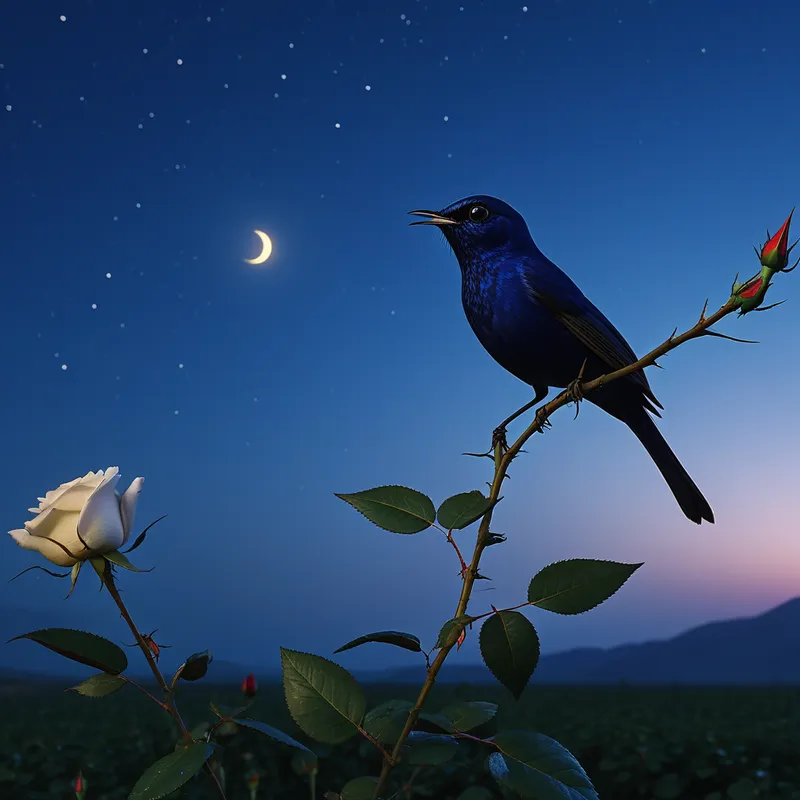
Nightingale and Rose Myth Meaning & Symbolism
A nightingale, pierced by a thorn, sings its life into a white rose, dyeing it crimson with its heart's blood in an act of ultimate, transformative love.
The Tale of Nightingale and Rose
Listen, and let the scent of jasmine and the chill of the desert night carry you. In the time when the moon was a younger god and the stars wrote poetry on the velvet sky, there lived a creature of pure song: the Bulbul. This was no ordinary bird. Its throat was a vessel for the wine of longing, its every note a thread in the tapestry of divine lament.
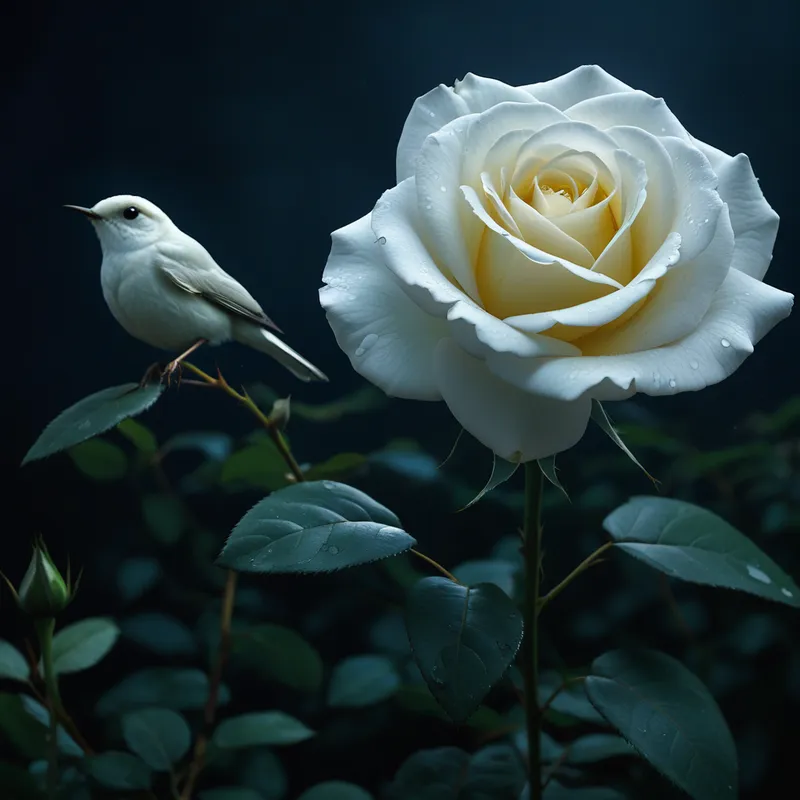
And in the same garden, kissed by the hesitant fingers of dawn, grew a Rose. Not yet the queen of flowers, she was a maiden of purest white, cloistered in a tight bud of virginal green. She was beauty asleep, a promise unspoken, a secret the sun had not yet fully coaxed into the world.
The Nightingale saw her. From his perch on the cypress, a tree that points ever toward eternity, his heart was pierced not by a thorn, but by a vision. In that white bud, he saw the culmination of all melody, the answer to every unanswered note that had ever trembled in his breast. He flew to her, his wings beating a frantic prayer. "Bloom for me," he sang, his voice a cascade of silver and sorrow. "Let me see your crimson heart. Let your fragrance be the air I breathe."
But the Rose was silent, bound by the law of her becoming. She could not hasten her own revelation. The Nightingale's desire became a tempest. He pressed his breast against her, pleading, and felt the cold warning of a thorn—a sentinel at the gate of paradise. In that moment, a choice crystallized, brighter and more terrible than any star. The law of the garden was this: only life can beget life; only essence can awaken essence.
So the Nightingale, the lover, made his covenant with the night. He leaned forward, deliberately, and let the thorn pierce his heart. And as the vital wound opened, he began to sing. This was no song of pain, but of ecstatic surrender. Each note was a drop of his life's blood, each trill a pulse of his departing soul. He sang of the dawn he would not see, of the fragrance he would never taste, of a beauty he would only know in the act of creating it. His song poured into the silent bud, and his blood, drop by sacred drop, seeped into her veins.
All night he sang, growing weaker, his song fainter yet more piercing. And as the first grey light touched the eastern hills, the miracle unfolded. The white petals, stained from within, began to unfurl. They flushed with a deep, triumphant crimson—the exact hue of the Nightingale's heart. The Rose bloomed, radiant and complete, her perfume a requiem and a birth-cry mingled. The thorn was stained. The garden was still. The singer was gone, his body a small, quiet shadow at the stem of the now-vibrant, blood-red Rose.
Cultural Origins & Context
This poignant myth is woven deeply into the fabric of Persian literature, most famously immortalized by the 12th-century poet Attar of Nishapur in his epic The Conference of the Birds, and later echoed in the works of Rumi. It is not a folktale of the people, but a teaching story of the mystics. Passed down in poetic couplets and recited in khaniqahs, its primary function was didactic and transformative.
Within the context of Sufism, the story served as a direct metaphor for the soul's relationship with God. The societal function was to model a specific type of love—ishq—which is not mere affection but a consuming, annihilating passion for the Divine Beloved. It taught that true beauty and spiritual realization (the blooming rose) are often born from a total sacrifice of the ego-self (the nightingale's life). It was a narrative compass pointing away from worldly logic and toward the paradoxical logic of the heart, where loss is gain and death is the only true beginning.
Symbolic Architecture
The myth is a perfect, crystalline structure of interdependent symbols. The Nightingale represents the human soul in its state of yearning—the aspi rant, the seeker, the poet. Its song is the expression of this longing, which is its essence. The White Rose is the unmanifest ideal, God, the Beloved, or the soul's own highest potential in its latent state. It is perfect but incomplete, awaiting activation.
The central, terrifying, and glorious symbol is the Thorn. It is the necessary suffering, the crisis, the point of friction where the seeker meets the immovable law of reality. It is not a punishment, but the very mechanism of transmutation.
The thorn is the narrow gate. The heart must be pierced for the song to become substance, and for substance to become soul.
The climax—the staining of the white rose with crimson—is the alchemical coniunctio, the sacred marriage. The lover's essence (blood/life/song) merges with the beloved's form. The rose does not simply turn red; it becomes the living memorial of the sacrifice. The nightingale's individual life ends, but his essence achieves immortality within the beauty he evoked. He becomes one with his desire.
The Dreamer's Resonance
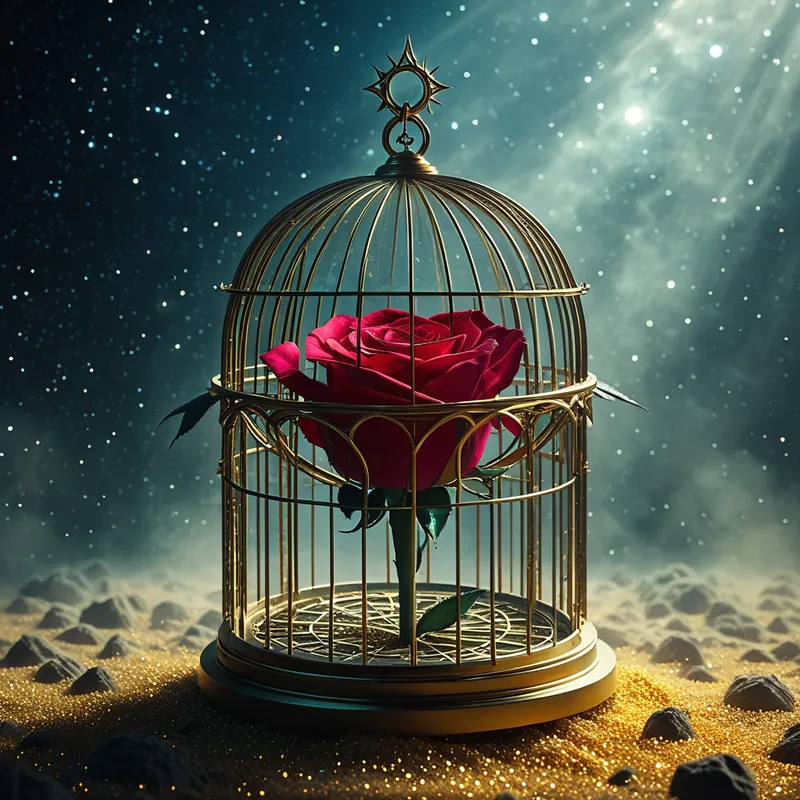
When this myth stirs in the modern unconscious, it often surfaces in dreams of poignant, painful creation or unrequited yearning that feels strangely sacred. You may dream of singing until your throat bleeds, of tending a plant that only blooms when you injure yourself, or of a beautiful object that you can only reach by traversing a field of sharp, piercing points.
Somatically, this can feel like a tightness in the chest—a literal "heartache"—accompanied by a surge of creative energy or deep empathy. Psychologically, you are likely at a crossroads where a deep part of you (the nightingale) is confronting a seemingly impossible ideal or relationship (the rose). The dream signals that a part of your psyche is ready to "spend itself" entirely, to risk profound vulnerability for the sake of bringing something beautiful, true, and deeply felt into the world. It is the process of the ego confronting the Self's demand for a higher, more integrated state of being, often through the agony of artistic creation, the surrender in deep love, or a spiritual crisis.

Alchemical Translation
For the individual on the path of individuation, the myth of the Nightingale and Rose is a manual for psychic transmutation. The first stage is Yearning (the nightingale's song)—identifying that which you most deeply desire, which is often your own unlived life or unexpressed potential. The second is the Confrontation with the Thorn—the painful realization that to achieve this, you must give up something fundamental, often your current identity, comfort, or control.
The core alchemical operation is Sacrifice. This is not martyrdom, but the conscious, willing offering of a lower value for a higher one.
One does not sacrifice to the rose; one sacrifices as the nightingale, and in doing so, becomes the rose. The lover and beloved exchange properties.
The ego (nightingale) must consent to its own dissolution, pouring its energy—its "life's blood"—into the service of the emerging Self (the rose). The final stage is Transfiguration. The white rose (the latent Self) blooms crimson, now containing the essence of the sacrifice. The individual is no longer the desperate seeker, nor the inert ideal, but a new, third thing: a realized being whose very existence is a testament to the transformative power of love and loss. The psychic structure is permanently dyed with the experience. The song ends, but the beauty it created is now an eternal, living fact within the soul's garden.
Associated Symbols
Explore related symbols from the CaleaDream lexicon: