Niflheim Myth Meaning & Symbolism
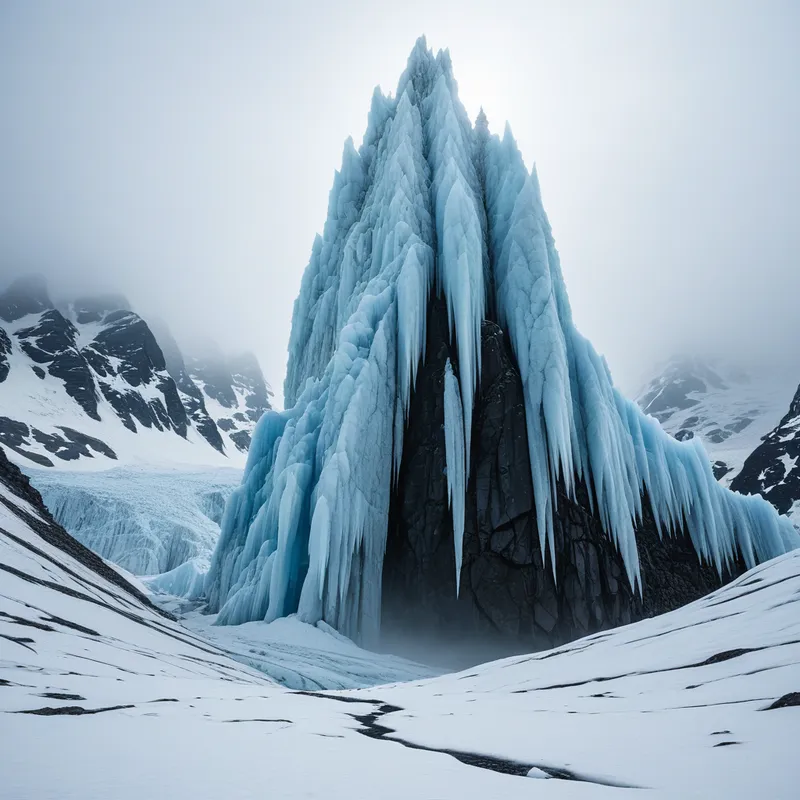
The primordial world of ice and mist from which all life and death emerge, a frozen void holding the latent potential for creation and dissolution.
The Tale of Niflheim
Listen, and hear of the time before time, when there was no sand, no sea, no waving grass. There was only the Ginnungagap, the yawning void, a breath held in the throat of eternity. And from this nothingness, two realms were born in the utter north and south.
To the south blazed Muspelheim, a realm of flame and radiance, where the fire-giant Surtr stood with his burning sword. But to the north… to the north was Niflheim. It was not a land, but a condition: a world of cold so profound it was a presence, of mist so thick it was a substance. Here, there was no warmth, no light, only the endless, whispering fall of rime and the groan of glaciers born in darkness.
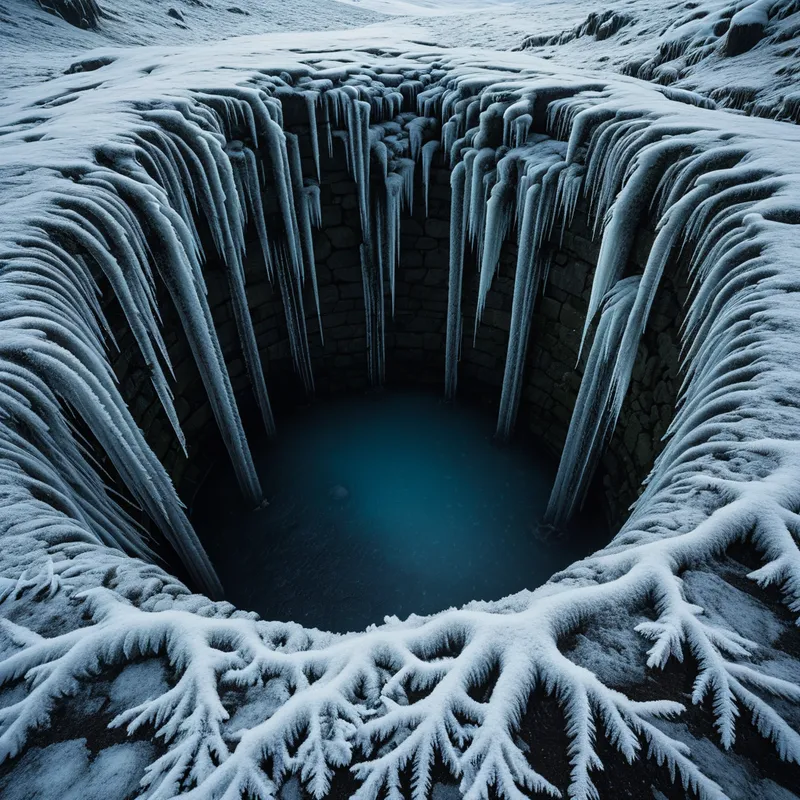
Within this frozen heart lay eleven rivers, born from the well Hvergelmir. Their names were curses and promises: Svöl, Gunnþrá, Fjörm. They were not water, but primordial ice, flowing with the slow certainty of geologic time. And from this well, the rivers crept like serpents into the Ginnungagap.
From the south came sparks and embers from Muspelheim. They flew across the great void, meeting the freezing rivers of Niflheim in the center of the abyss. Where fire met ice, a hissing, steaming miracle occurred. The rime melted, and from the dripping, lifeless slush, a form began to stir. This was Ymir, the first of the frost-giants, a being of chaotic, sleeping potential. And as more ice melted from the warmth, there emerged also Audhumla.
Audhumla licked the salty ice blocks of Niflheim. For three days she licked, and on the first, hair appeared. On the second, a head. On the third, an entire man emerged from the ice, strong and shining. This was Búri, whose grandson would be Odin. Thus, from the frozen void of Niflheim, through the meeting of opposites, came the ancestor of all gods and the substance of all giants.
But Niflheim was not done giving. Deep within its frozen roots, under one of the three great roots of the Yggdrasil, the well Hvergelmir bubbled with a darker purpose. Here, in this coldest deep, the dragon Níðhöggr gnawed eternally at the root of the world, dripping venom. And here, through a dark and mist-wreathed gate, lay Hel, the hall of the goddess Hel, where those who died of sickness or old age went to dwell. So from Niflheim came not only the stuff of creation, but also the final destination, the cold embrace from which the first life seeped and to which all life, in time, returns.
Cultural Origins & Context
The myth of Niflheim comes to us primarily from the Poetic Edda and the Prose Edda, texts compiled in 13th-century Iceland but containing far older oral traditions. For the Norse peoples, living in a world defined by harsh winters, encroaching ice, and the life-giving return of the sun, the landscape itself was a cosmological map. Niflheim was not a mere fantasy; it was the psychological and environmental reality of the frozen north, mythologized into a cosmic principle.
This myth was not a simple bedtime story. It was a foundational cosmology, recited by skalds and elders to explain the origins of a world that could be brutally cold and unforgiving. It answered the profound questions: Where did we come from? What exists before the beginning? The answer was not a benevolent creator, but an impersonal, dynamic process—a violent, fertile meeting of elemental opposites (fire and ice) within a void. Niflheim represented the necessary, terrifying precondition for existence. Its societal function was to root human life in a grand, dramatic, and ultimately fatalistic narrative where even the gods emerged from a primordial frost, forever linked to the cold and mist from which they sprang.
Symbolic Architecture
Niflheim is the archetypal symbol of the Uroboric state—the undifferentiated, latent potential that exists before consciousness and form. It is not merely "cold" in a physical sense, but represents psychic coldness: states of depression, isolation, emotional numbness, and the frozen patterns of trauma that feel eternal and lifeless.
The mist of Niflheim is the fog of the unexamined life, where everything is potential and nothing is yet real, a state of paralysis that precedes every necessary dissolution.
The eleven rivers, with their forbidding names, symbolize the frozen, yet flowing, currents of the unconscious. They are the "cold truths" we avoid, the repressed memories and instincts that flow with a power of their own from a hidden source (Hvergelmir). The meeting with the sparks of Muspelheim is the indispensable clash that generates life and consciousness. Without the fire of passion, spirit, and will (Muspelheim), the cold potential (Niflheim) remains forever inert. Without the cold, structuring principle, the fire is mere chaos and conflagration.
Crucially, Niflheim also contains the realm of Hel. This positions it as the psychic underworld—the place where outworn aspects of the self, old identities, and unresolved grief go to reside. It is the cold storage of the soul. The dragon Níðhöggr, gnawing at the roots of the world tree here, represents the latent, corrosive psychic material that constantly threatens the foundation of our conscious world (the Yggdrasil of the ego and its perceived reality).
The Dreamer's Resonance
When Niflheim emerges in modern dreams, it rarely appears as a named mythological place. Instead, it manifests as an atmosphere, a somatic experience. The dreamer may find themselves in a vast, empty, frozen landscape—a tundra, an abandoned ice rink, a house where all the heaters have failed. There is a profound sense of isolation and timelessness. The air is hard to breathe, thick with a chilling mist. Movement is slow, effortful, as if wading through psychic permafrost.
This dreamscape signals a confrontation with what psychologist James Hillman called the "archetype of the cold." The dreamer is likely experiencing a period of emotional shutdown, creative barrenness, or a depressive episode where feeling itself has frozen. It can also indicate a necessary, if painful, withdrawal—a psychic winter where energy is conserved deep within the unconscious (the well Hvergelmir) for a future thaw. The dream is the psyche's way of mapping this internal, frozen territory, making the numbness visible and knowable. To dream of finding a single, precious object in the ice, or seeing a distant light, is the first hint of a Muspelheim spark approaching.
Alchemical Translation
The journey of individuation—the process of becoming a whole, integrated Self—requires a descent into one's personal Niflheim. This is the alchemical stage of mortificatio or nigredo, often symbolized by blackening, freezing, or putrefaction. It is the experience of hitting psychic bedrock, where all comforting illusions and warm identities freeze and shatter.
To embrace one's Niflheim is to consent to the freezing, to sit in the mist of not-knowing, and to discover that within the deepest cold lies the latent blueprint of what you are meant to become.
The process begins with acknowledging the cold: the frozen anger, the chilled love, the icy core of a childhood wound. This is not about "fixing" it with false warmth, but about recognizing it as a fundamental, creative part of the self's landscape. The goal is not to eradicate the cold, but to allow the conscious fire of attention (the spark from Muspelheim) to meet it. This meeting is the alchemical conjunction, which produces the "dripping slush"—the fertile, messy, and alive material from which a new, more authentic structure of being (Ymir, then Búri) can be formed.
The work is to "lick the ice blocks" like Audhumla—to engage in slow, persistent, nourishing attention toward the frozen parts of oneself. With patient, repetitive care (the licking), form emerges from formlessness. What was once a block of numb potential becomes a distinct shape, a recognizable aspect of the soul ready to be integrated. Thus, the myth teaches that our deepest wounds and coldest voids are not enemies to be vanquished, but the primordial substance from which our most authentic gods—our sovereign consciousness and capacity for meaning—are born. The journey ends not in escaping the cold, but in understanding that one carries a necessary, creative fragment of that primordial frost within, forever balancing it with the inner fire.
Associated Symbols
Explore related symbols from the CaleaDream lexicon: