Net of Indra Myth Meaning & Symbolism
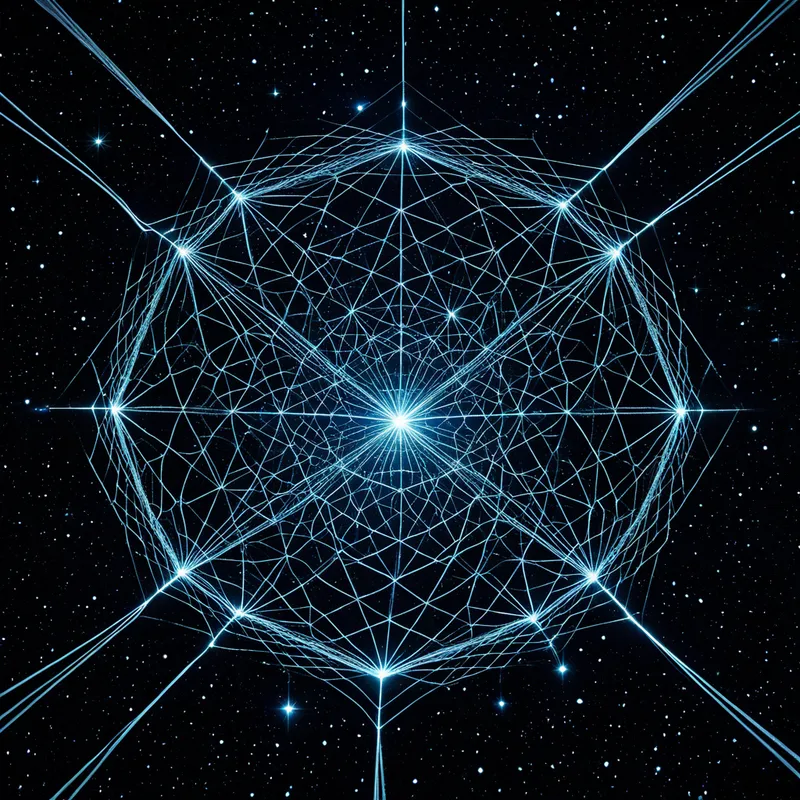
A cosmic net of infinite jewels, each reflecting all others, symbolizing the profound interdependence and luminous emptiness of all phenomena.
The Tale of Net of Indra
In the fathomless heights of the Trayastrimsa Heaven, where the air is music and the light is thought, the great god Indra presides. His palace, Vaijayanta, is a structure of such splendor it makes the constellations seem dim. Yet, in its most profound and silent hall, hangs his greatest wonder, a testament not to power, but to the very fabric of existence.
It is a net. But no net woven by mortal hands or divine whim. This net is infinite, stretching beyond the edges of perception in all directions. Its cords are threads of primordial light, fine as a spider's silk yet strong as the axis of the worlds. And at every single intersection of these luminous threads, at every node where possibility meets possibility, there is suspended a perfect, flawless jewel.
These are not ordinary gems. Each is a cintamani, a jewel that reflects all desires and all realities. They are multifaceted, polished to an impossible clarity. And here lies the mystery that humbles even the devas: gaze into any single jewel. There, in its depths, you do not see a mere reflection of the hall or the god. You see the entire net. Every other jewel, in its perfect entirety, is mirrored there. And within each of those reflected jewels, the entire net is mirrored again, and again, and again, in an endless, luminous recursion.
A visitor, a newly arrived deva, once stood before this net, their mind reeling. They focused on one jewel, then saw within it the image of another. They followed that reflection, diving deeper, only to find the first jewel they had chosen staring back at them from within the second. There was no beginning, no central jewel, no primary source of light. Each jewel simultaneously contained and was contained by all others. The light did not come from a sun or a lamp; it was generated, sustained, and magnified by the mutual reflection of all jewels upon all jewels. The net was not a thing that held the jewels; the jewels, in their infinite mutual embrace, were the net.
In that silent hall, the deva understood. This was not merely Indra's adornment. It was a living map, a breathing model of the cosmos itself. Every jewel, a world. Every reflection, a life. Every thread, the law of cause and effect that binds them. The brilliance of any single gem was utterly dependent on the brilliance of all the others. To dim one was to dim the whole. To polish one was to illuminate the entirety. In that moment of awe, the myth was born, not as a story of conquest, but as a silent revelation of how things truly are.

Cultural Origins & Context
The imagery of the Net of Indra is most famously expounded in the Avatamsaka Sutra (Flower Garland Sutra), a cornerstone of <abbr title="The "Great Vehicle" school of Buddhism">Mahayana Buddhism. This sutra is not a linear narrative but a vast, poetic, and philosophical tapestry meant to induce a direct experience of the universe's interdependent nature. The Net of Indra is its central metaphor.
It was a teaching tool for monks and philosophers, a visual and conceptual aid to grasp the doctrine of pratityasamutpada. In a culture where kings and emperors were often compared to Indra, the myth also carried a subtle political and ethical message: a ruler's well-being is inseparable from the well-being of the most distant subject, just as each jewel's light depends on every other. It was passed down not as a folktale of gods, but as a profound philosophical truth, recited in monasteries, contemplated in meditation, and used to deconstruct the illusion of a separate, independent self.
Symbolic Architecture
The myth’s power lies in its elegant, multi-layered symbolism. Each component is a door to understanding reality.
The Net represents the fabric of samsara itself—the interconnected web of all phenomena, time, space, and causality. It is the structured, manifest universe, the realm of form and relationship.
The Jewels are all individual existences: you, me, a star, a thought, a feeling, a stone. Each is unique, multifaceted, and possesses intrinsic value and clarity—its own tathata.
The Reflections are the principle of radical interdependence. A jewel has no inherent, isolated "jewel-ness." Its identity, its very existence as a brilliant gem, is conferred upon it by all other jewels. You are who you are because of the entire universe reflecting upon you and being reflected within you.
The universe is not a collection of objects, but a communion of subjects. To see oneself is to see the world; to know the world is to know oneself, for they are mutually arising reflections in the great net of being.
This leads to the core psychological insight: the ego’s greatest suffering stems from believing itself to be a solitary, opaque jewel, disconnected and competing for light. Enlightenment, from this view, is the shocking, liberating realization that one has always been a transparent reflector and a reflected image simultaneously—unique yet empty of a separate self.
The Dreamer's Resonance
When this myth stirs in the modern unconscious, it often manifests in dreams of profound connection or dizzying complexity. One might dream of a vast, intricate network—a neural web, a city's infrastructure, a mycelial network—where every node pulses with the life of the whole. The dreamer may find themselves as both a single point and the entire network, a disorienting yet peaceful experience.
Somatically, this can feel like a release of tension held in the body’s center—the armor of separateness dissolving. Psychologically, it signals a process of moving beyond the ego’s isolation. The conflict in such dreams is rarely a monster to fight, but a paradox to surrender to: the struggle to maintain the fiction of a separate self while the dream imagery relentlessly demonstrates interconnection. The resolution is the dreamer’s acquiescence to being a part of the pattern, which brings a deep sense of belonging and relief. It is the psyche’s way of rehearsing the death of narcissism and the birth of ecological selfhood.
Alchemical Translation
The individuation process, the journey toward psychic wholeness, is perfectly modeled by the Net of Indra. The modern individual often begins life identified with a single, precious jewel—the ego. The alchemical work is the polishing of that jewel through introspection, shadow-work, and engaging with the world (other jewels).
As one polishes their own jewel—becoming more conscious, integrating repressed parts—a miraculous thing happens. The clearer one becomes, the more vividly one reflects the world around them. The pain of others, the beauty of art, the complexity of systems, all begin to appear not as external phenomena, but as aspects of one’s own inner landscape. Conversely, one starts to see their own biases, traumas, and joys reflected in the faces and stories of others. The boundary between inner and outer softens.
Individuation is not about becoming a bigger, brighter, isolated gem. It is the process of becoming so transparent that you disappear as a separate entity, only to reappear as the clear, conscious space in which the entire net is revealed.
The final "triumph" is not conquest, but realization. It is understanding that your consciousness is the very faculty of reflection that allows the net to know itself. The struggle to "find yourself" transmutes into the peace of realizing you were never lost—you were, and are, an indispensable expression of the whole pattern. The ego-hero dissolves into the sage, who sees the play of reflections without clinging to any single image. In this alchemy, personal healing becomes inseparable from cosmic participation. To tend to your own jewel is, inevitably and beautifully, to polish the entire universe.
Associated Symbols
Explore related symbols from the CaleaDream lexicon: