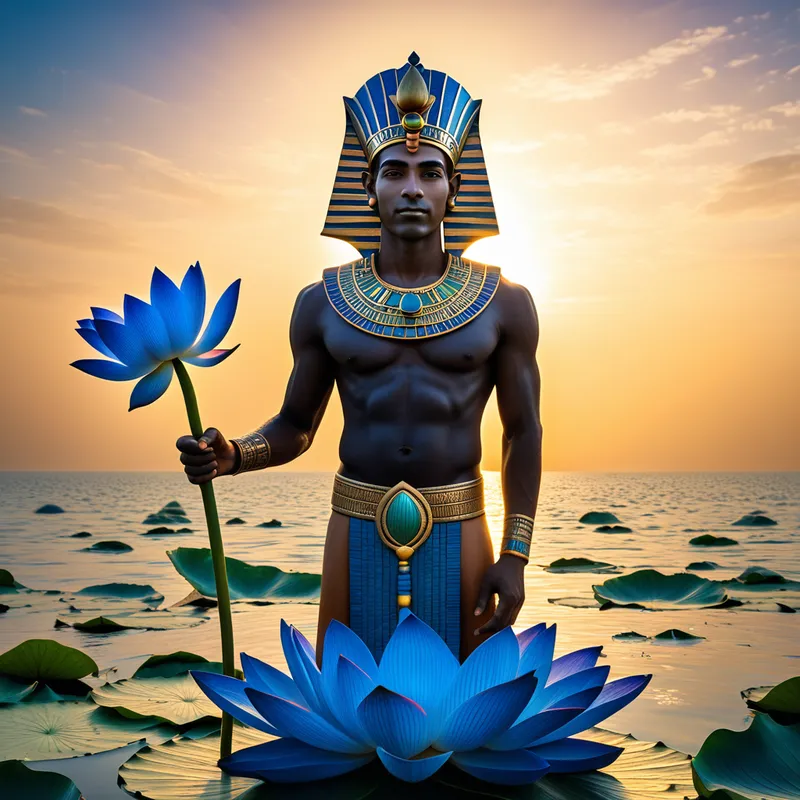
Nefertum Myth Meaning & Symbolism
The myth of the lotus-born god who brings the first light, the scent of creation, and the healing power of beauty from the primordial waters of chaos.
The Tale of Nefertum
Before the first name was spoken, before the first shore was drawn, there was only Nun. An endless, silent, dark ocean, pregnant with all possibilities and none. From its fathomless depths, a yearning stirred. Not a thought, but a feeling—a pull toward form, toward fragrance, toward light.
And in response, from the mud and the murk, a green stem began its impossible journey. It pushed upward through the weight of the abyss, driven by a silent imperative. It climbed through the cold and the dark until, at last, it broke the skin of the waters into a world of breath. There, in the interface between the deep below and the void above, it paused. A tight, blue bud, holding its secret close.
Then came the breath of Khepri, the one who comes into being by himself. A warm wind, the first sigh of a universe about to be. It touched the bud.
The blue lotus unfolded.
It was not a slow blooming, but a revelation. The petals parted and from its golden heart, a youth arose. He was the first beautiful thing. His skin was the dark, rich silt of the Nile bank; his eyes held the calm of the deep water. Upon his head sat the lotus from which he was born, and in his hands he held the power of life and dominion. He did not speak, for there were no words. Instead, he exhaled.
And his breath was the scent of the lotus itself—a perfume of creation, clean and sweet, cutting through the stale eternity of Nun. This fragrance was the first distinction, the first "this" is not "that." It was a declaration of beauty, and therefore, of existence.
Seeing this perfect, fragrant form, the sun disc, Ra, found its anchor. It rose for the first time, its light catching on the youth's brow, on the dewdrops on the lotus petals. The youth was named Nefertum, "the perfected one," "he who is beautiful." He was the lotus, the perfume, and the sunrise made manifest. His very being was the resolution of the silent conflict between non-being and being, between chaos and the first, fragile, breathtakingly beautiful order.
Cultural Origins & Context
The myth of Nefertum is woven into the very fabric of Egyptian cosmological thought, primarily centered in the northern city of Memphis. There, he was worshipped as the youthful third member of the great Memphite Triad, the son of the creator-god Ptah and the fierce lioness-goddess Sekhmet.
This familial context is crucial. He is the child of raw creative power (Ptah) and destructive, healing fury (Sekhmet). His myth was not a standalone epic recited in temples but a living, functional truth embedded in daily ritual and royal ideology. Priests invoked him at dawn as the embodiment of the rising sun, a daily re-enactment of the first sunrise. Perfumers and healers saw him as their patron, for his sacred scent was believed to carry divine power. To anoint oneself with lotus perfume was to participate in the primordial moment of creation, to align oneself with the first, perfect emergence of beauty and order from chaos. The myth served as a metaphysical anchor, assuring the people that each new day was not merely a repetition, but a sacred renewal of the world's first, most perfect moment.
Symbolic Architecture
Nefertum is not a god of grand battles or cosmic rulership, but of the primordial moment of becoming. He symbolizes the instant when potential becomes manifest, when feeling takes form. His symbolism is a triune mystery.
First, the Blue Lotus. Rooted in the mud of Nun, it rises through the dark waters to bloom in the air and light. It is the archetype of spiritual emergence, of consciousness (the flower) born from the unconscious (the waters). It closes at night and re-opens at dawn, a perfect symbol of rebirth and cyclical renewal.
Second, the Sacred Perfume. His breath, his very essence, is a fragrance. In a world without light, scent is the first sense. This perfume is the first differentiation, the first "quality" of the new creation.
The first act of creation is not a shout, but a scent. It is the subtle, pervasive announcement of a new quality of being.
Third, the First Sunrise. He is the "lotus at the nose of Ra," the beautiful, necessary precursor that makes the sun's journey possible. He is the dawn before the dawn, the condition that allows the great light to appear. Psychologically, he represents the inner awakening—the moment of insight, inspiration, or emotional clarity—that must precede any lasting change or "enlightenment."
The Dreamer's Resonance
When the archetype of Nefertum stirs in the modern psyche, it often manifests in dreams of profound, quiet emergence. One does not dream of Nefertum as a person, but as an experience.
You may dream of finding a single, perfect flower growing in an impossible place—a lotus in a concrete crack, a bloom in a dark basement. This signals a nascent part of the self, something beautiful and essential, struggling to emerge from a personal "Nun" of depression, confusion, or stagnation. The somatic feeling is often one of tightness in the chest or solar plexus, followed by a release upon seeing the flower.
Dreams of overwhelming, beautiful scents with no visible source—the smell of rain on earth, of a specific flower, of clean air—point to Nefertum's perfume. This is the psyche announcing a new quality of being, a change in your inner atmosphere that is felt before it is understood. It is the fragrance of a nascent self-state.
To dream of witnessing a breathtakingly beautiful, silent dawn over a calm sea is to stand at the Nefertum moment in your own life. It indicates you are on the cusp of a new beginning, where a long-held potential is about to break into the light of consciousness. The conflict here is not against an enemy, but against the weight of inner chaos and the fear of that first, fragile emergence.

Alchemical Translation
The alchemical journey modeled by Nefertum is not one of heroic conquest, but of allowing. It is the process of Primordial Individuation—the birth of the unique self not from social roles, but from the primal, chaotic waters of one's own unconscious foundation.
The first stage is the Nigredo, the black phase, represented by the dark, muddy depths of Nun. This is the fertile chaos of un-lived life, repressed memories, and raw potential. The work here is not to fight the mud, but to be the seed within it. It requires sinking into one's own depths, into the feelings and formless urges that seem like nothing.
The gold is not found by fleeing the mud, but by being the lotus that knows the mud as its only possible birthplace.
The Albedo, the white phase, is the stem's journey upward and the bud breaking the surface. This is the often arduous, blind push toward consciousness—the therapy session, the journal entry, the moment of vulnerable confession. It is the act of bringing something from the deep, personal Nun into the realm of possible expression.
The Rubedo, the red phase of culmination, is the blooming. This is not a grand finale, but a quiet, perfect opening. It is the moment a deep insight finally "clicks," when a long-held grief transforms into compassion, when a creative idea reveals its core form. This is Nefertum born—the "perfected" moment where a fragment of the true self emerges, beautiful, fragrant, and whole. It heals not by fighting disease (that is his mother Sekhmet's domain), but by presenting the original, beautiful blueprint of being. To integrate Nefertum is to learn to trust these moments of pristine, inner-born beauty as the truest guides, the first sunrises of a self continually being created anew.
Associated Symbols
Explore related symbols from the CaleaDream lexicon: