Nataraja Myth Meaning & Symbolism
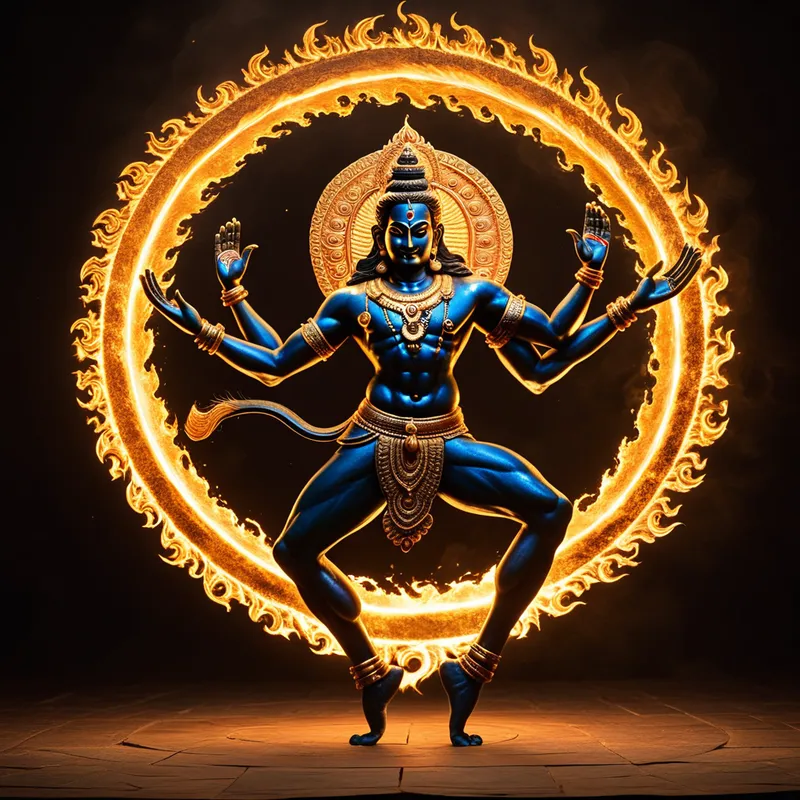
Shiva, as the cosmic dancer Nataraja, performs the Tandava within a ring of fire, embodying the eternal cycle of creation, preservation, and dissolution.
The Tale of Nataraja
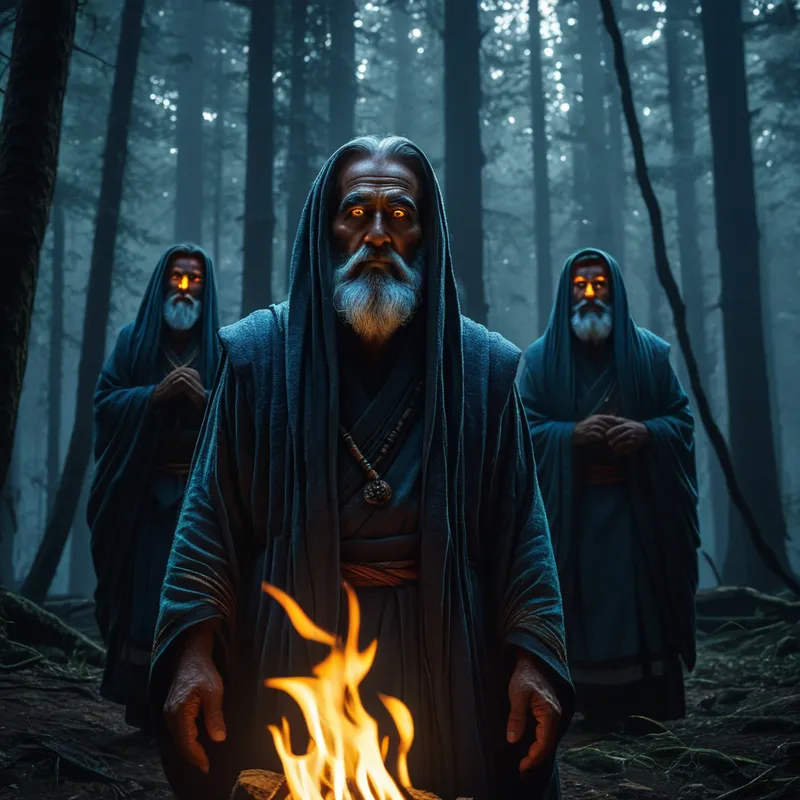
Listen. In the deep, primordial forests of Daruka, the air was thick with the smoke of arrogance and the murmur of misplaced power. Here, ten thousand sages and their families had made their home, convinced their rituals and austerities had granted them dominion over the cosmos itself. Their pride was a fortress, their rites a challenge thrown at the heavens.
They performed a great sacrifice, a yajna, but not for grace or wisdom. It was a weapon, a fire born of ego to consume the divine order. From the heart of their sacrificial pit, they conjured a monstrous tiger, its stripes like shadows of violence, and sent it leaping toward the one who dwells beyond all rites—Shiva. The god merely smiled, a flicker of infinite patience. With the ease of plucking a flower, he stripped the skin from the beast and draped it around his waist, a garment of conquered ferocity.
Undeterred, the sages hissed incantations and sent a great serpent, Vasuki, its hood spread like a deadly canopy, to strangle the life from the silent one. Shiva caught the serpent in mid-strike and coiled it like a living ornament around his neck, a cool necklace against his blue throat.
Then came their ultimate fury. From the fire rose a dwarf, Apasmara, the embodiment of crushing ignorance. He was small, but his weight was the weight of the universe’s sleep, and he lumbered toward Shiva to trample him into the dust. This was the final, foolish challenge.
And Shiva began to dance.
It started as a tremor in the earth, a rhythm older than time. His right foot lifted, and the cosmos held its breath. His left foot descended, not upon the earth, but upon the back of the dwarf Apasmara, pinning ignorance down—not to destroy it, but to hold it in place, the necessary foil for wisdom. His body became a symphony of motion. One hand held the damaru, its beat the pulse of creation itself. Another hand held the Agni, promising dissolution. A third was raised in the Abhaya Mudra, a gesture of boundless protection. The fourth pointed to his raised foot, the path to liberation.
He danced the Tandava within a great arch of flames—the Prabhamandala. His hair, wild and matted, flew out, catching the Ganga as she fell from heaven, and the crescent moon. The sages fell to their knees, not in defeat, but in awe. Their weapons of pride shattered against the reality of this dance. They saw it now—not a god to be conquered, but the very principle of the universe in motion: serene, terrible, beautiful, and utterly free. The dance was the answer, and the answer was everything.
Cultural Origins & Context
The icon and myth of Nataraja finds its most profound expression in the devotional (Bhakti) traditions of Southern India, particularly in Tamil Nadu. While references to Shiva as a dancer appear in ancient texts, the crystallized form we recognize—the bronze statue within the circle of flames—was perfected by the Chola dynasty sculptors. These were not mere artworks; they were murtis, consecrated vessels for the divine presence, carried in temple processions.
The myth, as told in texts like the Tiruvilayadal Puranam, served a critical societal function. It was a narrative weapon against dogmatism and empty ritualism. The sages of Daruka represent entrenched priestly orthodoxy, believing the cosmos can be controlled by formulaic sacrifice. Nataraja’s dance shatters that illusion, demonstrating that the divine reality is dynamic, ecstatic, and beyond mere ritual control. The story thus validated the Bhakti path—a path of direct, personal, and often ecstatic connection with the divine, accessible beyond the strictures of Vedic ritual.
Symbolic Architecture
The form of Nataraja is a meticulously crafted map of cosmic and psychological principles. Every element is a dialectic, holding opposites in perfect, dynamic tension.
The dance is the still point of the turning world. It is the dynamic equilibrium where creation and destruction are not sequential, but simultaneous breaths of the same reality.
The Prabhamandala represents the entire cycle of phenomenal existence—birth, life, death, and rebirth. To be within it is to be in the world of time, cause, and effect. Yet, the dancer within is utterly tranquil, depicting the consciousness that witnesses the cycle without being consumed by it.
The crushing of Apasmara is profoundly psychological. Ignorance (Avidya) is not annihilated; it is subdued and made the foundation. This signifies that our base instincts, forgetfulness, and delusions are not enemies to be hated, but energies to be mastered and integrated. They provide the resistance against which the dance of awareness gains its strength.
The four arms present the cardinal activities of the universe: creation (damaru), protection (Abhaya Mudra), destruction (fire), and liberation (pointing to the raised foot). The raised left foot signifies transcendence, the release from the cycle, while the planted right foot signifies groundedness in the world. The dancer is thus the ultimate bridge between the transcendental and the immanent.
The Dreamer's Resonance
When the pattern of the Nataraja myth stirs in the modern unconscious, it often manifests in dreams of profound, sometimes chaotic, motion. One may dream of being in a whirlwind, a spinning room, or of dancing uncontrollably. This is not a nightmare of chaos, but a somatic signal of a psychic structure being broken down and reconfigured.
The dreamer may encounter a formidable, collective "panel of judges" (the sages)—representing internalized societal expectations, rigid personal dogma, or critical inner voices. The emergence of the dancer in this scenario signals the psyche's innate capacity to respond not with argument, but with a superior, encompassing action—a creative act that re-orders reality from a deeper level. The feeling upon waking may be one of awe, exhaustion, or a strange, serene power. The body itself may feel as if it has undergone a purge, as the dream-dance works to metabolize stuck energies and outdated identities.

Alchemical Translation
For the individual on the path of individuation, the Nataraja myth models the ultimate alchemical operation: the conjunctio oppositorum (the union of opposites) in a state of dynamic flow. The goal is not to achieve a static, conflict-free peace, but to become the dancer who contains the dance.
Individuation is not the cessation of inner conflict, but the attainment of a rhythmic grace within it. One learns to hold the drum of new possibilities in one hand and the flame that burns away the old in the other, all while maintaining a posture of fearless compassion toward oneself.
The "forest of Daruka" is the tangled, overgrown state of the personality, ruled by complexes (the sages) that believe they are in charge through willpower and rigid discipline (austerities). The eruption of the dance is the Self breaking through this egoic management system. Psychic transmutation occurs when we can "dance upon our Apasmara"—when we can face our fundamental ignorance, our shadow, our inertia, and not be crushed by it, but use its very presence as the stage for our liberation.
To integrate Nataraja is to find that poised center within life’s constant flux. It is to engage fully in the world (the dance within the flames) while knowing one's essence is untouched by its dramas (the serene face). It is the ultimate magician archetype in action: transforming the base metal of chaotic experience into the gold of conscious, rhythmic, and liberated being.
Associated Symbols
Explore related symbols from the CaleaDream lexicon: