
Nanabozho Myth Meaning & Symbolism
The story of the Great Hare, a shape-shifting hero who shaped the world, stole fire for humanity, and embodies the sacred, chaotic spirit of transformation.
The Tale of Nanabozho
In the time before time, when the world was soft and new, there was only water and the great sky. From the breath of Gichi-Manidoo came the first beings. And among them was Nanabozho, born of a human mother and the West Wind. He was not a god, but something more vital: a promise, a question wrapped in flesh and fur.
He woke into a world of immense loneliness. His mother was gone, taken by the spirits of the deep. His twin brother, Ma'iingan, was his only kin, and their bond was a tangled root of love and rivalry. Nanabozho’s heart was a wild place, filled with a grieving child’s sorrow and a creator’s restless fire. He looked upon the watery world and saw not emptiness, but potential. “My grandmother,” he said to the ancient Nokomis, “we need land.”
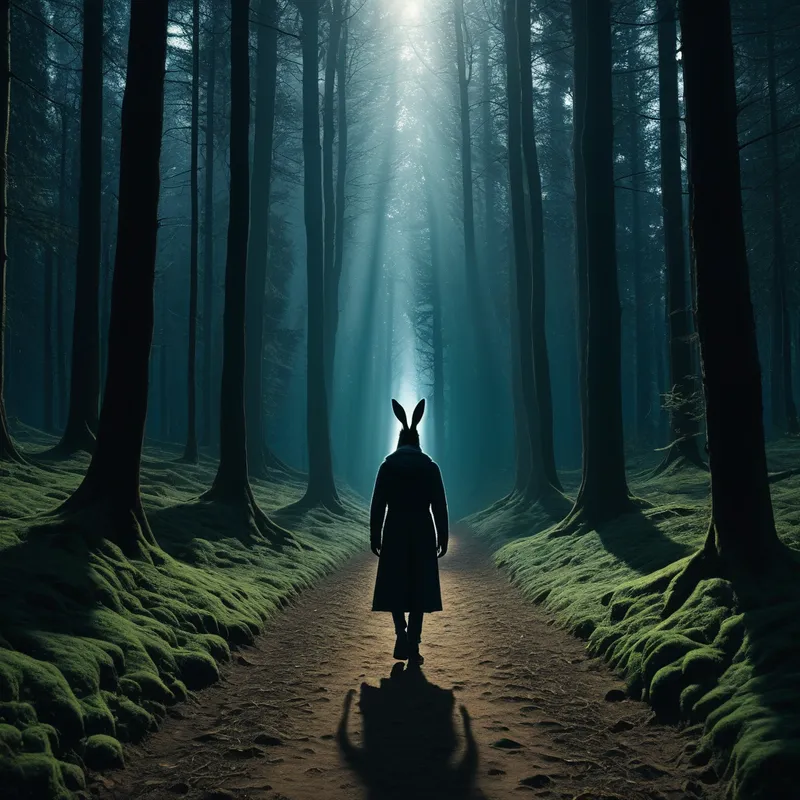
Guided by her wisdom, he took the form of a great hare, his fur the color of wet ash, and dove. Down, down into the cold, silent dark, where the water pressed like a weight of ages. His lungs burned. Just as the blackness threatened to claim him, his paws touched soft ooze. He grasped a handful of sacred clay and kicked for the surface. Gasping, he placed the mud upon the back of a great turtle—Mikinak. He breathed upon it. The wind from the four directions came. The mud spread, greened, grew. Forests sprang up. Mountains humped their backs. The world was born from a act of desperate need and courageous diving.
But the world was dark and cold. People shivered. Nanabozho saw the Binesi guarding fire on a distant island, jealously hoarding its warmth. A plan, mischievous and daring, unfolded in his heart. He transformed again, into a tiny, trembling rabbit, and paddled across the black water. He let himself be caught, a pitiful, frozen thing. Taken to the village of the Thunderers, he waited by their great central fire. When they slept, he seized a burning brand. He ran. The sky erupted behind him. Thunder shook the bones of the earth, lightning speared the ground at his heels. Changing shape as he fled—now a wolf, now a man, now a darting deer—he felt the fire’s heat sear his tail. He never let go. He brought the spark back, and from it, all hearths were lit.
His adventures were never-ending. He taught the people how to make maple syrup sweet, not thick as sap. He named the animals and plants. He fought monstrous serpents and foolish giants, sometimes through brute strength, more often through clever wit. He was the one who laughed at his own mistakes, who wept for his brother, who shaped the world not with perfect grace, but with a messy, passionate, and utterly alive love. He walked the land, and in his footprints, stories grew.

Cultural Origins & Context
The stories of Nanabozho are the living breath of the Anishinaabe. They were not written, but carried on the air of winter lodges, spoken by elders and storytellers—the aadizookaanag—when the snow lay deep and the fire crackled. This oral transmission was not mere entertainment; it was pedagogy, cosmology, and law. Through Nanabozho’s exploits, children learned geography, botany, ethics, and their place in the web of life.
His tales served as a social and spiritual compass. They explained the origins of natural phenomena (why the rabbit has a short tail, why the loon has a haunting cry) and encoded survival knowledge. More profoundly, they modeled a relational way of being. Nanabozho’s world is animate. Rocks, winds, and animals are persons with whom one must negotiate, often with respect, sometimes with cunning. The myth cycle functioned as a collective dream, a narrative container holding the people’s understanding of a universe where order (dibendaagaziwin) is continually negotiated with creative chaos.
Symbolic Architecture
Nanabozho is the archetypal Trickster, but to label him as merely mischievous is to miss his profound depth. He is the embodied principle of transformation itself. His shape-shifting signifies the fluid nature of identity and the psyche’s capacity for adaptation. He is not one, but many: the orphaned child, the culture hero, the foolish braggart, the grieving brother.
The Trickster does not destroy the world to rebuild it perfectly; he stumbles, schemes, and feels his way toward a world that can sustain life, teaching us that creation is an ongoing, participatory, and often messy conversation.
His dive for the earth is the primal descent into the unconscious, the watery realm of potential and memory, to retrieve the substance (primordial matter) of reality. The theft of fire is the heroic—and perilous—act of bringing consciousness (light, warmth, technology) from the realm of the gods (the unconscious) into human awareness. Each adventure represents a negotiation between opposing forces: chaos and order, nature and culture, individual desire and communal need. Nanabozho is the boundary where these opposites meet and are synthesized, however imperfectly.

The Dreamer's Resonance
When the pattern of Nanabozho stirs in the modern dreamer, it signals a profound psychic activation. To dream of a shape-shifting figure, particularly one that is animal and human, points to a crisis or opportunity of identity. The psyche is laboring to integrate disparate parts of the self. The dreamer may feel like an orphan, disconnected from their roots or their own inner nurturing principle.
Dreams of diving into deep, dark water or lakes mirror Nanabozho’s quest for the foundational clay. This is a somatic signal of a necessary descent—into depression, into forgotten memory, into the shadow—to retrieve something essential for building a new psychic structure. Conversely, dreams of fleeing with a precious, burning object while being pursued by titanic forces (storms, giants) reflect the anxiety and exhilaration of integrating a powerful new insight or creative force into one’s life, often against internalized resistance or old, thunderous patterns. The dream-ego is being called to become the trickster-hero of its own narrative, to embrace cunning, adaptability, and a willingness to get its tail singed in the process of claiming its own fire.
Alchemical Translation
The myth of Nanabozho is a masterful map of the individuation process, the alchemical journey of becoming whole. He begins as the orphaned prima materia, full of potential but unrefined. His entire journey is the solve et coagula—repeatedly dissolving his form and reconstituting it in response to the demands of life.
His theft of fire is the illuminatio, the critical moment when the ego seizes a spark of the Self’s transformative energy from the unconscious. This is never a clean, sanctioned act; it is always a transgression that brings both light and the threat of destructive retaliation (the thunder). The integration of this fire is the long, perilous flight home—the slow, often painful work of embodying a new level of consciousness in daily life.
Individuation is not a quest for saintly perfection, but for sacred wholeness. It requires the Trickster’s willingness to be foolish, to break taboos for the sake of life, and to negotiate with every aspect of reality, both noble and base.
Ultimately, Nanabozho does not ascend to a static heaven. He walks the earth he helped shape. His triumph is not in transcending the world, but in learning its language and participating in its endless becoming. For the modern individual, this translates as the realization that the goal of psychological growth is not to escape one’s humanity with its flaws and passions, but to fully inhabit it—to become a conscious, creative, and compassionate co-creator of one’s own world, footprints filled with stories, heart scarred by fire, and spirit forever capable of change.
Associated Symbols
Explore related symbols from the CaleaDream lexicon: