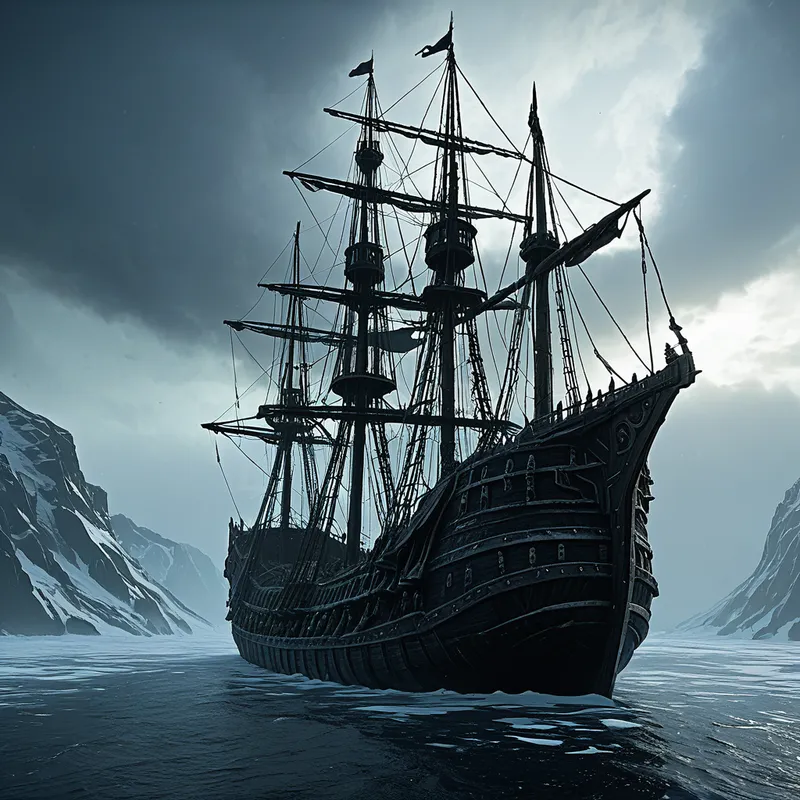
Naglfar Myth Meaning & Symbolism
A ship of fingernails, built in secret, destined to sail at the end of all things, carrying the forces of chaos to their final battle.
The Tale of Naglfar
Listen now, by the hearth-fire’s dying glow, to a tale not of beginnings, but of endings. It is a story woven in the cold, silent places, in the long shadows cast by the Yggdrasil. It begins not with a shout, but with a whisper—the whisper of a file against keratin, a sound so small it is lost in the sighing of the wind through the Valhalla rafters and the groans of the ice in Jötunheimr.
For in the realm of Hel, where the disharmonious dead dwell, a great work proceeds in the gloom. It is a shipyard of a most macabre kind. No axe bites into oak here; no adze shapes a keel. The material is gathered not from forests, but from bodies. It is the uncut fingernails and toenails of every man, woman, and child who has died and been denied the glory of a warrior’s end. These grim parings, neglected by the living in their grief or haste, are delivered by silent decree to this chill shore. And there, in the half-light, unseen hands—the hands of giants and the most wretched of the dead—fit them together. Claw upon claw, shard upon shard, they are bound with a pitch blacker than a moonless night. Thus grows Naglfar, the Ship of Nails.
Its construction is the world’s slowest hourglass. It is the measure of our collective forgetfulness, our small neglects given monstrous form. The ship lies moored, a terrible potential, waiting for the omens to align.
And the omens do come. The wolf Fenrir breaks his bonds. The serpent Jörmungandr stirs the oceans into fury. The sun and moon are devoured. This is Ragnarök, the Twilight of the Gods. As the cosmos unravels, the great mooring cable of Naglfar—said to be woven from the sinews of bears—snaps. The sea, risen in global flood, lifts the dreadful vessel free.
At its helm stands a figure of cunning and chaos: Loki, freed from his agonizing bonds, his spirit now pure, undiluted malice. Beside him is Surtr, his sword blazing with a light that brings no warmth, only annihilation. And filling the ship, crowding its deck forged from mortal vanity, is a host. It is an army of all that has been rejected, all that festered in darkness: frost giants, mountain giants, and the pale, murmuring dead from Hel’s halls.
Naglfar sails then, not on water, but on the flood of chaos itself. It cuts a swath through the drowning worlds, its prow aimed at the plain of Vígriðr. It is the final, physical manifestation of every grudge, every broken oath, every unaddressed shadow. It carries the accumulated weight of the world’s ignored darkness to the final battle, where it will be unleashed against the ordered powers of Asgard. Its sailing is the point of no return, the moment the ledger of neglect is presented for payment in full, in blood and fire.
Cultural Origins & Context
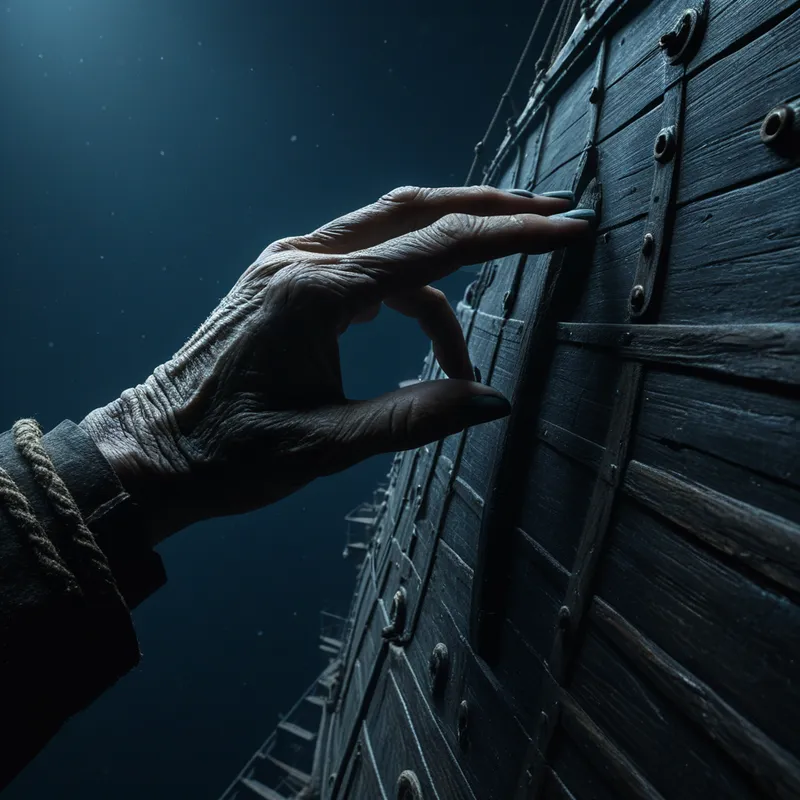
The myth of Naglfar reaches us primarily through the Prose Edda of Snorri Sturluson, a Christian scholar writing centuries after the Viking Age. He sourced older, now-lost poetic fragments, meaning the tale’s roots are ancient, pre-dating its written form. This was not a story for children at bedtime; it was a cosmological truth shared in the longhouse, a stark piece of the world’s architecture understood by seafarers, farmers, and warriors alike.
Its function was multifaceted. On one level, it was a stark eschatology—a detailed prophecy of how the world would end. For a culture living in a harsh, unpredictable environment, the idea of a final, cataclysmic battle had a grim resonance. But more importantly, it served as profound social and ethical instruction. The very building material of the doom-ship—the uncut nails of the dead—created a direct, tangible link between individual behavior and cosmic consequence. It taught that small acts of neglect, of failing to perform the proper rites for the deceased (which included trimming their nails), had cumulative power. The myth externalized a collective anxiety: that the disorderly, dishonored, and un-mourned could amass into a force that would one day destroy the world of the living and the gods. It was a powerful argument for ritual order, for community responsibility, and for honoring the dead, lest you contribute to the vessel of your own annihilation.
Symbolic Architecture
Naglfar is not merely a ship; it is the ultimate symbol of the neglected shadow. Its construction is passive, automatic, and inevitable, fed not by active evil but by inattention.
The most terrifying forces are not those we fight, but those we ignore into existence.
The fingernails are the perfect symbol. They are dead tissue, yet they grow continuously from the living body. They are a part of us we must regularly attend to and shed. To neglect them is a small, seemingly harmless act of disregard for our own physical process. Mythologically, this personal neglect is magnified into a collective one. The ship represents everything a culture—or a psyche—refuses to integrate: its shame, its broken promises, its unmourned losses, its repressed rage. These elements do not disappear; they are filed away in the dark, where they autonomously assemble into a structure of immense destructive potential.
The sailing at Ragnarök symbolizes the inevitable return of the repressed. When the conscious order of the psyche (the world of the gods) becomes too rigid, too brittle, or too blind to its own weaknesses, the shadow armada breaks its moorings. It is the psychic crisis, the breakdown, the eruption of long-buried trauma or denied aspects of the self that can no longer be contained. Loki at the helm signifies that this is not a mindless force, but one guided by cunning intelligence—the trickster energy that seeks to dismantle false order, however violently.
The Dreamer's Resonance
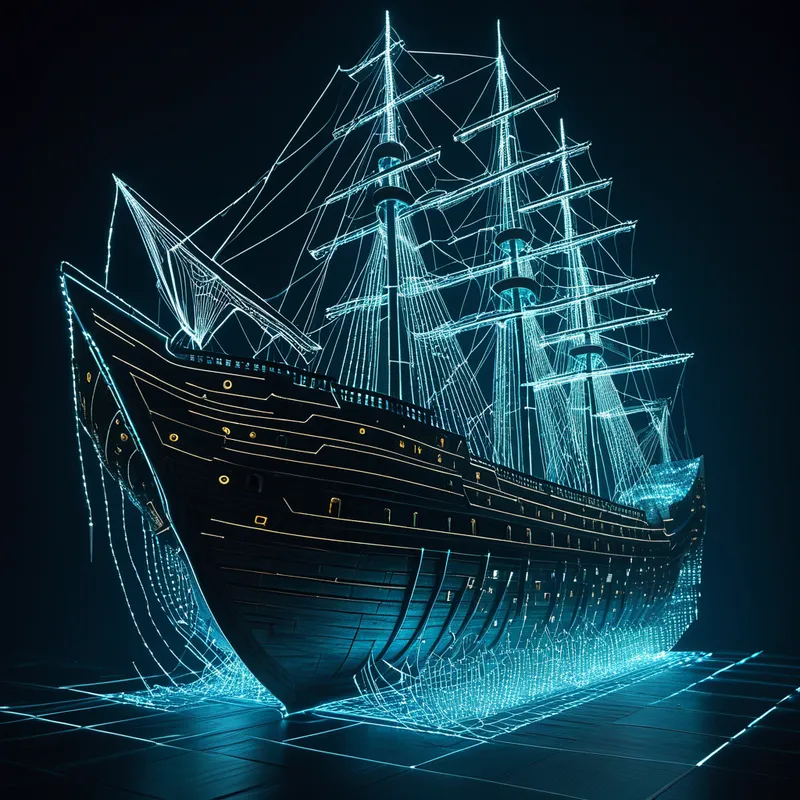
When the imagery of Naglfar surfaces in modern dreams, it rarely appears as a literal Viking longship. Instead, the dreamer may encounter a sense of a vast, looming structure built from forgotten things—a wall of old, yellowed papers; a bridge made of discarded plastic; a vehicle constructed from childhood toys now sinister and oversized. The somatic feeling is one of deep unease, of a neglected duty now grown monstrous. There is often a quality of inevitability; the dreamer watches this structure form or approach, feeling powerless to stop it.
Psychologically, this signals that the unconscious is presenting a bill for ignored inner work. The dreamer may be going through a period where small anxieties, unresolved griefs, or unexpressed frustrations have been consistently brushed aside. The "Naglfar dream" is a warning from the deep psyche that these elements are coalescing into a unified force—depression, a sudden rage, a psychosomatic illness—that threatens to "sail" into conscious life and disrupt everything. It is the psyche’s way of saying the shadow fleet is nearing completion, and its launch is imminent unless conscious attention is paid.

Alchemical Translation
The alchemical journey of individuation is not only about seeking the gold of the Self; it is crucially about confronting and transmuting the nigredo, the black, chaotic base material. Naglfar is the nigredo in its most collective and terrifying form.
The ship of nails is the prima materia of the soul—the worthless, dead refuse that must be acknowledged before any transformation can begin.
The individuation process modeled here is one of conscious reclamation. The myth’s warning provides the formula: to prevent the autonomous, destructive launch of the shadow, one must engage in the continuous, mindful practice of "cutting the nails." This is the alchemical separatio and solutio. It means regularly examining what we have shed—our old hurts, our judgments, our fears—and not simply letting them fall away into the unconscious. It requires the ritual act of acknowledging them, honoring their origin in our lived experience, and consciously deciding how to integrate their lesson or release their energy.
To do this is to dismantle Naglfar plank by plank. It is to take the dead, rigid material of past pain and, through the fire of conscious attention, transform it from a vessel of chaos into something usable. Perhaps the nails become the rivets in a new, more resilient structure of the self, or are ground into a pigment for painting one’s inner world. The goal is not to destroy the shadow (an impossibility), but to rob it of its autonomous, monstrous form by integrating its components. In doing so, the final, catastrophic "Ragnarök" of the psyche—a total collapse—can be averted. It is replaced by a series of smaller, manageable conflicts and integrations, where the conscious ego does not battle the shadow fleet on the open sea, but meets its raw materials in the quiet shipyard of reflection, and chooses their fate.
Associated Symbols
Explore related symbols from the CaleaDream lexicon: