Nachi Falls Myth Meaning & Symbolism
A sacred waterfall where a kami descended, Nachi embodies the violent, purifying grace that shatters stagnation to reveal the divine within the natural world.
The Tale of Nachi Falls
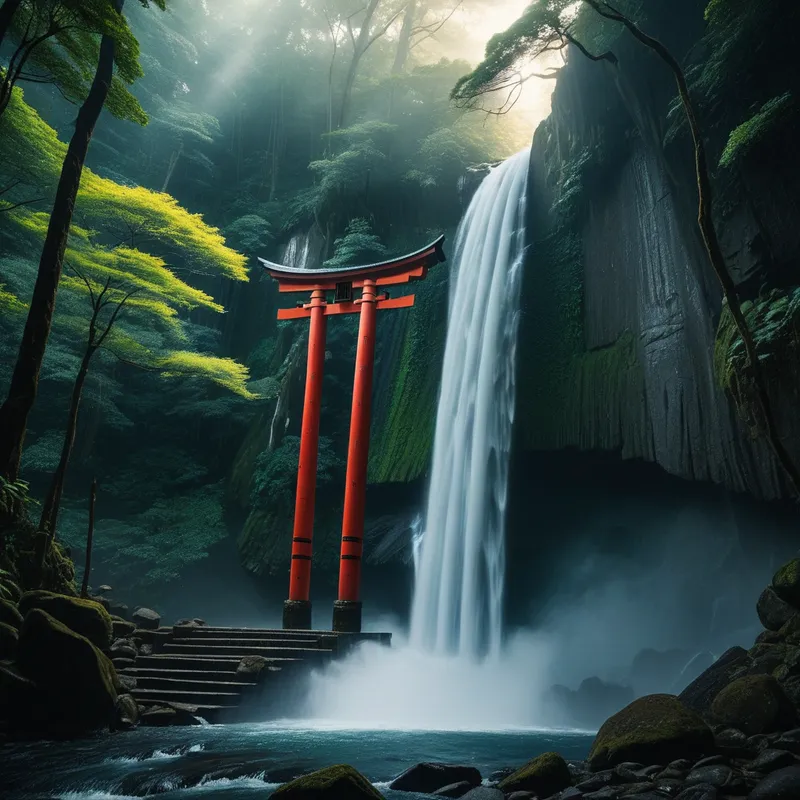
Listen. Can you hear it? Not with your ears, but with the bones of your soul. It is the sound before sound, a deep-throated roar that has echoed in the green heart of the Kii Peninsula since the world was young. This is the voice of Nachi no Taki, a silver spear of water plunging one hundred and thirty-three meters from a cliff of ancient stone into a pool of churning, white fury.
In the Age of the Gods, this was not merely a place of beauty, but a threshold. The mountain, Nachisan, was a yorishiro, a vessel waiting to be filled. And the kami heard its call.
From the High Plain of Heaven, Takamagahara, a presence stirred. It was kami, but not as a man or woman. It was the spirit of the waterfall itself, a being of pure, cascading intention. It descended not on wings, but on the very threads of the falling water, weaving itself into the torrent. The earth trembled at its arrival. The forest bowed. The rock, which had known only silence and slow erosion, was now kissed by perpetual, thunderous motion.
The kami took residence in a great, steadfast boulder beside the roaring basin—the Goshintai. Here, at the hyphen between sky and earth, water and stone, the divine became localized. The waterfall was no longer just a feature of the land; it was the kinetic body of a god, a continuous act of sacred descent.
But a solitary god is an unfinished hymn. From the deep sea, drawn by the potent vibration of this new sacred site, came another. Hiryū Gongen, the dragon divinity, ascended the river from the Pacific’s depths. Its power was of the dark, profound abyss, of hidden currents and fertile potential. It arrived at the foot of Nachi, where the mist made perpetual rainbows, and recognized its counterpart.
Thus began the eternal dance. The waterfall kami, born of celestial descent, met the dragon kami, born of oceanic ascent. Their union was not a marriage of flesh, but of principle: the relentless, purifying fall meeting the wise, coiling rise. Together, they sanctified the space. The violent, cleansing crash of the water onto the rocks became a ritual of unimaginable scale, performed without cease, washing the world clean moment by moment.
Cultural Origins & Context
This myth is not a story with a single author, but a truth that grew from the land itself, articulated through the practice of Shintō and later woven into the tapestry of Shugendō. Nachi Falls is the central shintai of the Kumano Nachi Taisha, one of the three sacred Kumano Sanzan.
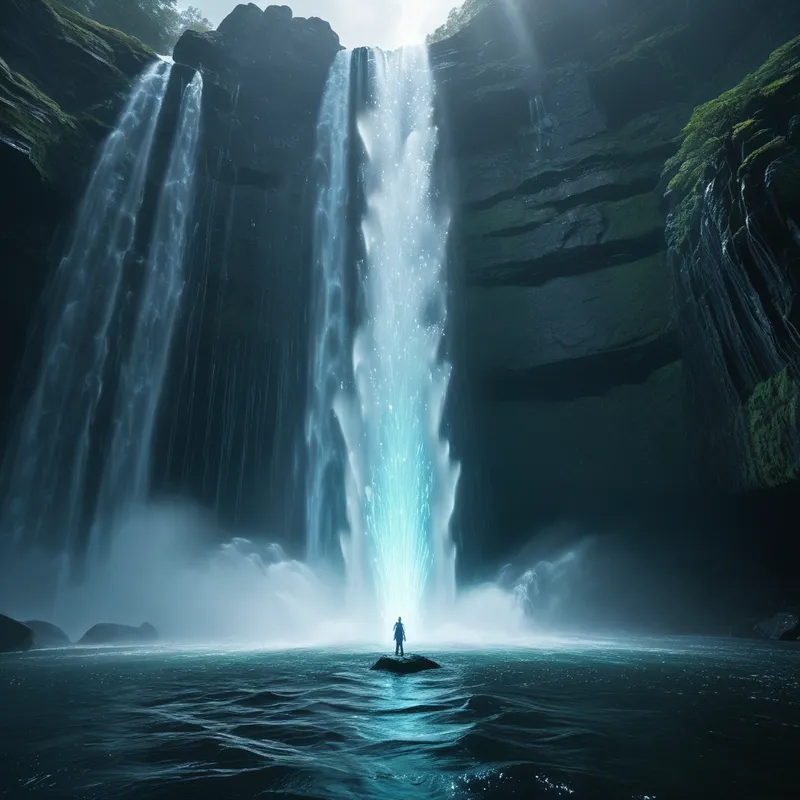
For over a millennium, pilgrims have walked the Kumano Kodō to stand before this cascade. They did not come merely to see a sight. They came to undergo an experience. The myth provided the cosmological framework: to witness the falls was to witness the ongoing descent of the kami, to be sprayed by its mist was to receive its direct, physical blessing. The story was passed down not just in words, but in the soreness of pilgrims' feet, the deafening roar that silenced the internal chatter, and the visceral shock of the water’s power. It served a societal function of anchoring the sacred in the tangible, teaching that the divine is not abstract, but operational, a force as real and present as gravity, embodied in the very landscape that sustained life.
Symbolic Architecture
At its core, the myth of Nachi Falls is a profound symbol of dynamic purification. It is not the gentle washing of hands, but a cataclysmic scouring. The waterfall represents a necessary, violent grace that shatters stagnation.
The psyche, like a mountain pool, can become still, deep, and opaque. The waterfall is the divine intervention that crashes into that stillness, oxygenating the depths and stirring up all that has settled on the bottom.
The two kami embody a fundamental duality reconciled. The waterfall kami symbolizes descent—spirit entering matter, consciousness plunging into the unconscious, the divine will manifesting in the physical world. The dragon kami symbolizes ascent—the latent power of the deep (the unconscious, the instinctual) rising to meet that descent. Their union at the Goshintai, the sacred rock, represents the axis mundi, the world pillar where heaven and earth, spirit and nature, eternally meet and generate sacred power. The rock itself is the symbol of the enduring Self, the immutable core around which the torrent of psychic experience rages.
The Dreamer's Resonance
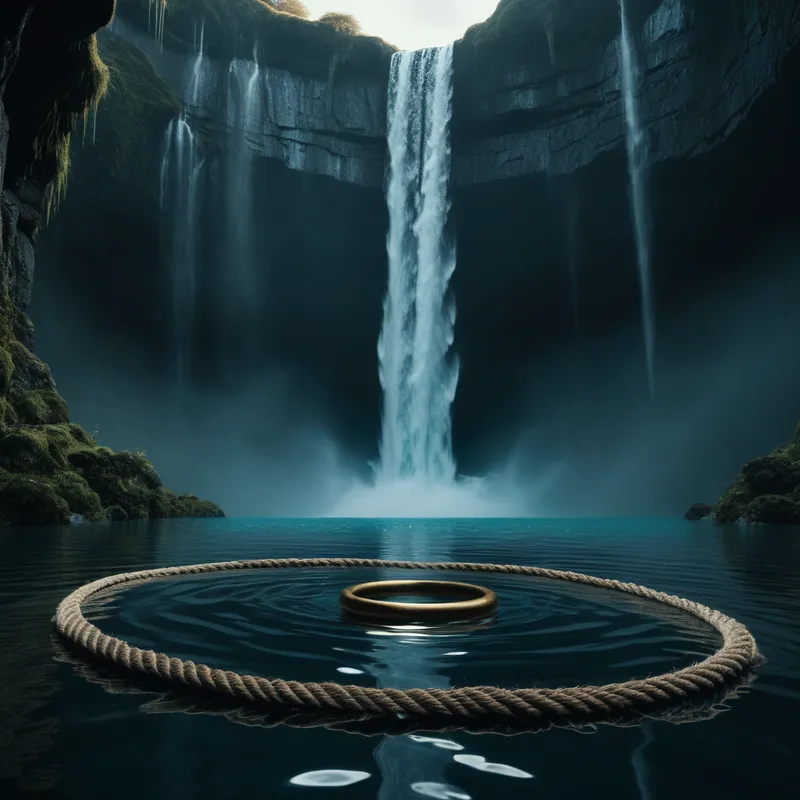
When this myth stirs in the modern unconscious, it often manifests in dreams of overwhelming, transformative water. One may dream of a waterfall suddenly erupting in their living room, or of being compelled to stand under a freezing, powerful shower that feels both terrifying and exhilarating. The somatic sensation is key: the pounding pressure on the crown of the head and shoulders, the inability to hear anything but the roar, the breath caught in the chest.
Psychologically, this signals a process of forced purification. The dreamer’s psyche is invoking the Nachi no kami to break apart a psychic complex that has solidified—a long-held resentment, a stagnant pattern of thought, a period of depressive inertia. The dream is an announcement: a cleansing is underway that you did not consciously choose, but one your soul requires. It is often experienced as a crisis, a breakdown, or a sudden flood of emotion that washes away the familiar landscape of the ego. The presence of a dragon in such dreams points to the simultaneous awakening of immense, primal life force (the kundalini or libido) from the depths to meet this cascade.

Alchemical Translation
The individuation journey modeled by Nachi Falls is not one of gradual ascent, but of courageous descent and subsequent integration. The waterfall’s plunge is the nigredo, the darkening, where one must consent to be broken apart by a truth too powerful to ignore. This is the sacrifice of the ego’s illusion of control to the greater flow of the Self.
To stand in the basin of Nachi is to allow the persona—the carefully constructed face we show the world—to be dissolved by the relentless truth of what we are.
The pilgrim’s journey on the Kumano Kodō mirrors this internal alchemy. The arduous hike is the conscious preparation and longing. The first glimpse of the falls is the shocking confrontation with the numinous. The receiving of the mist is the ablutio, the cleansing. Finally, the understanding that the dragon and the waterfall are one—that the destructive force and the creative life force are a single cycle—is the coniunctio.
For the modern individual, the myth instructs: your most profound renewal will not come from adding more, but from submitting to a sacred force that subtracts. It asks you to identify what in your life is the immutable Goshintai (your core values, your true Self) and what is the stagnant pool that needs the waterfall’s devastating, merciful crash. The goal is not to escape the torrent, but to learn that you are the rock within it, and eventually, the very flow itself.
Associated Symbols
Explore related symbols from the CaleaDream lexicon: