
Mustard Seed Myth Meaning & Symbolism
A grieving mother seeks a mustard seed from a home untouched by death, only to find that no such place exists, revealing the universality of loss.
The Tale of Mustard Seed
The world is heavy with a mother’s grief. It is a weight that bends the spine, a silence that swallows all song. Her name was Kisagotami, and her joy, her tiny sun, her first-born son, had grown cold and still in her arms. The monsoon of her tears could not wash the stillness from his face. Clutching the small, lifeless form to her breast, she moved through the village like a ghost, her mind unraveling, refusing the finality of the earth.
“He is only ill,” she whispered to the fearful glances. “He sleeps. A medicine, a charm, a miracle—there must be something!” The villagers pointed her toward the grove where the Buddha taught. Desperation gave her feet wings. She found him seated, a mountain of calm amidst the swirling dust of human suffering. Falling at his feet, she pressed her child’s body toward him. “Great Physician! You who have conquered death, use your power! Bring my son back to life!”
The Buddha regarded her with eyes that held the depth of a thousand quiet lakes. There was no pity there, but a boundless, knowing compassion. “There is a medicine,” he said, his voice like distant thunder. “But you must gather its ingredient. Go into the city. Bring me a single mustard seed. But it must come from a house where no one has ever died.”
A spark, a frantic hope, ignited in Kisagotami’s dead heart. A mustard seed! The simplest of things! She laid her child’s body down gently and ran, her empty hand already clutching at the promise.
At the first grand house, she knocked. “I seek a mustard seed for a sacred medicine. Has death ever visited this home?” The lady of the house, her eyes softening, said, “Little sister, you ask for the impossible. My husband’s father died in the back room last season.” She offered a sack of seeds, but Kisagotami, bound by the condition, turned away.
At the next house, a merchant recalled the loss of his daughter. At a third, a young man spoke of his mother. Door after door, story after story. The wealthy mansion and the beggar’s hovel—all were inscribed with the same indelible script of loss. A father, a sister, a child, a friend. The afternoon sun waned as she walked, and the singular obsession with her own tragedy began to dissolve into a vast, echoing chorus. Her private, isolating agony was not hers alone; it was the universal tax on love. The mustard seed, which she had not found, had become a mirror, and in it, she saw not just her own tear-stained face, but the face of all humanity.
As twilight painted the sky, she returned to the grove. She did not carry a seed, but she carried a new, terrible understanding. She approached the Buddha, her frantic energy replaced by a deep, weary stillness. “I have walked the whole city,” she said. “I could not find a single house free from death. The mustard seed you asked for… it does not exist.”
The Buddha asked softly, “And what have you learned, Kisagotami?”
She looked at the small body she had come to reclaim, and then out at the world, now seen through cleansed eyes. “I have learned that death is the way of all things. My grief is not a unique curse, but the shared condition of all who live. To cling is to suffer.”
In that moment, the personal storm broke. She asked not for her child’s life, but for a path through the wilderness of her sorrow. The Buddha taught her of impermanence, of the river that never stops flowing. She buried her son. And then, letting go of the world she had clutched so tightly, Kisagotami took a new path—not away from suffering, but through its very heart, toward peace.
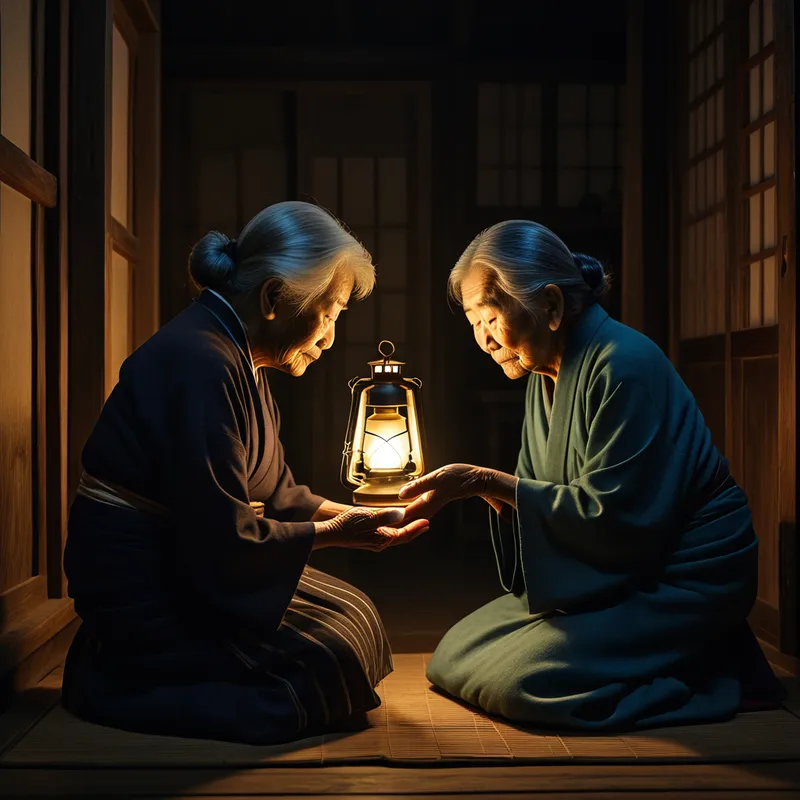
Cultural Origins & Context
This story, known as the parable of Kisa Gotami and the Mustard Seed, is not a myth of gods and monsters, but a Jataka-style narrative embedded in the Pali Canon. It functions as a parable, a pragmatic teaching tool used by the Buddha and his monastic community to convey the foundational doctrine of Anicca to laypeople. Its power lies in its visceral, relatable humanity—it bypasses philosophical abstraction to strike directly at the universal experience of loss.
Passed down orally for generations before being committed to text, it was a story told not in royal courts, but in village squares and under roadside trees. It served a critical societal function: to normalize and contextualize grief. In a culture where spiritual liberation (Nirvana) was the ultimate goal, paralyzing attachment was the great enemy. This tale provided a compassionate, step-by-step methodology for transforming paralyzing, personal agony into a wider, wisdom-based understanding. It taught that awakening often begins not in meditation on a mountaintop, but in the dusty, tear-soaked streets of our deepest despair.
Symbolic Architecture
The myth’s symbols form a perfect, devastatingly simple mandala for understanding suffering.
The Dead Child represents not just personal loss, but all forms of attachment to that which is inherently impermanent: relationships, status, health, life itself. The child is the ultimate object of a mother’s clinging, making the lesson absolute.
The Mustard Seed is the genius of the parable. The smallest of seeds, it symbolizes the specific, concrete condition the ego demands for its healing: “Cure my unique pain.” The quest for it is the ego’s frantic search for an exception to universal law.
The medicine for universal suffering cannot be found in a house that denies that suffering exists.
The Walk from House to House is the ritual of disillusionment, the painful expansion of consciousness. It is the journey from the isolated, self-pitying “I” to the compassionate, interconnected “we.” Each house is a world, and each story of death is a reflection of her own, breaking the shell of her narcissistic grief.
The Buddha’s Instruction is not a trick, but a skillful means (Upaya). He does not lecture her on doctrine; he gives her an embodied task that leads her to self-discovery. He acts as the archetypal sage, guiding her not by providing answers, but by structuring the question that her own experience must answer.
The Dreamer's Resonance
When this myth patterns a modern dream, the dreamer is not literally seeking a mustard seed. They are in the throes of a profound psychological initiation through loss. The somatic feeling is one of heavy, frantic searching—running through endless, unfamiliar neighborhoods, knocking on doors that offer no solace.
To dream of being Kisagotami is to be in a state where the conscious mind (the grieving mother) refuses to accept a painful reality (the dead child). The ego is desperately seeking a loophole, a special dispensation from the laws of life: “If I just find the right job, the right partner, the right recognition, this core feeling of lack/death/betrayal will be cured.” The dream signals that the psyche is attempting to break the dreamer out of this narcissistic contract with suffering. The eventual realization in the dream—the empty hand—is the beginning of ego deflation, the necessary precursor to a more resilient, grounded self that can bear the truths of existence.

Alchemical Translation
The alchemy here is the transmutation of personal sorrow into universal compassion, and of clinging into release. It is a precise model for individuation.
First, the Nigredo: The blackening, the crushing weight of undifferentiated grief. The psyche is identified entirely with its loss (the dead child). All energy is consumed in denial and magical thinking.
Second, the Albedo: The whitening, the purifying journey. The Buddha’s task initiates the circumambulatio—the sacred walk. By forcing the conscious mind to engage with the world, it collects the mirrored fragments of its own pain in others. This is the critical work of depersonalizing the shadow. The pain is not taken away; it is shared, and thus its chemistry begins to change.
The cure for the wound is not found in forgetting the knife, but in recognizing that everyone bears the scar.
Third, the Rubedo: The reddening, the culmination. The return to the Buddha with empty hands symbolizes the surrender of the ego’s impossible demand. The old identity of “the one uniquely cursed” dies. What is born is the sage within—the one who can see the truth of impermanence without being shattered by it. The psychic energy once bound up in clinging to the dead past is liberated. It can now be used not for building a fortress against loss, but for living with deep, clear-eyed engagement in the ever-changing present. The individual is no longer just a victim of life’s conditions but a conscious participant in its tragic, beautiful, and fleeting dance.
Associated Symbols
Explore related symbols from the CaleaDream lexicon: