
Mount Sinai Myth Meaning & Symbolism
The story of a people, a prophet, and a mountain where the divine voice thundered, forging a covenant and a new consciousness from the desert's heart.
The Tale of Mount Sinai
In the third moon after the great escape from the house of bondage, the people of Israel came to the wilderness of Sinai. They camped before the mountain, a vast, brooding presence of granite and silence. The air was thin, charged with a waiting. Then, the voice of YHWH called to Moses from the mountain, a sound not of wind, but of intent: “You have seen what I did to the Egyptians. Now, if you obey my voice and keep my covenant, you shall be my treasured possession.”
Moses ascended the stark slopes, his sandals scuffing the ancient stone. The people below washed their garments, a ritual of skin and spirit, preparing for a meeting not with an army, but with a presence. A boundary was set around the mountain’s base, a line drawn in the dust of the world: “Beware,” the warning went, “do not go up the mountain or touch its edge. Whoever touches the mountain shall be put to death.”
On the third day, as morning bled into the sky, there was thunder. Not from clouds, but from the mountain itself. A thick cloud descended, and the whole mountain trembled. The sound of a shofar grew louder and louder until every heart shook with it. Smoke ascended like the smoke of a furnace, and the mountain was seized with fire. The people in the camp trembled. They saw the lightning and heard the voices—a multitude of voices within the one voice. It was a sound that could unmake a soul.
And YHWH descended upon the peak in fire. Moses spoke, and the divine voice answered him in thunder. The people begged Moses, “You speak to us, and we will listen; but do not let God speak to us, lest we die.” The terror was too great, the naked truth of the voice too bright. So Moses alone approached the thick darkness where God was.
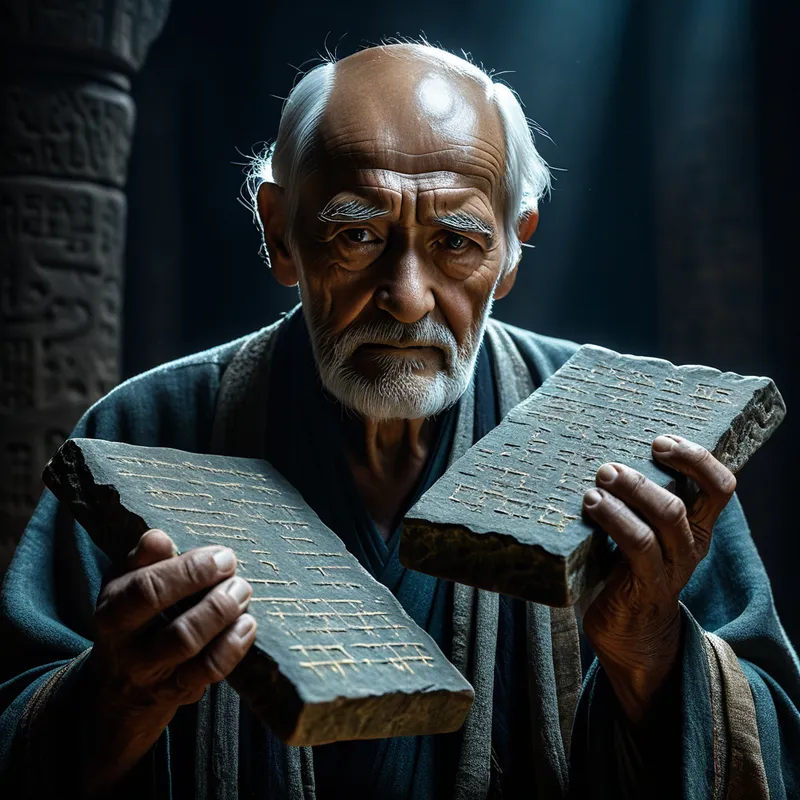
For forty days and forty nights, Moses dwelt in that terrifying intimacy. The mountain was a womb of law, a forge of covenant. There, upon tablets of stone, inscribed by the finger of God itself, were given the words—not suggestions, but the architecture of a shared soul: boundaries against chaos, commands toward a sacred order. The Ten Commandments were born from the fire.
But below, in the camp’s shadow, the people’s fear curdled into forgetfulness. In the absence of the mediator, they fashioned a god they could see, a god of gold—a Golden Calf. They traded the terrifying voice for a comforting echo. When Moses descended, the tablets in his hands, he saw the singing and the dancing around the molten idol. The covenant was broken before it was received. In a fury of holy grief, he cast the tablets from his hands, and they shattered at the mountain’s foot, the divine script exploding into fragments on the holy ground.
Yet, the story does not end in shards. Moses returned to the darkness. He carved new tablets from the mountain’s own heart, and the voice wrote upon them again. This time, the law entered not just stone, but through the brokenness, into the possibility of renewal. He descended a second time, his face shining with a light so unbearable he had to veil it. The covenant was remade, not from perfection, but from the fragments of what was shattered.
Cultural Origins & Context
The Sinai narrative is the foundational epic of ancient Israel, crystallized during the monarchic period (circa 10th-6th centuries BCE) but drawing on much older oral traditions of tribal covenants and theophany (divine appearance). It functions as the constitutional myth for the nation, the moment a disparate group of escaped slaves is forged into “a kingdom of priests and a holy nation” (Exodus 19:6).
The story was preserved and transmitted by priestly and prophetic circles, for whom Sinai was not merely a past event but the ongoing template for the relationship between YHWH and the people. Its societal function was multifaceted: it established the absolute authority of the Mosaic Law as divine in origin, it explained the unique, non-idolatrous nature of Israelite worship, and it provided a model for leadership through the figure of Moses—the mediator who stands between the overwhelming divine and the fragile human community. The mountain became the symbolic center of the world, the axis where heaven and earth met to establish order.
Symbolic Architecture
At its core, Sinai is a myth of interface. The mountain is the ultimate axis mundi, the meeting point between the transcendent and the immanent, the eternal and the historical. It represents the terrifying but necessary moment when pure potential—the voice of the divine—must condense into form—the law.
The mountain is not where God lives, but where God speaks. The law is not a cage, but the shape of the relationship.
Moses embodies the archetype of the mediator, the one who can withstand the direct current of the numinous and translate it into a language the community can bear. His repeated ascents and descions model the necessary rhythm of revelation: encounter, interpretation, application. The shattered first tablets symbolize the inevitable failure of the pristine, absolute ideal when it meets the flawed reality of human nature. The second set, carved by human hands but inscribed by the divine, symbolize the covenant remade through grace and perseverance—a law that now includes the knowledge of brokenness within it.
The people’s creation of the Golden Calf is the shadow of the Sinai event. It represents the psyche’s desperate retreat from the demanding, invisible reality of the Self into the comforting, visible, and controllable image of the ego. It is the preference for a manageable idol over an unmanageable God.
The Dreamer's Resonance
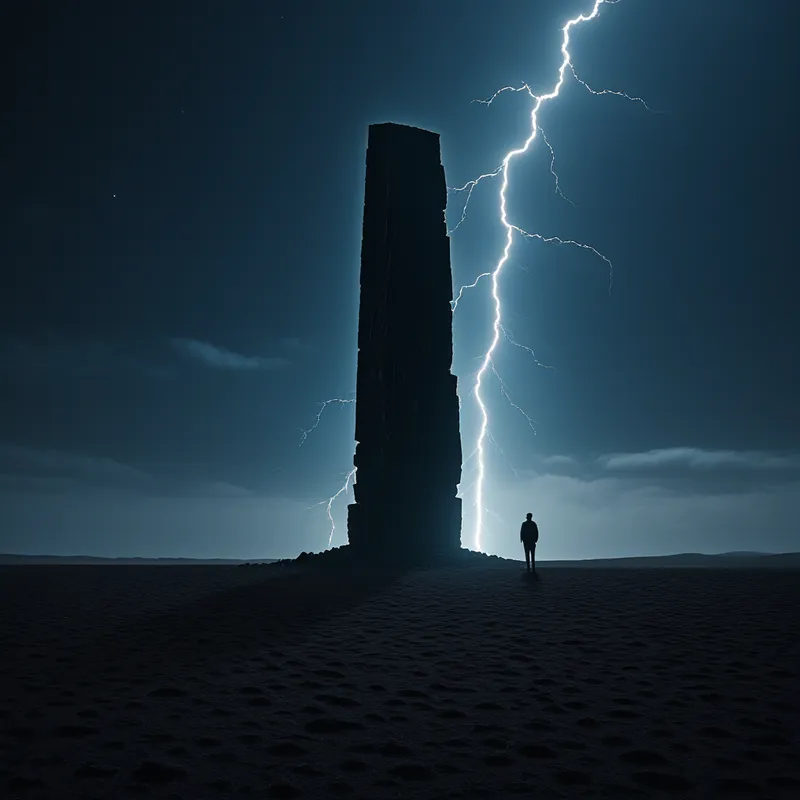
To dream of a Sinai pattern is to be in a state of profound psychic reorganization. The dreamer may find themselves at the base of a tremendous, forbidding mountain or tower, hearing a commanding, impersonal voice or feeling an atmospheric pressure of immense significance. There is often a sense of being tested or called to account.
Somatically, this can feel like anxiety, a trembling in the limbs, or a tightening in the chest—the body’s response to the ego’s confrontation with a greater authority (the Self). The dreamer might be like the Israelites, wanting a mediator (a therapist, a guru, a rulebook) to buffer the direct experience. Or they might be like Moses, tasked with carrying a fragile, precious truth (the tablets) down into a world that may not be ready for it. This dream pattern signals the end of an old, unconscious way of being and the terrifying, exhilarating call to establish a new inner constitution.
Alchemical Translation
The alchemy of Sinai is the transmutation of chaos into covenant. Psychologically, it maps the individuation process where the diffuse energies of the unconscious (the formless desert, the chaotic camp) are confronted by the organizing principle of the Self (the thundering voice from the mountain).
The first stage is Confrontation: the ego must approach the boundary of its known world (the foot of the mountain) and acknowledge a power greater than itself. This is often experienced as a crisis, a “dark night of the soul.”
The second stage is Revelation and Shattering: the core, non-negotiable truths of one’s being (the innate law of the Self) are revealed. This often leads to the shattering of the old persona—the “first tablets” of one’s previous identity and compromises. The creation of the “golden calf” in this phase is the temptation to revert to an older, simpler, more narcissistic identity when the new truth feels too demanding.
Individuation is not about receiving perfect stone tablets, but about learning to carve new ones from the rubble of the old, with the divine finger writing anew upon our willing substance.
The final stage is Integration: the return to the source (Moses’ second ascent), the patient work of carving a new structure from one’s own substance (the human-carved tablets), and the reception of the law a second time. This law is now lived law, etched with the memory of failure. One descends with a “shining face”—a personality transformed and authentic, yet perhaps needing a veil to move gently in the ordinary world. The covenant is no longer an external imposition, but an internal architecture, the law of one’s own deepest being.
Associated Symbols
Explore related symbols from the CaleaDream lexicon: