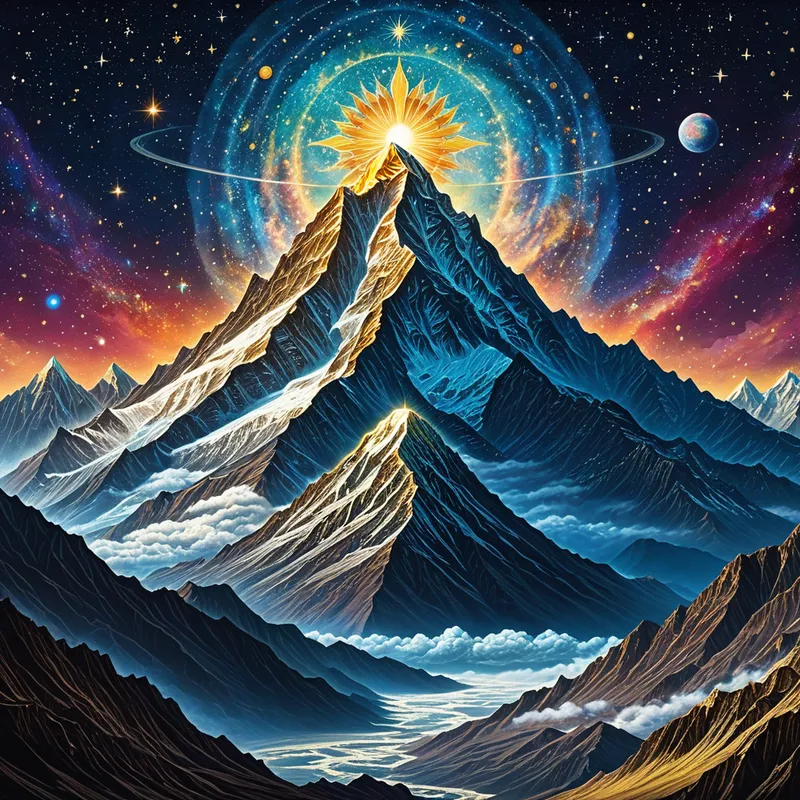
Mount Meru/Kailash Myth Meaning & Symbolism
The myth of the world-mountain, the axis of all universes, where gods reside and the soul journeys toward ultimate reality and inner truth.
The Tale of Mount Meru/Kailash
Listen. Before time had a name, before the first breath was drawn, there was only the dark, infinite waters. From the depths of that primordial silence, a longing stirred—a desire for form, for a place to stand. And so it was that the great churning began. The Devas and the Asuras, grasping the colossal serpent Vasuki as their rope, coiled him around a mighty peak that had risen from the deep. They pulled, back and forth, for an acon. The mountain turned, grinding the ocean of possibility itself. From that furious, sacred labor, the nectar of immortality was born, and so too was the mountain fixed—as the axis of all that is, was, and will be.
This is Mount Meru. Its roots plunge deep into the netherworlds; its trunk passes through the earthly realm; its summit pierces the highest heavens. Its four faces are made of crystal, ruby, gold, and lapis lazazuli, bathing the directions in their colored light. Here, in palaces of unimaginable splendor, the Lokapalas keep watch. The sun and moon circle its waist. It is the pivot around which the stars themselves turn.
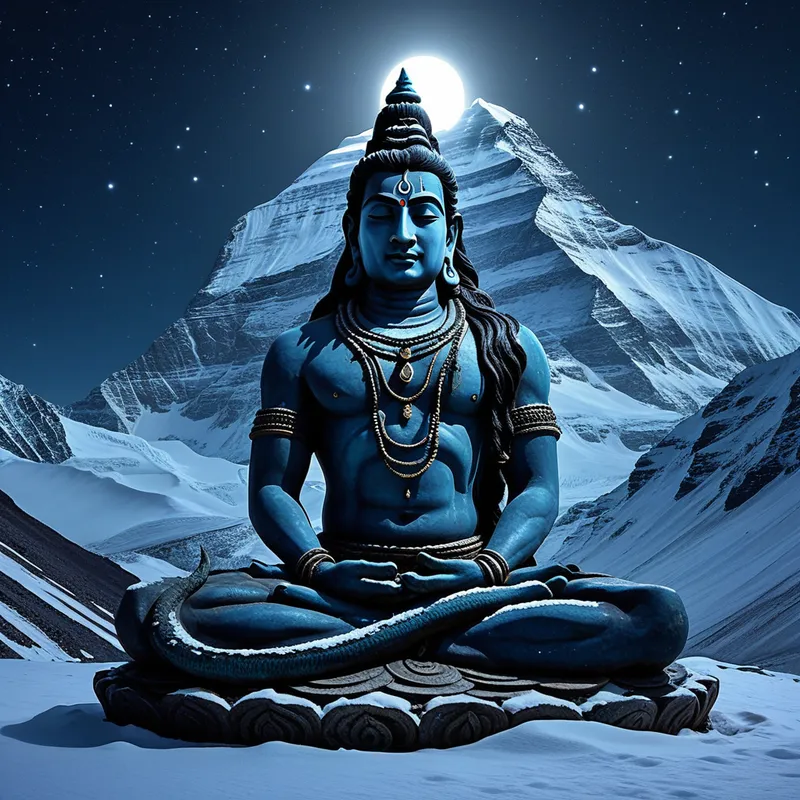
But there is another tale, of a mountain in the north, a mountain of stone and snow and stark, terrifying beauty—Kailash. This is the abode of the one who is beyond all abodes. Here resides Shiva, the great ascetic, his body smeared with the ashes of the universe, seated in eternal, perfect meditation. His consort, Parvati, is by his side. The sacred river Ganges is said to fall from the heavens onto his matted locks before flowing to the world below. To circumambulate this mountain is to walk the rim of reality itself. The air is thin, the wind sings a hymn of emptiness, and the sheer faces of rock stand as silent testament to a truth too vast for words. This is not a place one conquers; it is a presence one encounters. It does not yield to the climber’s ambition; it accepts only the pilgrim’s awe.
Cultural Origins & Context
The myth of the world-mountain is not a single story but a foundational pillar of cosmology across South and Central Asia. Its earliest seeds are found in Vedic texts, where it is called Sumeru. It was systematized in later Puranic literature and Buddhist Abhidharma, each tradition elaborating its architecture in exquisite, symbolic detail. For Hindus, it is the literal and metaphysical center of all worlds (Lokas). For Jains, it is the site where liberated souls ascend. For Buddhists, it is Sumeru, the central mountain of a universe, around which continents turn and where beings of great karma dwell.
This myth was passed down not merely through scripture, but through ritual, art, and pilgrimage. It was painted on temple walls, described by traveling storytellers, and embodied in the very design of temples and stupas, which are themselves architectural echoes of the mountain. Its societal function was profound: it provided a cosmic map, orienting human life within a vast, ordered, and meaningful universe. It answered the fundamental human questions: Where is the center? What holds everything together? Where do the gods reside? The myth of Meru/Kailash asserted that chaos has a axis, disorder has a core, and the sacred has an address.
Symbolic Architecture
At its heart, Mount Meru/Kailash is the ultimate symbol of the Axis Mundi. It is the still point of the turning world, the connection between the terrestrial, the celestial, and the infernal. It represents the principle of order emerging from chaos, the fixed pillar in the flux of existence.
The mountain is not merely a location, but the very architecture of consciousness—the spine connecting the mud of instinct to the light of awareness.
Psychologically, it symbolizes the Self in the Jungian sense—the central, ordering principle of the total psyche around which the constellations of the ego, persona, and shadow revolve. Its four sides correspond to the process of orientation and wholeness (the four functions of consciousness, the four directions). Its inaccessibility mirrors the elusive nature of true self-knowledge. Shiva’s meditation upon it signifies the ultimate state of integrated consciousness, where all opposites (creation/destruction, male/female, activity/stillness) are transcended in pure being.
The Dreamer's Resonance
When this myth stirs in the modern unconscious, it often manifests in dreams of immense, daunting structures—towers, ladders, or, indeed, mountains. The dreamer may find themselves at the base, looking up with a mixture of dread and longing. They may be attempting a climb that feels Sisyphean, or they may be circling the base in a repetitive, ritualistic walk.
Somatically, this can correlate with feelings of vertigo, breathlessness, or a profound sense of being both grounded and drawn upward—a tension in the very spine. Psychologically, this dream pattern signals a critical phase of centering. The ego feels adrift, buffeted by life’s chaos (the churning ocean), and the psyche is attempting to locate its own internal axis. The mountain in the dream is the psyche’s own blueprint for order. The struggle to approach or ascend it reflects the often arduous process of moving from a life driven by external complexes toward one oriented by the inner Self.
Alchemical Translation
The individuation process, the alchemical Opus, is perfectly modeled by the myth of Meru/Kailash. The initial state is the prima materia: the chaotic, undifferentiated waters of the unconscious. The “churning” represents the necessary conflict and tension of psychological life—engaging with our inner devas and asuras (our noble aspirations and our shadowy resistances) to produce the transformative “nectar.”
The pilgrimage around the mountain is the circumambulation of the Self—a patient, humble recognition that the center cannot be seized, only honored through devoted approach.
The ascent, then, is not an egoic conquest but a gradual shedding. Each step is a letting go of identifications, until one reaches the summit—not a place of triumph, but of stillness. This is Shiva’s state: the alchemical unio mentalis, the union of mind and spirit in pure, witnessing consciousness. The modern individual’s journey toward wholeness is this same pilgrimage: moving from the periphery of one’s being (the scattered roles and reactions) toward the silent, immovable center. It is the work of building an inner Meru—a stable, luminous structure of meaning—from which to view, and participate in, the swirling cosmos of one’s own life. The mountain does not move. We learn to orbit its truth.
Associated Symbols
Explore related symbols from the CaleaDream lexicon: