Mount Meru Myth Meaning & Symbolism
The sacred mountain at the center of all worlds, the axis of the cosmos, and the symbolic spine of the universe and the self.
The Tale of Mount Meru
In the time before time, when the universe was a single, boundless ocean of potential, the gods and the asuras gathered. They were weary of chaos, of formlessness. A great purpose was needed, a catalyst to stir the primordial milk. They uprooted the cosmic mountain, Mandara, to be their churning rod. But it sank into the soft, endless depths. In desperation, they called upon Vishnu, who took the form of a colossal turtle, Kurma, and dove to the absolute bottom. Upon his impenetrable shell, they placed the mountain.
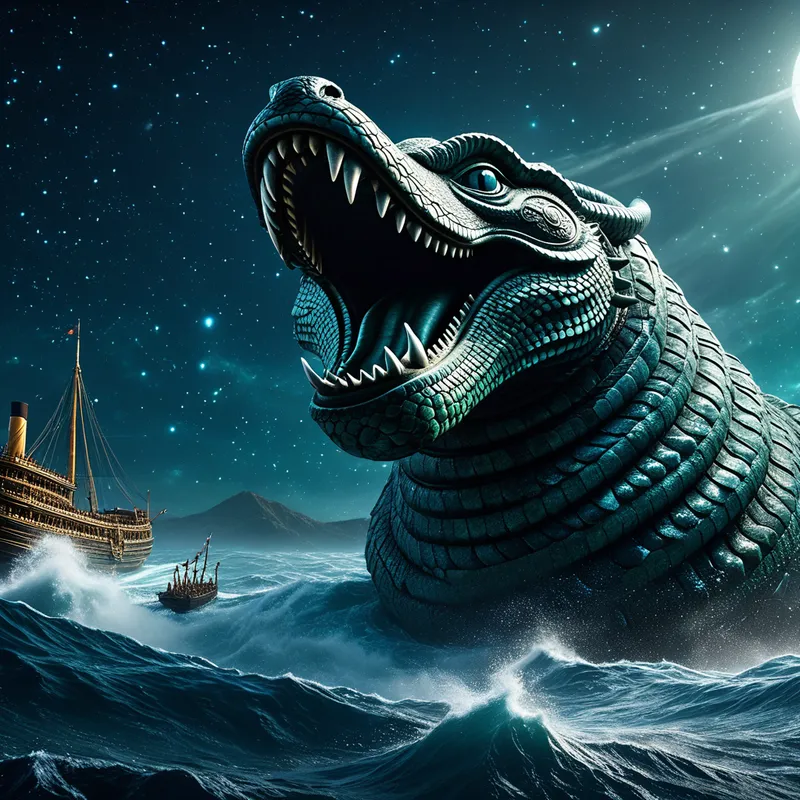
Then came the great serpent, Vasuki, who offered himself as the churning rope. The gods took his head, the asuras his tail, and they began to pull. The mountain spun, grinding upon the turtle’s back, churning the ocean into a frothing maelstrom. From the depths arose terrible poison, threatening to end all creation. The world held its breath until Shiva drank the venom, holding it in his throat, which turned blue—a permanent sacrifice to preserve life.
Then, treasures began to surface. The moon, plucked from the waters and placed in Shiva’s hair. The celestial cow, Kamadhenu. The wish-fulfilling tree. Finally, rising with a radiance that outshone the sun, came Lakshmi, who chose Vishnu as her eternal consort. Last of all emerged the nectar of immortality, amrita. A great struggle ensued, but Vishnu, in the form of the enchanting Mohini, secured the amrita for the gods, establishing a temporary order in the cosmos.
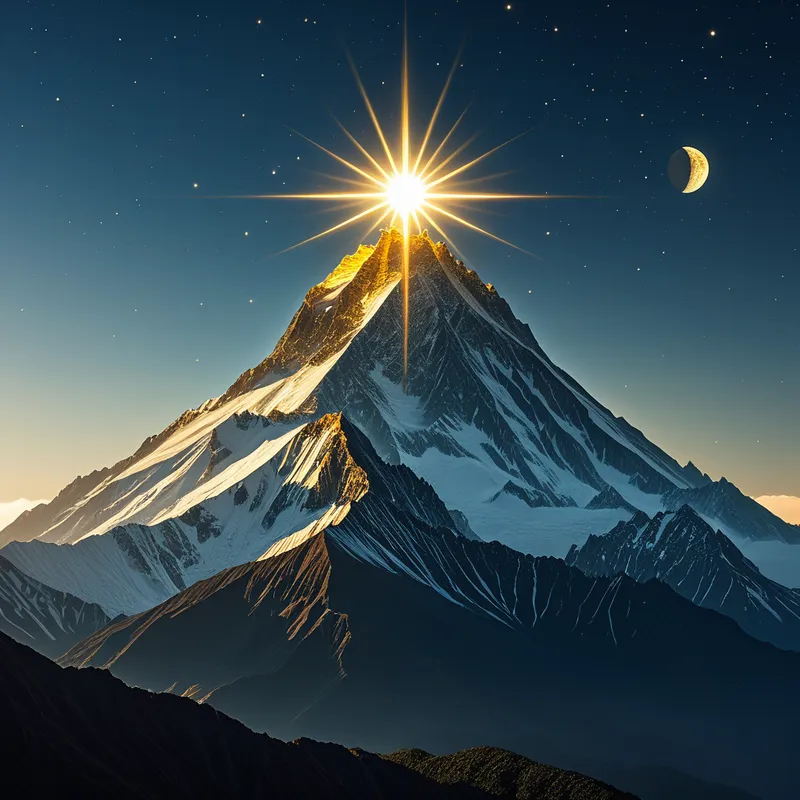
Yet, the mountain itself was transformed. Honored and stabilized, it became the permanent axis of the world. It was given a new name and a supreme station: Mount Meru. Its roots plunged into the infernal realms, its trunk passed through the earthly plane, and its peak soared into the highest heavens, where Indra built his glittering city. The sun, the moon, and all the stars were fixed to wheel around its colossal, immovable peak. It became the spine of reality, the unmoving center around which all of existence—with all its conflicts, treasures, and poisons—eternally revolves.
Cultural Origins & Context
The myth of Mount Meru is not a single story but a foundational concept woven into the fabric of Vedic and post-Vedic cosmology. Its earliest mentions are in texts like the Rigveda, where it is hinted at as the navel of the world. Its full architectural and narrative glory is detailed in later Puranas and astronomical treatises.
This was a myth told by priests (Brahmins) and poets to map the cosmos, both outwardly and inwardly. It served a critical societal function: to provide a model of perfect order (dharma) against the ever-present threat of chaos (adharma). The image of Meru stabilized the universe in the collective imagination. It explained the movement of celestial bodies (they orbit the mountain), defined sacred geography (temples and kingdoms were seen as microcosms of Meru), and provided a literal ladder for the soul’s ascent through various realms of existence in pursuit of liberation (moksha).
Symbolic Architecture
Mount Meru is the ultimate symbol of the axis mundi. It is the central pillar that connects the underworld (Patala), the earthly realm (Bhur), and the heavenly realms (Svarga and beyond). Psychologically, it represents the integrated Self—the central, organizing principle of the psyche around which the chaos of the unconscious and the order of consciousness must revolve.
The mountain does not move. The world turns around it. So too, the true Self is not in the turmoil of changing thoughts and emotions; it is the still center that grants them meaning and orbit.
Its four sides, facing the cardinal directions and made of different jewels (gold, lapis lazuli, ruby, crystal), symbolize the totality and multifaceted nature of reality, as well as the need for orientation. The churning of the ocean using Meru is the primal act of creation through tension—the interplay of opposites (gods and demons, poison and nectar, death and immortality) that generates the world’s richness. The mountain itself is the stable axis required for this transformative work. It is the spine of the universe, mirroring the human spine in yogic tradition, along which the latent spiritual energy, kundalini, must rise to achieve enlightenment.
The Dreamer's Resonance
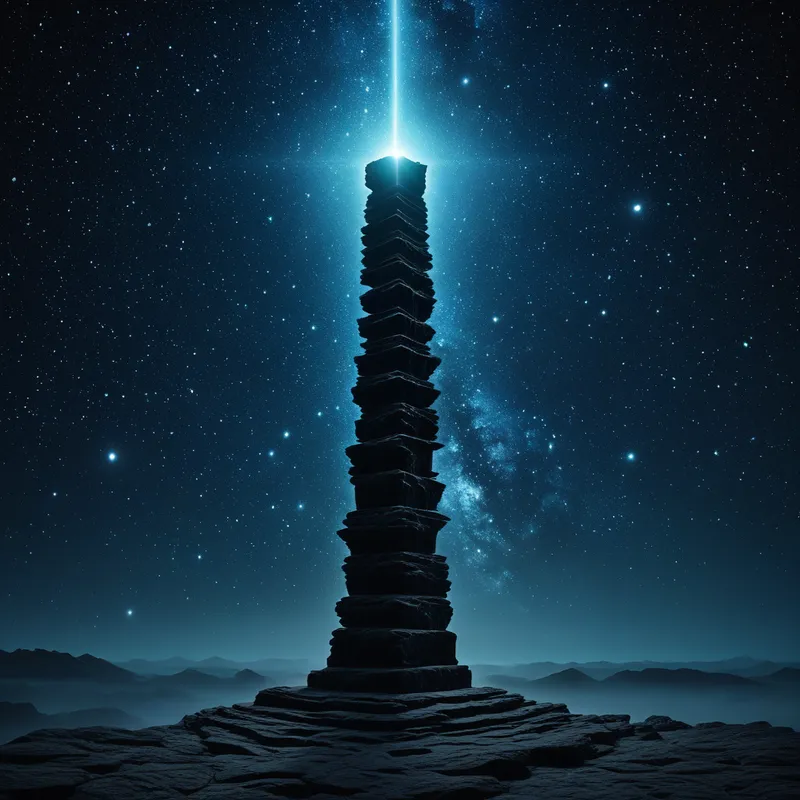
When Mount Meru appears in a modern dream, it rarely manifests as a literal mountain. Instead, the dreamer may encounter a towering, central structure in a vast landscape—a skyscraper, a lighthouse, a giant tree, or even a monumental spinal column. There is a profound sense of it being the "center of everything." The dream ego might be trying to reach its peak, measure its circumference, or simply stand in awe at its base.
This dream signals a process of psychic centering. The conscious ego is being confronted with the overwhelming scale of the unconscious—the "cosmic ocean" of latent memories, potentials, and fears. The dream of Meru is the psyche’s attempt to establish an inner axis, a core identity or value system that can provide stability. Somatic sensations often accompany it: a feeling of vertical alignment in the body, a tingling along the spine, or a grounding solidity in the legs. The dreamer is undergoing the foundational work of building an inner structure capable of withstanding the "churning" of life’s conflicts and extracting from that turmoil their own unique "treasures" and "nectar."
Alchemical Translation
The individuation process, the alchemical journey toward wholeness, is perfectly modeled by the Meru myth. The initial state is the formless ocean—the undifferentiated psyche. The first act is not to flee conflict, but to use it. The ego (the gods) and the shadow (the asuras) must engage in the difficult, cooperative work of churning. This requires a foundational axis: a commitment to self-knowledge, a moral or ethical center (the mountain), and a connection to the instinctual, supportive base of being (the turtle).
The poison emerges before the nectar. The darkest aspects of the self must be acknowledged and contained before the treasures of the personality can be realized.
The rising treasures—the moon (the reflective mind), Lakshmi (inner value and abundance), the wish-fulfilling tree (creative potential)—are the nascent symbols of the emerging Self. The final goal, the amrita, is the achieved state of psychic integration, a taste of timeless essence. But the myth warns that this integration is fragile; the forces of inflation and greed (the asuras claiming the nectar) are ever-present, requiring continual discernment (the role of Mohini/Vishnu).
Ultimately, the alchemical goal is not to possess the mountain but to become it. To become the unmoved center within one’s own swirling universe, providing order and meaning to all experiences, from the deepest roots of instinct to the highest aspirations of spirit. The individual becomes their own axis mundi, a living Mount Meru, around which a complete and conscious life can gracefully, purposefully revolve.
Associated Symbols
Explore related symbols from the CaleaDream lexicon:
- Spine
- Solid
- Galactic Core
- Galactic Portal
- Tourmaline Strand
- Petalite Crystals
- Quartz Cluster
- Zircon Gem
- Calcite Layer
- Calcium Ridge
- Osmium Core
- Infinite Staircase
- Hindu Mandir
- Holy Mountain
- Cosmic Gateway
- Courageous Peak
- Cylinder
- Layered Mountains
- Triangle Mountain Range
- Mountain Shadow
- Agate Stone
- Mountaintop
- Temple Gopuram
- Mountain Peak
- Mount Kunlun
- Mountain Temple
- Axis
- Pediment
- Spire
- Core
- Chakra
- Stability
- Density
- Ascending
- Peak
- Apogee
- Accretion
- Tuff
- Pinnacle
- Globe