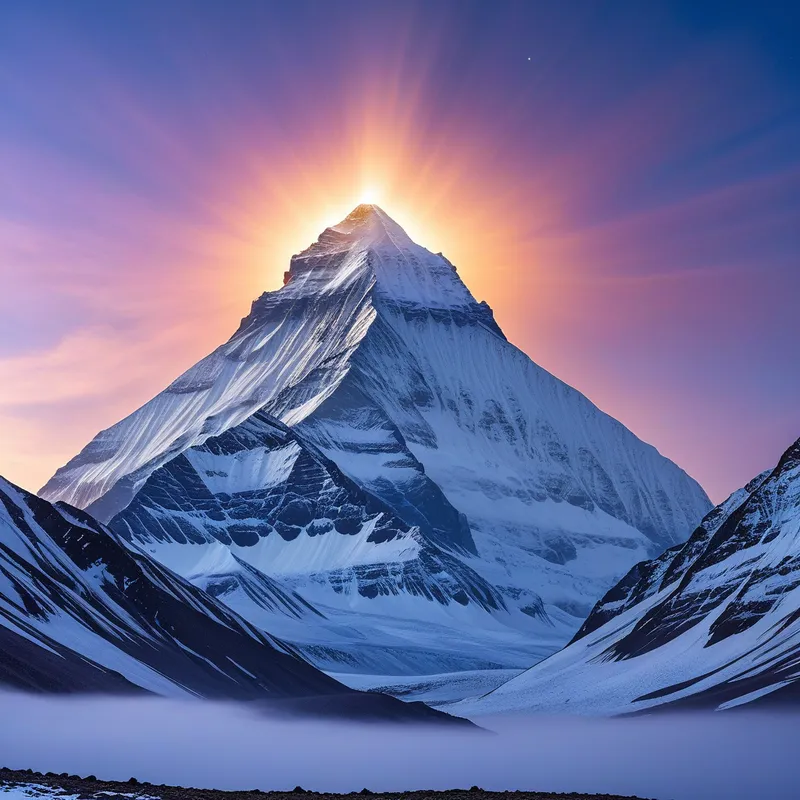
Mount Kailash Myth Meaning & Symbolism
The sacred mountain where Shiva resides in eternal meditation, a cosmic pillar of stillness and the ultimate destination of the spiritual seeker.
The Tale of Mount Kailash
Listen. Before time was counted, before the oceans learned their tides, there stood a mountain. Not of mere rock and ice, but of pure consciousness solidified. This is Kailash, the navel of the world, the axis around which all stars turn in silent reverence.
Here, upon a summit that touches the void between worlds, sits Shiva. He does not rule from a throne, but rests upon a tiger skin, smeared with the ash of burnt universes. His eyes are closed, yet they see all that is, was, and will be. The rhythm of his breath is the rhythm of creation and dissolution. His matted locks are the gathering clouds; the crescent moon perched within them is the cool, measured mind. The great river Ganga flows from his hair, a cascade of grace falling to the mortal plains. Beside him, the mighty bull Nandi waits, patient as eternity, guarding the gate to this supreme silence.
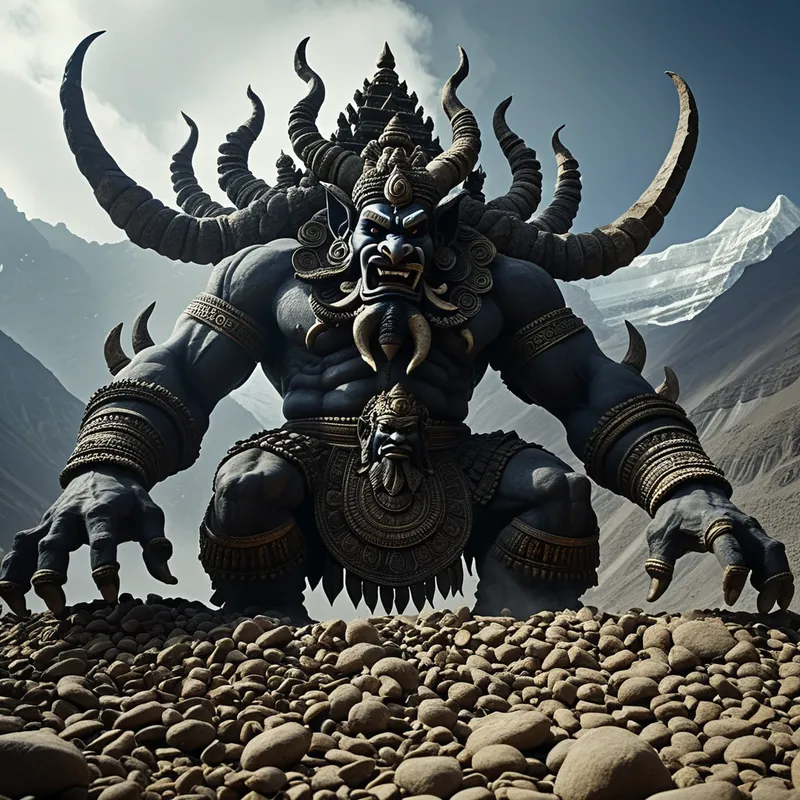
But stillness invites the test of motion. From the southern island of Lanka came a force of immense will: the ten-headed, twenty-armed Ravana, a being of unparalleled power and knowledge, yet burning with the fire of ego. He sought to move the universe to his will, and what greater prize than the very home of the Lord? He journeyed north, his chariot darkening the sky, and arrived at the foot of the immovable peak.
With a roar that shook the foothills, Ravana wrapped his mighty arms around the base of Kailash. He strained, his muscles like mountain ranges coiling. He summoned all his ascetic power, all his demonic strength. The earth groaned. Birds took flight in terror. The very foundations of the world seemed to shudder.
And Shiva, the Adiyogi, the first yogi, merely smiled. With the slightest pressure of his big toe, he pressed down.
The mountain settled. It became heavier than all the worlds combined. Ravana’s arms were trapped, crushed beneath the weight of divine stillness. His roar turned to a cry of agony and realization. For years—some say millennia—he remained pinned, his mighty ego humbled against the unmoving reality. In that crushing embrace, his arrogance was ground to dust. He sang. He sang hymns of praise from a thousand throats, his pain alchemized into the most beautiful poetry, the Shiva Tandava Stotram, born from the ultimate surrender.
And when the song was complete, when the lesson was etched into his soul, Shiva released him. Ravana emerged not as a conqueror, but as a devotee, his power now tempered by the knowledge of a force greater than his own. The mountain had not moved an inch. It never does. It only reveals who we are when we try to move the unmovable.
Cultural Origins & Context
The myth of Mount Kailash is not a single story with one author, but a living constellation of narratives woven through the vast tapestry of Puranic literature, epic poems like the Ramayana and the Mahabharata, and countless local oral traditions. It functions as a foundational cosmogram—a map of reality. For millennia, sages, yogis, and storytellers have used Kailash as the ultimate reference point, the axis mundi that connects heaven, earth, and the underworld.
Its societal function is multifaceted. Geographically, it anchors the sacred landscape of the Himalayas. Ritually, it is the ultimate pilgrimage (yatra), though its summit is considered beyond human ascent. Psychologically, it provides a model of the cosmos that is also a model of the inner self. The mountain is not merely Shiva’s home; it is the ideal state of consciousness—perfect, centered, and immutable. By telling and retelling tales of Kailash, the culture reinforces the values of inner stillness (shanti), the futility of untempered ego, and the transformative power of surrender to a higher order.
Symbolic Architecture
Mount Kailash is the ultimate symbol of the centered Self. It is not the ego, which is fluid and reactive, but the Self—the eternal, unchanging core of being that exists prior to and beyond personality.
The mountain does not aspire to be a mountain; it simply is. In its absolute being, it becomes the center of all worlds.
Shiva’s meditation upon it represents consciousness resting in its own source. The various elements—the crescent moon (clarity), the Ganga (purifying grace), the tiger skin (mastery over primal instincts)—are not decorations but attributes of this realized state. The myth of Ravana is the crucial shadow drama. Ravana symbolizes the titanic intellect and will, the empowered ego that mistakes its own grandeur for ultimate reality. His attempt to lift Kailash is the psyche’s attempt to control, possess, or intellectually comprehend the core Self. The inevitable failure and subsequent humbling represent the necessary crucifixion of the ego on the rock of reality. His beautiful hymn, born from this crushing, is the alchemical gold—the ego’s energy, once devoted to conquest, now redirected into worship and creative expression.
The Dreamer's Resonance
When the archetype of Mount Kailash appears in a modern dream, it often signals a profound encounter with the inner axis. The dreamer may find themselves at the base of an impossibly large, perfect mountain, feeling both awe and a daunting sense of scale. They may be trying, like Ravana, to climb it through sheer force of will, only to find the path vanishing or the mountain growing taller.
Somatically, this can correlate with a feeling of being “stuck” or “pinned down” by life circumstances—a job, a relationship, an internal conflict—that feels immovable. Psychologically, this is the Self asserting its sovereignty. The mountain-dream presents the ego with a truth it has been avoiding: there is an immutable reality within you that cannot be bargained with, only recognized and aligned with. The frustration and humility felt in the dream are the beginnings of ego-deflation, making space for a deeper, quieter authority to emerge. It is the psyche’s way of initiating a pilgrimage to its own center.
Alchemical Translation
The individuation process modeled by the Kailash myth is not one of heroic achievement, but of sacred return. It is the journey from identifying with the Ravana-like ego—the ten-headed ruler of the personal kingdom—to recognizing oneself as the abode of Shiva, the silent witness.
The first alchemical stage is conjunctio, the confrontation. The ego, with all its ambitions and complexities, meets the mountain (the Self). This meeting is often experienced as a crisis, a failure, or a feeling of being utterly humbled by life. The second stage is mortificatio, the crushing. This is the painful but necessary dissolution of the ego’s illusion of control. Like Ravana trapped, the individual must stay in the discomfort, allowing old identities to be compressed. The final stage is sublimatio, the ascent through song. This is not a physical climbing, but a spiritual refinement. The energy once used for egoic striving is sublimated into a new form: creativity, devotion, or a calm, abiding wisdom.
The pilgrimage to Kailash is never about reaching a new destination. It is the arduous, beautiful process of realizing you have never left home.
For the modern individual, this translates to the practice of finding the inner “mountain”—that place of unshakable stillness amidst the chaos of life. It is the cultivation of a meditation practice, not to gain anything, but to return to the axis. It is the recognition that our deepest struggles often arise from trying to move what is meant to be still, and that true power lies not in moving the world, but in discovering the unmoving center within it.
Associated Symbols
Explore related symbols from the CaleaDream lexicon: