Moses's Ark of Bulrushes Myth Meaning & Symbolism
A Hebrew infant, destined for death, is set adrift in a basket of reeds on the Nile, only to be found and raised by the very power that sought his end.
The Tale of Moses's Ark of Bulrushes
Hear now a tale woven from fear and hope, set on the banks of the great, life-giving Nile. In the land of mud-brick and monument, under the shadow of a paranoid king, a decree of iron was issued: every newborn son of the Hebrews was to be cast into the river, a sacrifice to the Pharaoh's trembling power.
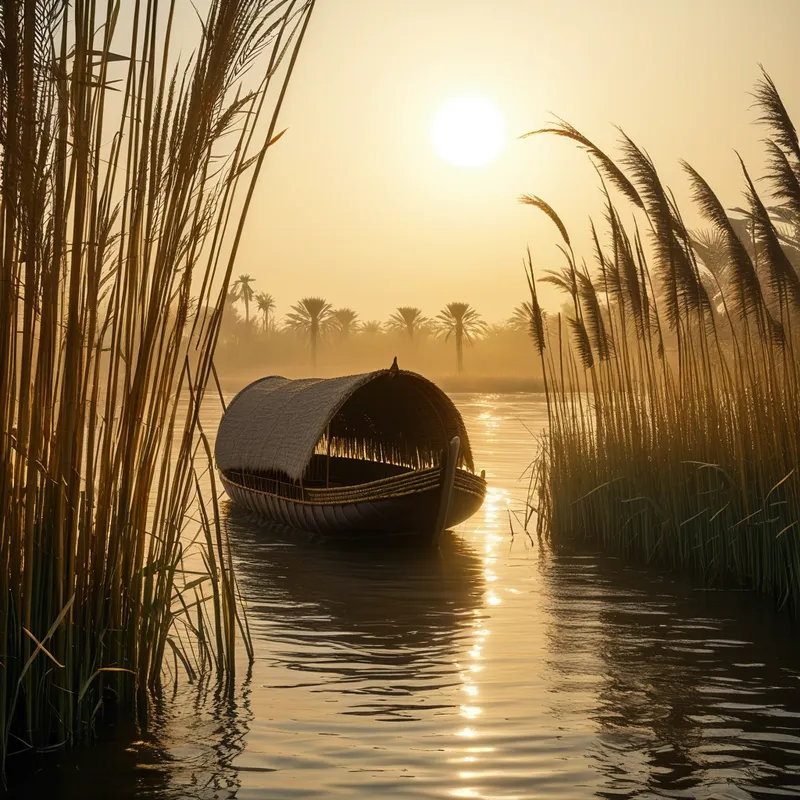
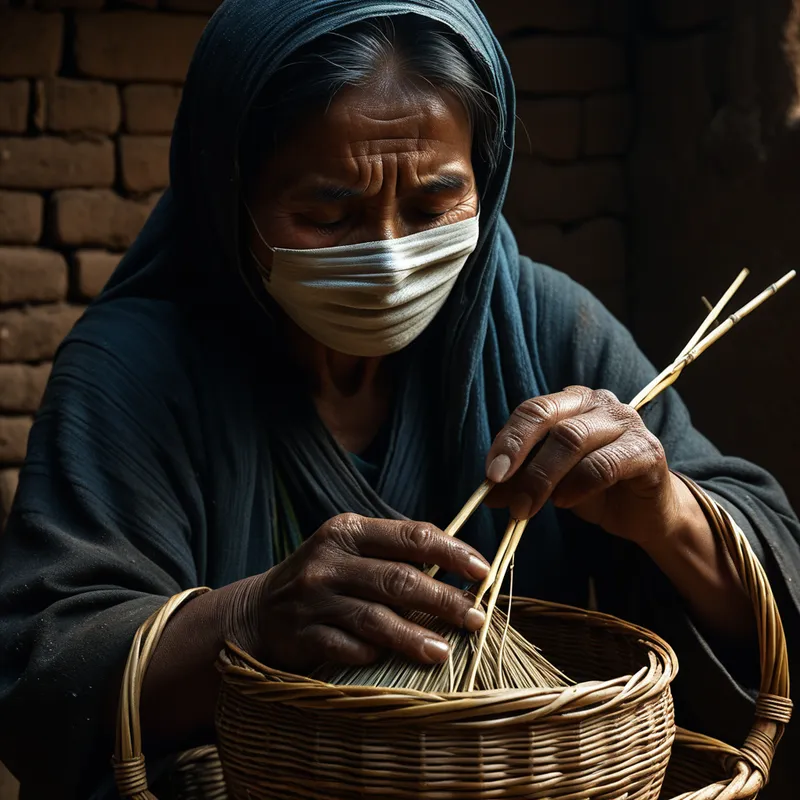
But in one Hebrew household, a mother’s love was a force stronger than any royal command. For three moons, she hid her beautiful boy, his cries muffled against her breast, until the day hiding was no longer possible. With a heart splitting like a dry reed, she conceived a desperate prayer of action. She took papyrus reeds, the very stuff of the river’s edge, and wove them tight with the skill of her ancestors. She sealed this tiny vessel with pitch and bitumen, making it watertight—a womb of reeds for a second birth. She laid her son within this ark of bulrushes, and with a final kiss, she placed it among the reeds at the river's brink. His sister, Miriam, stood sentinel at a distance, her young heart a drum of dread and watchful hope.
The river, that capricious god, carried the little ark not toward death, but toward destiny. The current, or perhaps a gentler hand, guided it to a place where the royal women came to bathe. The daughter of Pharaoh herself, accompanied by her attendants, descended to the water's edge. She saw the strange basket among the reeds and sent a maid to fetch it. Upon opening it, she beheld the weeping child, and her compassion—a divine spark in the house of oppression—was kindled. “This is one of the Hebrews' children,” she said, knowing full well her father’s edict.
Then Miriam, seizing the moment with a courage beyond her years, stepped forward. “Shall I go and call a nurse from the Hebrew women to nurse the child for you?” The princess agreed. And so, the child’s own mother was summoned, paid wages from the royal treasury to nurse her own son, whom the princess named Moses, “because I drew him out of the water.” The child destined for the river’s embrace was drawn from it into the heart of the palace, raised between two worlds, his true identity a secret held in the heart of the woman who bore him.
Cultural Origins & Context
This foundational narrative is embedded in the Torah, specifically the Book of Exodus. It functions as the origin story for Moses, the central human figure of the Israelite liberation saga. Passed down orally long before its textual crystallization, the tale served multiple vital societal functions. It established Moses’s unique, liminal identity: a Hebrew by birth, raised with the education and status of an Egyptian prince. This duality equipped him for his ultimate role as mediator and liberator.
The story also reinforced key cultural values against its historical backdrop of oppression. It portrayed the cunning and resilience of the oppressed (the mother’s and Miriam’s actions), the subversion of tyrannical power (the princess defying her father), and the belief in a protective, guiding providence that works through seemingly chance human compassion. It was a myth of hope, telling a people under threat that their future could be saved from the very waters of destruction, and that salvation could come from unexpected, even royal, quarters.
Symbolic Architecture
The myth’s power lies in its dense, archetypal symbolism. The ark of bulrushes is the primary vessel of meaning. It is not a grand ship, but a fragile, handmade craft of humble materials—papyrus and pitch. This represents the vulnerable, nascent self, the core identity that must be protected when the outer world becomes hostile.
The ark is the psyche’s own lifeboat, crafted from the raw materials of one’s innate resources and set adrift on the unconscious waters when conscious life becomes untenable.
The river Nile is the great flow of life, history, and fate. It is the same river meant for death that becomes the pathway to destiny. This encapsulates the alchemical principle of the prima materia—the very substance of the problem contains the seed of the solution. The mother who obeys the letter of the law (cast him into the river) by ingeniously subverting its intent embodies the creative, preserving power of the anima and the Great Mother archetype. Pharaoh’s daughter represents the redeeming influence that can arise from within the “dominant culture” or the ruling complex itself—a moment of Ego consciousness recognizing and saving the precious, threatened content of the Self.
The Dreamer's Resonance
When this myth pattern stirs in modern dreams, it signals a profound psychic process of abandonment and salvage. To dream of placing a precious, vulnerable part of oneself (a child, a pet, a cherished object) into a small boat and setting it adrift speaks to a necessary, if terrifying, psychological surrender.
The dreamer may be in a life situation where a core identity, talent, or feeling is threatened by an overwhelming “pharaonic” force—be it a crushing job, a toxic relationship, or an inner critic. The somatic feeling is often one of acute grief mixed with a thread of desperate hope. The act of crafting the “ark” in the dream reflects the psyche’s innate resourcefulness, using whatever is at hand (reeds, memories, creativity) to create a protective vessel. The dream is an enactment of the ego relinquishing control, trusting the deeper currents of the unconscious (the river) to carry this fragile self-fragment to a place where it can be recognized, claimed, and integrated by a new, more compassionate aspect of the personality (the princess).

Alchemical Translation
For the modern individual, the myth models the critical early stage of individuation: the separation and rescue of the nascent Self from the collective or personal tyranny that would annihilate it.
The “Pharaoh’s decree” represents the oppressive, one-sided attitude of the conscious mind—a rigid persona, a crushing societal expectation, or a monolithic complex that demands the sacrifice of all unique, spontaneous, or vulnerable life. The infant Moses is the filius philosophorum, the divine child, the germ of the future individual wholeness that is not yet allowed to exist.
The journey begins not with a heroic charge, but with a strategic retreat—the endangered Self must go into hiding, then be intentionally surrendered to the great unknown.
The alchemical work is in the crafting of the ark: the conscious effort (the mother’s love and ingenuity) to create a vessel strong enough to survive the immersion in the unconscious (the Nile). This is the development of a temenos, a sacred, protected space within the psyche—through journaling, therapy, art, or ritual—where the true self can be held while the currents of transformation do their work. Being “drawn out” by Pharaoh’s daughter symbolizes the moment of grace when the ego, from its place of privilege or authority, finally recognizes and claims this long-repressed, precious content. The child is raised in the “palace,” meaning the once-rejected Self is now brought into the center of one’s identity and nurtured with all available resources. The myth assures us that the very waters meant to destroy us can become the medium of our deliverance, if we have the courage to build our little ark of reeds and set it bravely adrift.
Associated Symbols
Explore related symbols from the CaleaDream lexicon: