Moses in Heaven
A mystical Jewish tale of Moses ascending to heaven, encountering divine realms and receiving hidden wisdom beyond mortal understanding.
The Tale of Moses in Heaven
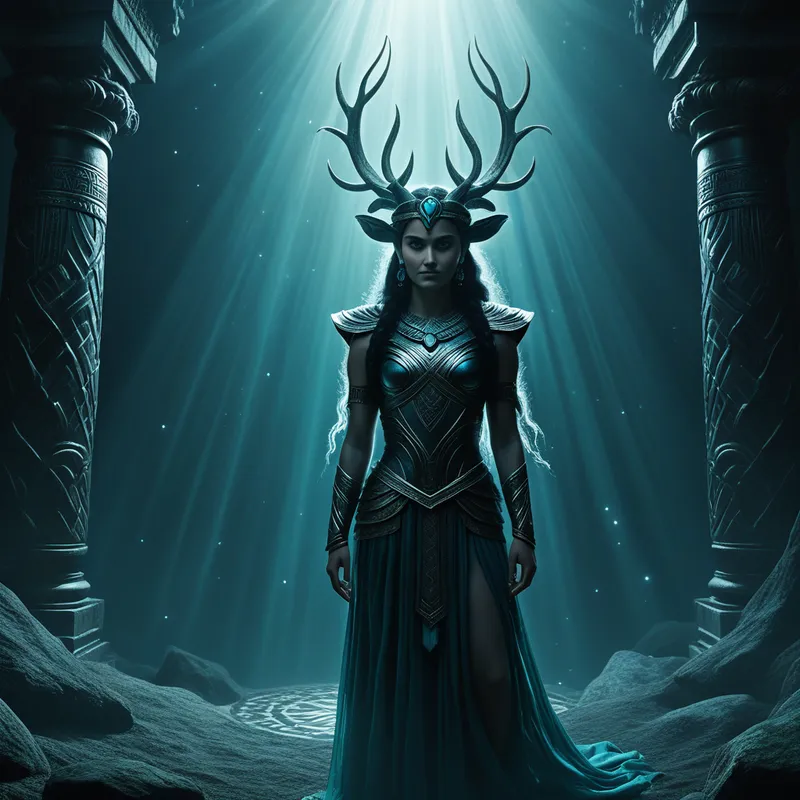
The mountain’s peak was lost in a cloud that was not a cloud, but the shimmering hem of a garment not meant for mortal eyes. Moses stood alone, the weight of a people’s wandering and a lawgiver’s burden upon his shoulders. Yet, the call that drew him upward was not one of duty, but of a final, terrifying intimacy. His earthly journey from the Nile’s reeds to the precipice of the Promised Land was complete; now began the ascent for which his soul had always been destined.
He did not climb with feet of flesh. His spirit, refined by decades of desert solitude and fiery dialogue with the Divine, became his vessel. The solid rock of Sinai dissolved beneath him, giving way to the first of the Seven Heavens. Here, the celestial order was revealed not as abstract philosophy, but as a living, breathing architecture of light and song. He passed through realms where constellations were not distant stars but the gleaming faces of angelic hosts, where the planets moved to a music that was the very pulse of creation. The angels themselves, the Mal’akhim, barred his way, their voices a chorus of cosmic law: “What business has one born of woman among the fires of the holy?” But Moses, armed not with a staff but with the ineffable Name whispered to him in the burning bush, passed through.
He beheld the celestial Heavenly Chariot</ab title>, a vision of wheels within wheels, eyes upon their rims, a storm of movement that was perfect stillness. It was the engine of all existence, and to gaze upon it was to see the machinery of destiny and grace intertwined. Here, in the highest heaven, he stood before the Divine Presence, the Shekhinah. It was not the voice from the bush or the cloud on the mountain. It was an encounter beyond sound and sight, a knowing that flooded his being. He received wisdom that could not be carved on stone—secrets of creation’s dawn, the hidden structures of time, the true meaning of suffering, and the ultimate destiny of Israel and the world. These were the hidden teachings, the soul of the Law whose body he had already delivered.
Yet, the most profound revelation was perhaps the most human. He saw the future, the long exile, the tears of his people. He saw the scholars and mystics who would, in ages to come, pore over his written words, yearning for the very secrets he now held. And in a moment of timeless compassion, he was shown that his own death, the final mystery awaiting him on Nebo’s lonely ridge, was not an end, but a seamless return. His ascent was a homecoming. He would not enter the earthly Canaan, for his portion was this—to dwell forever in the supernal Canaan of the spirit, his soul a fixed star in the firmament of the righteous.
Cultural Origins & Context
The celestial journey of Moses is not found in the plain text of the Torah, which ends with his earthly death. It flowers instead in the rich soil of post-biblical Jewish imagination, particularly within the mystical traditions known as Merkabah and Kabbalah. These texts, such as the Midrash Rabbah and later the Zohar, treat the biblical narrative as a surface layer, beneath which flows an ocean of esoteric meaning.
In a culture where the study of sacred text is itself a form of worship and a path to the Divine, the figure of Moses naturally evolved. He became the archetypal Yored Merkabah, the first and greatest mystic. His ascent validated the later mystical pursuits of the sages; if Moses could ascend and return with hidden wisdom, then the quest for direct, unmediated knowledge of the Divine was not only possible but was a continuation of the prophetic legacy. This myth addresses a deep theological tension: the God who is utterly transcendent and unknowable, yet who desires relationship. Moses’s journey bridges that chasm, modeling a path where the human soul can traverse the unimaginable gulf to touch, however briefly, the source of all.
Symbolic Architecture
The myth is a masterwork of spiritual cartography. The Seven Heavens represent a graduated path of initiation, each level a test of purity and understanding, stripping away the illusions of the material world. The confrontation with the angels is not merely a celestial obstacle course; it symbolizes the ego’s final resistance, the parts of the self that cling to a limited, earthbound identity and must be overcome to achieve true spiritual liberation.
The Heavenly Chariot is the ultimate symbol of dynamic paradox. Its terrifying, chaotic movement signifies the perpetual flux of the created universe, yet at its center is the throne, the point of absolute stillness and divine will. To comprehend it is to hold the tension between change and permanence, between the many and the One.
Moses’s reception of the hidden wisdom transforms him from a lawgiver into a cosmic scribe. The written Torah is the body; the secrets he receives in heaven are its Soul. This duality reflects the Jewish mystical view that every letter, word, and commandment is a vessel containing infinite layers of light. His ascent thus becomes the archetype for all deep study, where the scholar seeks not just to read the text, but to ascend through it, back to the moment of revelation.
The Dreamer's Resonance
For the individual psyche, the tale of Moses in Heaven maps the journey of Individuation. The “Promised Land” of the ego’s desires is forsaken for the far more perilous and rewarding ascent to the Self. Each heaven represents an integration of a complex—a confrontation with inner “angels” (cherished beliefs, personal history, the superego) that guard the gates to deeper consciousness.
The myth speaks to anyone who has ever felt a calling beyond their prescribed role. Moses leaves behind his identity as leader, prophet, and even human, to become pure seeker. This is the psychological death required for rebirth into a more authentic existence. The wisdom he receives is not intellectual data, but the symbolic language of the unconscious—the hidden patterns of one’s own life and destiny, the “secrets” that make sense of suffering and guide towards wholeness. His final vision of his own death as a return signifies the ultimate psychological achievement: the reconciliation with one’s own mortality as a completion, not a termination.
Alchemical Translation
In alchemical terms, Moses is the prima materia, the base human soul subjected to the great work. His eighty years of life are the stages of nigredo (the blackening—slavery, murder, exile), albedo (the whitening—the burning bush, the purification of the desert), and now, in the ascent, the sublime rubedo (the reddening)—the final union with the divine.
The ascent itself is the process of sublimatio—the spirit rising, purified, from the earthly vessel. The heavens are the alembic, the retort in which the last impurities of separateness are burned away by the angelic fires. The hidden wisdom he receives is the Philosopher’s Stone—not a physical object, but the perfected, redeemed consciousness that has united with its source and can now, in turn, transmit transformative truth.
His role shifts from the active Warrior who battles Pharaoh to the receptive Sage who contains the universe’s secrets. This is the alchemical marriage of Sol and Luna, of active principle and receptive vessel, completed within a single being. He becomes the living Temple, the human form fully sanctified as a dwelling place for the absolute.
Associated Symbols
Explore related symbols from the CaleaDream lexicon:
- Mountain — The axis mundi, the meeting point of heaven and earth, representing the arduous climb of spiritual aspiration and the solitude required for transcendence.
- Heavenly Chariot — The dynamic, awe-inspiring vision of the divine order, symbolizing the complex, interlocking machinery of fate, cosmos, and revelation that underlies apparent reality.
- Ascension — The vertical movement of the soul towards its source, representing liberation from earthly constraints and the yearning for direct, unmediated knowledge of the divine.
- Revelation — The sudden, overwhelming descent of divine truth into human consciousness, which simultaneously illuminates and transforms the recipient.
- Fire — The purifying and illuminating element of divine presence, which consumes impurity without destroying essence, as in the burning bush.
- Veil — That which separates the holy from the profane, the known from the unknown; the ultimate barrier Moses penetrates in his ascent.
- Stone — The tablets of the Law, representing the fixed, eternal truth, yet also the material from which the heavenly temple is built, hinting at the solidity of divine promise.
- Key — The ineffable Name of God, which Moses uses to pass the angelic guards; symbolizing the precise knowledge or inner state required to unlock higher realms of being.
- Soul — The refined essence of the individual that makes the celestial journey, representing the immortal core of identity that seeks reunion with its origin.
- Light — The fundamental substance of the heavenly realms and of divine wisdom, representing pure consciousness, understanding, and the emanation of the Infinite.
- Bridge — The path Moses forges between heaven and earth, prophecy and law, the known and the secret; representing the human capacity to connect transcendent reality with embodied life.
- Destiny — The foreknowledge Moses gains in heaven, seeing the future tapestry of his people; representing the paradoxical interplay between divine providence and human free will.