
Moses at Sinai Myth Meaning & Symbolism
The prophet ascends a trembling mountain to meet the unnameable divine, receiving the covenant that forges a people from a tribe.
The Tale of Moses at Sinai
The desert was a crucible of forgetting. For three moons, the people of Israel camped in its barren shadow, a ragged multitude of former slaves, their spirits still echoing with the crash of the Reed Sea. Before them, a mountain brooded—Sinai—its peak lost in a veil of cloud and portent.
On the third new moon, a sound began, not from the camp, but from the mountain itself. A deep, resonant blast, as if the earth were a great horn. It grew, joined by peals of thunder that shook the dust from every tent. Lightning scribbled the sky in divine script. The mountain smoked like a furnace, and the heart of every living thing trembled. Moses alone did not turn away. Summoned, he began the ascent, leaving the plain of human fear for the summit of holy terror.
The people watched, a sea of upturned faces, as their mediator vanished into the cloud. For forty days and forty nights, the mountain was a closed fist. The air tasted of ozone and awe. Below, faith curdled into a golden calf, a desperate shape for the formless terror above. But on the summit, in the eye of the storm, Moses stood in the thick darkness where YHWH dwelt. There were no carven idols here, only a Voice that spoke from the heart of the fire, etching law not on parchment, but on the soul of a people. The terms of a covenant were given: a way of being, a structure for holiness, the ten words that would become their spine.
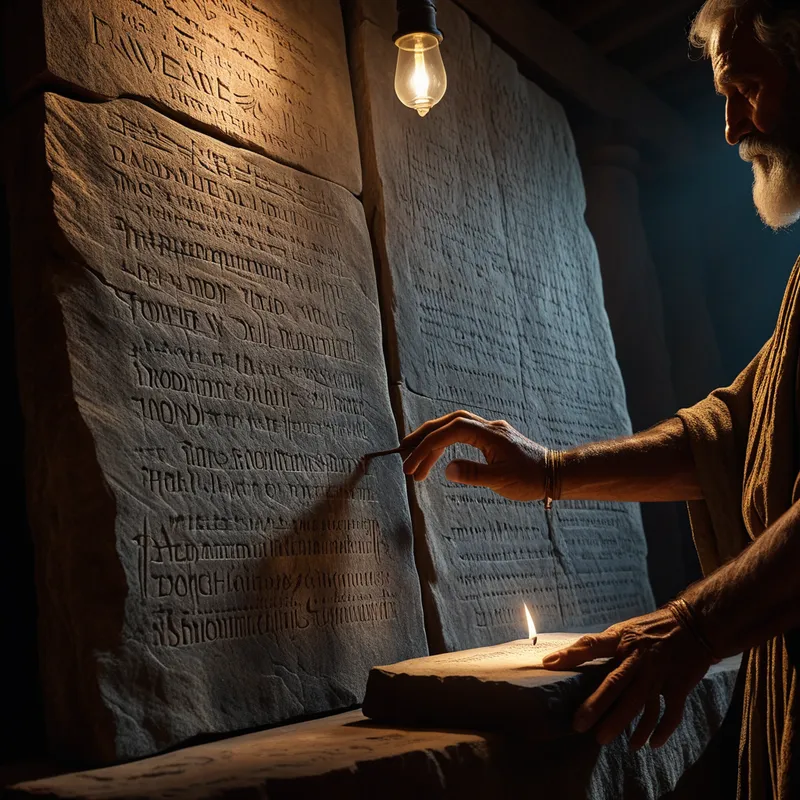
Then, the gift of the tablets—two slabs of sapphire, it is said, hewn by the divine hand, their surface inscribed with the finger of God. Moses descended, his face unknowingly alight with a residual radiance, the stones of the covenant cradled in his arms. But the sound of revelry from the camp reached him, the noise of the broken vow. In a climax of prophetic fury, seeing the people dancing before their molten god, he cast the tablets from his hands, and they shattered at the mountain's base, the holy words meeting the dust of human failure.
Yet, the story does not end in brokenness. The Voice called Moses back up the mountain. "Cut two tablets of stone like the first," it commanded. This time, the work was a collaboration: Moses brought the raw material, and the divine hand wrote again. He returned, his face now veiled, for the reflected glory was too much for mortal eyes to bear. The law was restored, not as a pristine ideal shattered by reality, but as a covenant rewritten through the grit of failure and the hard-won grace of return.
Cultural Origins & Context
This foundational narrative is woven into the Torah, the core of Judaism, and reverberates through Christianity and Islam (where Moses, or Musa, is a paramount prophet). It emerged from the collective memory of tribal confederations in the ancient Near East, codified during the monarchy and exile periods as the definitive origin story of Israel's unique relationship with the divine. It was told at pilgrim festivals, recited in temple liturgy, and taught as the moment a disparate group of escapees became a nation bound by law and purpose. Its function was ontological: to answer who we are (a covenanted people) and why we are here (to live in accordance with divine instruction, or Torah). It established the paradigm of prophecy, law, and the fraught, intimate dialogue between the human and the ultimate.
Symbolic Architecture
At its heart, Sinai is the archetypal encounter with the numinous—the wholly other. The mountain is the axis mundi, the meeting point of heaven and earth, but here it is not a gentle ladder but a terrifying transformer. The storm, fire, and thick darkness symbolize the irreducible mystery of the transcendent, which shatters all comfortable conceptions.
The shattered tablets are not a tragedy but a profound necessity. The perfect law must break against the imperfect heart to create the space for a covenant of mercy.
Moses represents the mediating consciousness, the part of the psyche that can endure the terrifying encounter with the Self (in Jungian terms, the totality of the psyche, both conscious and unconscious) and return bearing structure. The forty days signify a period of incubation, death, and rebirth. The laws themselves are a symbolic architecture for the soul—boundaries that create sacred space within the chaos of instinct and collective life. The radiant face symbolizes the transformative effect of such an encounter: one who has stood in the presence of the ultimate is fundamentally altered, carrying a light they themselves may not perceive.
The Dreamer's Resonance
When this myth stirs in the modern dreamer, it signals a profound encounter with inner authority and the need for a new psychic structure. Dreaming of approaching a terrifying, luminous mountain may reflect a summons from the deep Self to confront a life-altering truth or accept a daunting responsibility. The trembling ground is the somatic echo of the ego’s foundation being shaken to its core.
Dreams of receiving tablets, a scroll, or any inscribed object often point to the emergence of a personal ethic or a clarifying insight that demands to be integrated. Conversely, dreaming of shattering such an object may not indicate failure, but the necessary breakdown of an old, rigid ideal—a moral code, life plan, or self-image—that was too brittle for the complexities of lived experience. The dream may then cycle toward a second chance, a rewriting on a heart that has been humbled and made ready. The feeling is one of awesome, fearful responsibility, the call to become the mediator of one’s own destiny.
Alchemical Translation
The alchemy of Sinai is the transmutation of collective chaos into conscious order, and later, of rigid law into living covenant. The first stage (nigredo) is the desert and the terrifying ascent: the dissolution of the old slave identity in a confrontation with the terrifying, purifying fire of the Self. The people’s fear and the creation of the golden calf represent the ego’s desperate attempt to re-solidify the familiar amidst the unbearable fluidity of transformation.
The summit encounter is the albedo, the illuminating whitening, where in the thick darkness, the law is received—the conscious principle (Moses) is imprinted with a structure from the Self.
The shattering of the tablets is the crucial rubedo, the reddening. Here, the perfect, received ideal meets the flawed reality of the human community (and the human heart). This breaking is not the end of the work, but its most vital phase. It introduces the element of relationship, failure, and forgiveness into the spiritual process. The second ascent and the cutting of the new tablets by Moses himself symbolize the individuated outcome: the law is no longer a purely external imposition, but a structure co-created. The psyche’s own substance (the stone he cuts) is now the medium for the divine inscription. The final descent with the veiled face represents the integrated individual, who carries the transformative light of the Self but must veil its full radiance to live in compassionate relation with the world. The covenant is now internal, a living law written on the heart.
Associated Symbols
Explore related symbols from the CaleaDream lexicon: