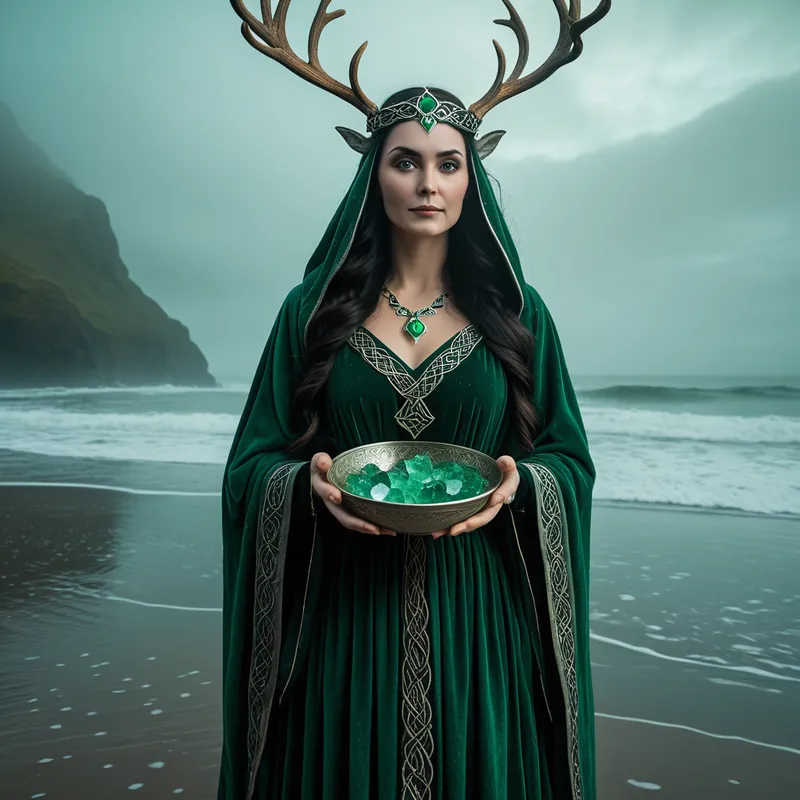
Morgan le Fay Myth Meaning & Symbolism
A shapeshifting sorceress of Avalon, Morgan le Fay weaves destiny and challenges kings, embodying the untamed feminine power of sovereignty and fate.
The Tale of Morgan le Fay
Listen, and let the mists of Avalon gather. In a time when the world was woven from song and stone, when the veil between the realms was thin as a maiden’s shift, there lived a woman whose name was a whisper and a storm: Morgan.
She was born of the old blood, daughter to a queen of Tír na nÓg and a king of this mortal earth. From her first breath, she knew the language of herbs that cure and kill, the secret paths stars carve in the dark, and the weight of water in a single tear. They sent her to a convent to tame her, but the walls could not hold a spirit that conversed with hawks. She fled to the wilds, to the druids, and finally to the glass isle, Avalon, where nine sisters tend the sacred fire at the world’s heart.
There, Morgan became the chief among them. Not by decree, but by right. Her hands could knit a broken bone with a chant; her gaze could still a fevered mind. She learned to shape the mist into ships and her own form into that of a crow, a hare, a beautiful stranger. Her power was the power of the land itself—untamed, fertile, and severe.
Her half-brother, Arthur, wore a crown of forged unity, a kingdom of law and round tables. Morgan’s realm was the older sovereignty: the law of root and tide, of fate written in owl-flight. Their worlds were oil and water, destined to clash. She saw the fragility in his dream, the pride that would be its undoing. Through guile and glamour, she tested him. She sent visions, temptations, and enchanted gifts—not from malice, but from a terrible, loving necessity. A king who cannot see through illusion is no true king. A kingdom that does not honor the old ways of the land is built on sand.
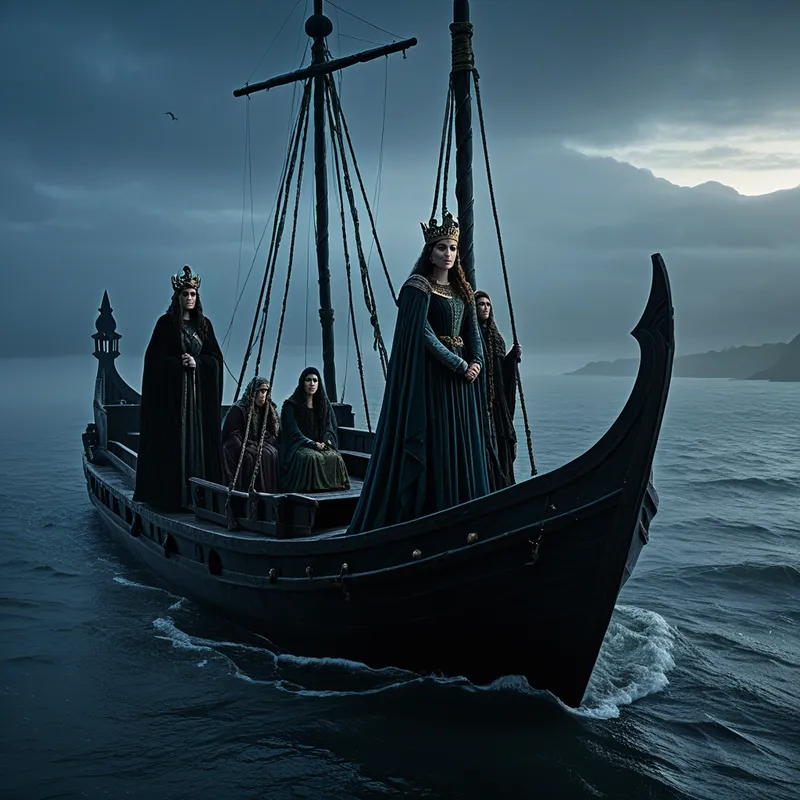
The great conflict came not with armies, but with a single, poisoned spear-thrust on a desolate field. Arthur, the once and future king, lay mortally wounded, the dream of Camelot shattered around him. It was then the barge came, draped in black samite, moving soundless through the reeking water. And it was Morgan who stood at its prow. Her face, often painted with cunning or wrath, was now a mask of profound and ancient sorrow. With her sisters, she gathered the broken king. She did not speak words of forgiveness or triumph, only the old tongue of healing. She guided the barge back through the parting mists, away from the world of men, toward the isle of apples. To Avalon. To mend him, or to let him sleep until the land calls again. She became not his destroyer, but his ferryman, the keeper of his twilight, the hand that closes one cycle so that, perhaps, another may begin.
Cultural Origins & Context
The figure of Morgan le Fay is a profound palimpsest, a Celtic goddess rewritten by Christian scribes. Her deepest roots tap into the Sovereignty Goddess</ab title>, a divine embodiment of the land itself who chooses and tests the rightful king. Figures like the Mórrígan or Ceridwen echo in her—female powers of prophecy, transformation, and fearsome magic.
Her transmission is a story of cultural negotiation. The myth was carried by Welsh and Breton bards, eventually captured in the manuscripts of Geoffrey of Monmouth and Chrétien de Troyes. Here, the old goddess was often reduced to a scheming enchantress, a convenient foil for Arthurian chivalry. Yet, her essential nature—healer, ruler of Avalon, master of shapes—persisted like a stubborn root, refusing to be fully Christianized or villainized. Her societal function was dual: for the old Celtic ear, she was a reminder of the land’s primal power and the feminine authority over life, death, and destiny. For the medieval court, she became the necessary shadow, the "other" against which the ideals of courtly love and martial honor were defined and tested.
Symbolic Architecture
Morgan represents the archetype of the Wild Feminine, the aspect of the psyche that operates outside consensual reality and rational law. She is not chaos, but a different, older order.
She is the intelligence of the deep, self-regulating system—the immune response of the soul that attacks foreign, rigid structures to preserve a more fluid and ancient wholeness.
Her island, Avalon, is the Self—the inner sanctuary of healing and integration, accessible only through surrender (the wounded journey) and often shrouded in the mists of the unconscious. Her shapeshifting signifies the fluid nature of identity and truth, challenging the ego’s desire for fixed, singular narratives. Her antagonism toward Arthur is not personal evil, but the necessary tension between the Ego (the King’s Logos) and the Animus/Anima (the Goddess’s Eros). She forces a confrontation with what the conscious project has rejected or forgotten.
The Dreamer's Resonance
To dream of Morgan le Fay is to feel the stirring of a deep, autonomous psychic force. You may dream of a mysterious, commanding woman who is alternately healing and threatening, offering a potent gift that is also a test. You may find yourself lost in a fog, seeking an island you can sense but not see. Or you may be the one ferrying a wounded, kingly figure (a parent, a partner, an aspect of your own ambition) to a place of rest.
Somatically, this can feel like a rising, unsettling energy in the gut or womb space—a power that feels both yours and alien. Psychologically, you are likely at a point where a long-held, conscious "kingdom" of your life (a career, a relationship, a self-image) is failing or has been wounded. Morgan appears not to gloat, but to initiate. She signals that the old heroic striving must end. The process is one of relinquishment. The ego is being asked to surrender its sole authority, to be carried into the mist, to admit it does not know the way. This is the beginning of healing at a depth that conscious will cannot reach.
Alchemical Translation
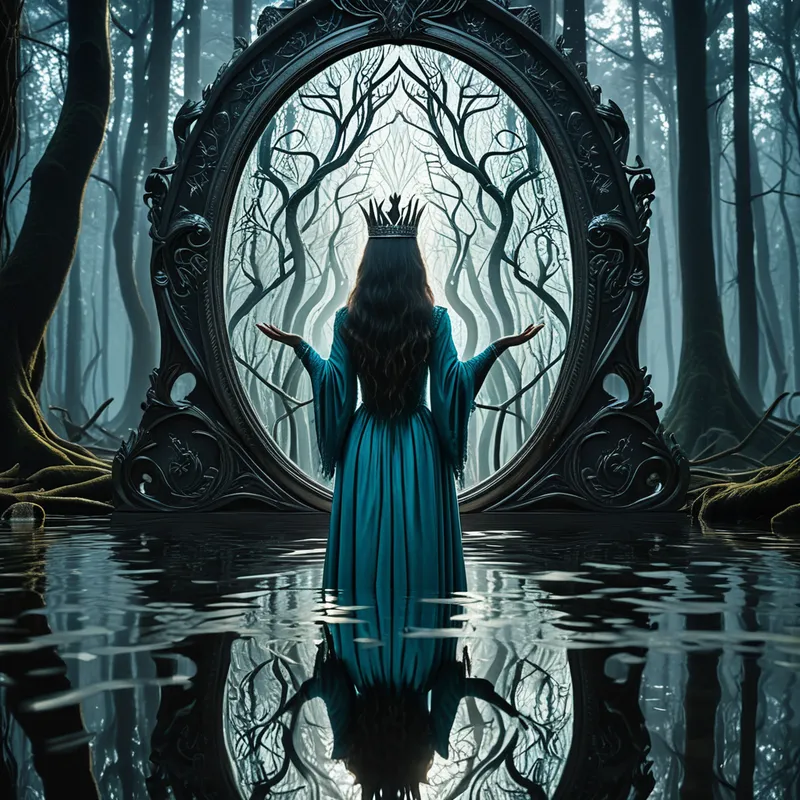
The alchemical journey modeled by Morgan is the Nigredo, the descent into the dark waters, and the subsequent Ablutio, the healing bath. Our modern "Camelot" is the persona—the shining, successful, socially-approved identity we construct. Its inevitable wounding is not failure, but an invitation to the next stage of individuation.
The myth teaches that true sovereignty is not won by conquering the external world, but by submitting to the transformative crucible of the inner one.
Morgan is the operator of this crucible. First, she dissolves through her tests and illusions, breaking down the ego’s rigid structures. Then, she ferries the essential core of the self (the wounded king) to Avalon, the place of Coniunctio, where opposites—male/female, spirit/body, light/shadow—can be held and reconciled. The goal is not to destroy the king, but to heal him in a realm beyond time, integrating his conscious striving with her unconscious wisdom. For the modern individual, this translates to the painful but vital process of letting a dying self-image pass, allowing oneself to be guided by a deeper, often feared, inner authority (the Morgan within) into a period of fertile darkness and non-doing. From this incubation, a more authentic, embodied sovereignty can emerge—one that rules not from a lonely throne, but from the sacred, apple-laden isle at the center of one’s own being.
Associated Symbols
Explore related symbols from the CaleaDream lexicon: