Moonstone Myth Meaning & Symbolism
A myth of stolen moonlight, a perilous journey to the underworld, and the restoration of fractured light, creating the first moonstone gem.
The Tale of Moonstone
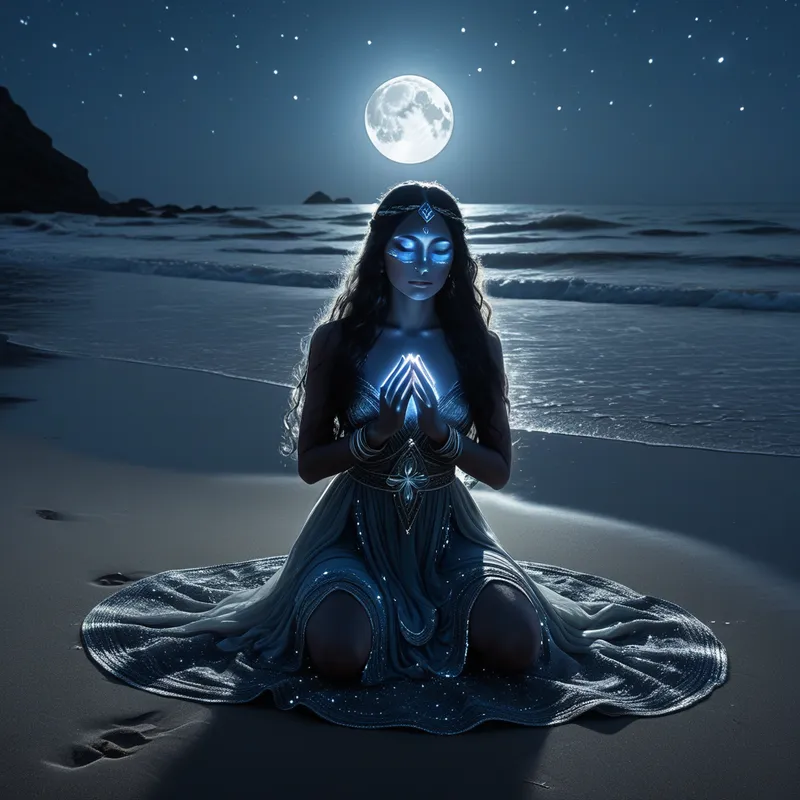
Listen, and hear the story written not on parchment, but on the face of the night sky. In the time before memory, when the world was young and soft, the Moon was not a distant, cold mirror. She was a goddess, Selene, and her light was a living, silver milk that nourished the dreams of all sleeping things. It was a light of gentle knowing, of tides within and without, of secrets whispered and promises kept.
But in the deep places, where no star's gleam could reach, dwelled Korax, the Maw of Want. He was not evil, but emptiness given form, and the sight of Selene's radiant wholeness was an agony to him. He desired not to destroy, but to possess, to fill his hollow core with her essence. One night, as Selene leaned closest to the world to bless a newborn forest, Korax surged from the abyss. With a net woven from the silence between heartbeats, he captured not her body, but the very heart of her light—a single, pulsing tear of pure moonlight that fell from her eye as she was seized.
The world plunged into a silence deeper than any winter. Dreams turned to ash. The seas lay still and listless. The night became a domain of pure, unbroken shadow, and a terrible coldness, a numbness of the soul, crept into every living thing. Selene, bereft, wandered the darkened heavens, her form now a pale, ghostly outline, her light dimmed to a feeble memory.
It was then that a mortal, Aelia, who had always found solace in the moon's path, could bear the silence no longer. Guided not by sight, but by the aching hollow in her own chest that mirrored the sky's, she embarked on a journey with no map. She followed the fading echo of the moon's song down into the roots of the world, into the realm of Korax. The path was lined with the ghosts of forgotten hopes and the chilling whispers of despair.
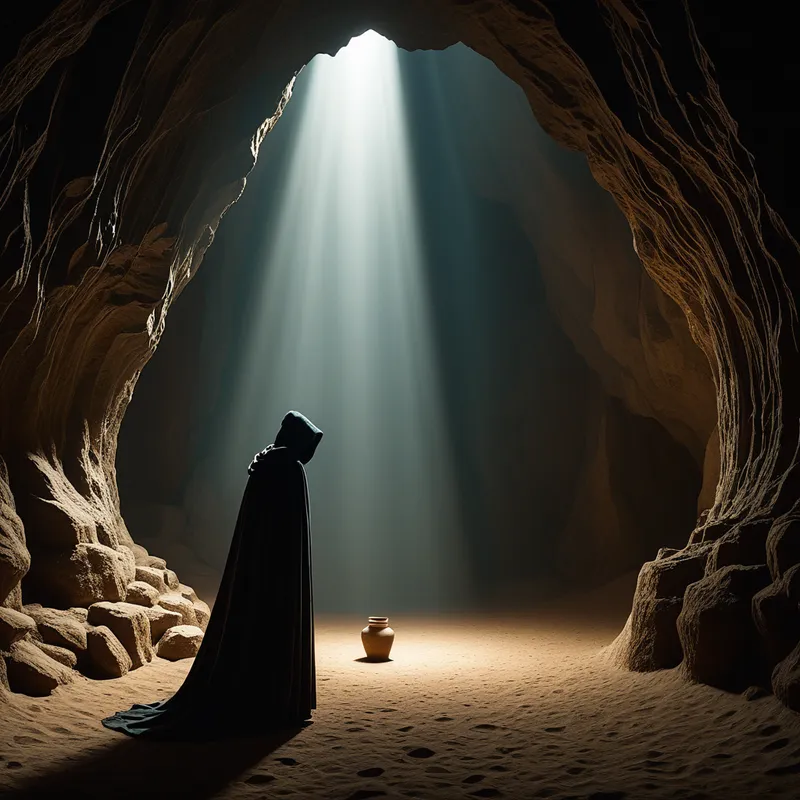
She found Korax in his cavern, not gloating, but weeping. The stolen tear of light did not warm him; it burned his hands of shadow, a searing reminder of a wholeness he could never integrate. He held it trapped in a jar of black obsidian, where it fluttered like a dying moth. Aelia felt no rage, only a profound recognition of mutual loss. She did not fight. She sang—a wordless, mortal song of all the things the moonlight once blessed: the lover's glance, the ocean's sigh, the child's peaceful sleep.
Hearing the very beauty he had tried to steal given voice, Korax shuddered. The song, fragile and human, did what divine power could not: it reminded him of connection, not possession. With a sound like a mountain sighing, he opened his hands. Aelia took the jar, the light within now beating in rhythm with her own heart.
Her return was a slow rebirth. As she climbed back toward the world, the light from the jar seeped into the stone around her, into the veins of the mountain itself. When she finally broke the surface, the jar dissolved. The tear of light shot upward, not to a distant goddess, but to the space between Selene and the Earth. It shattered into a million gleaming fragments, each catching the restored moonlight and holding it within. They fell like gentle rain, embedding themselves in the earth—the first moonstones. Selene's light was restored, but forever changed, forever shared. The moon now shone with a softer, more compassionate light, and in the stones below, a piece of that night, and of the journey through the dark, was kept forever.
Cultural Origins & Context
The myth of the Moonstone is not the property of a single people, but a story that has emerged, in varying forms, across disparate cultures—from the Tlingit tales of Raven stealing the moon-box to certain Celtic lore of the "moon's tear." Its persistence suggests it addresses a fundamental, pan-human experience. It was typically a story for the threshold times: told at twilight, during lunar eclipses, or to adolescents undergoing initiation. The teller was often a keeper of lore, a grandmother or a shaman, whose role was not merely to entertain but to provide a narrative container for the community's collective anxiety about loss, darkness, and the fragility of light—both literal and spiritual. Its function was prophylactic; by giving a story to the darkness, it made the night less terrifying, teaching that what is lost can be sought, and that even the thief is part of the cycle of restoration.
Symbolic Architecture
At its core, this is a myth of the fractured Self. Selene represents the original, unconscious state of psychic wholeness—the Self before the trauma of individuation. The theft of her luminous tear symbolizes the inevitable "fall" into consciousness, where a part of our innate, glowing totality is seemingly lost, captured by the shadowy, neglected aspects of the psyche (Korax).
The treasure is always guarded by a dragon; the light is always held in the deepest dark. The value of the prize is measured by the terror of its keeper.
Aelia, the mortal seeker, embodies the conscious ego embarking on the necessary, perilous journey into the underworld of the unconscious. Her weapon is not force, but empathy—the song born of felt experience. This is critical. She does not slay the shadow; she sings to it, acknowledging its pain and its place in the story. The resolution is not a victory of light over dark, but a sacred exchange. The light is returned, but transformed; it is no longer the sole property of the celestial "goddess" (the remote Self), but is fragmented and embedded in the earthly realm (the embodied individual). The moonstone becomes the symbol of this integration: a piece of the celestial trapped within the terrestrial, holding both the memory of loss and the fact of restoration.

The Dreamer's Resonance
When this myth stirs in the modern dreamer, it often manifests as dreams of searching in dark, labyrinthine places—forgotten rooms, basements, caves—for a lost object of glowing, personal significance. The dreamer may feel a somatic chill, a literal coldness, representing emotional numbness or dissociation following a loss. Alternatively, one might dream of holding a fragile, luminous vessel, terrified of dropping it, or of a beloved light source (a lamp, the moon) being suddenly extinguished.
These dreams signal a psychological process of recollection. The psyche is attempting to retrieve a vital, but abandoned, aspect of its own energy—a talent stifled, an emotion repressed, a truth ignored. The "Korax" figure in the dream, whether as a menacing presence or a pitiable one, is the psychic complex that has swallowed this energy. The dream is the beginning of Aelia's descent; it is the ego being compelled to turn toward, not away from, the inner darkness where its own stolen light is held captive.

Alchemical Translation
The myth of the Moonstone is a perfect map for the alchemical process of individuation. The initial state (Selene whole) is the unconscious unity. The theft (nigredo) plunges the soul into the blackness of confusion, depression, and felt incompleteness. Aelia's descent is the mortificatio, the deliberate engagement with this darkness, the "making conscious" of the shadow.
Her empathetic encounter with Korax is the crucial coniunctio oppositorum—the conjunction of opposites. The conscious ego (mortal, feeling) does not annihilate the shadow (the empty, envious one) but recognizes it as a part of the whole system. This recognition is the catalyst for albedo, the whitening. The light is released, but it must be integrated. This is not a return to the old, unconscious state.
The goal is not to recover the pristine, lost light, but to create the moonstone: a new, conscious substance that contains the journey through the dark within its very structure.
The final stage (rubedo) is the embodiment of this integrated light. The moonstones seeded in the earth represent the new, enduring psychic structures formed from the ordeal—a lasting compassion, a hard-won wisdom, a creativity born of acknowledged brokenness. For the modern individual, the "moonstone" is the part of your character that is most resilient and beautiful precisely because it remembers the dark journey of its own creation. You do not simply get your "light" back; you become the vessel that holds both the light and the memory of its absence, shining with a more complex, human radiance.
Associated Symbols
Explore related symbols from the CaleaDream lexicon: