Moon Gate Myth Meaning & Symbolism
A celestial archer's quest for immortality creates a lunar gate, separating him from his beloved, forging a myth of eternal longing and the price of transcendence.
The Tale of Moon Gate
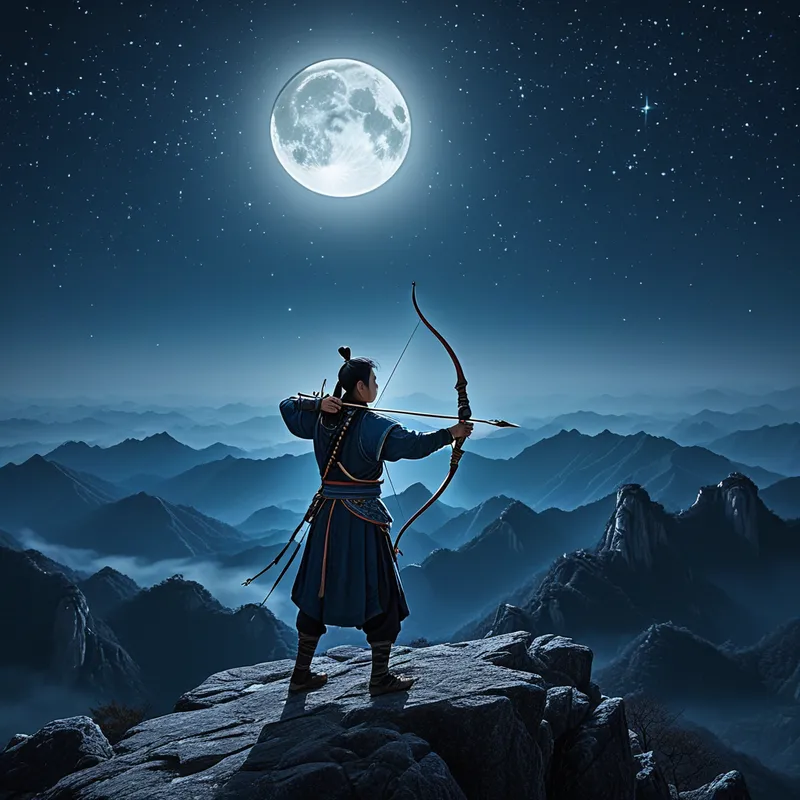
In the time when the sky was young and ten suns, the children of Di Jun, raced across the heavens, scorching the earth to cinders, a hero arose. His name was Hou Yi, and his bow was strung with the sinew of dragons. With arrows fletched with phoenix feathers, he drew his bow not in anger, but in desperate mercy. Nine times the string thrummed, a sound like the cracking of the world’s spine, and nine suns fell as burning tears from the sky. For this, the great Xi Wangmu granted him a treasure beyond price: a single pill of immortality.
Yet, a pill for one is a poison for two. Hou Yi returned to his mortal home, to his beloved wife, the radiant Chang'e. He hid the elixir, for to consume it alone meant an eternity of solitude, a heaven of one. But fate is a sly thief. While Hou Yi hunted, a shadow moved in their home—some say it was the envious apprentice, Peng Meng; others whisper it was Chang'e’s own fearful curiosity, a longing to secure their destiny. Discovering the pill, and fearing its theft, she swallowed it whole.
The change was not glorious, but terrifying. Her feet lifted from the packed earth of their courtyard. The familiar weight of her body, the warmth of the hearth, the scent of her husband’s bow—all fell away. She became as light as regret, pulled by a silent, terrible song toward the cold, silver orb in the night sky. Up she drifted, a leaf on a celestial wind, her cries lost in the vast gulf between earth and heaven.
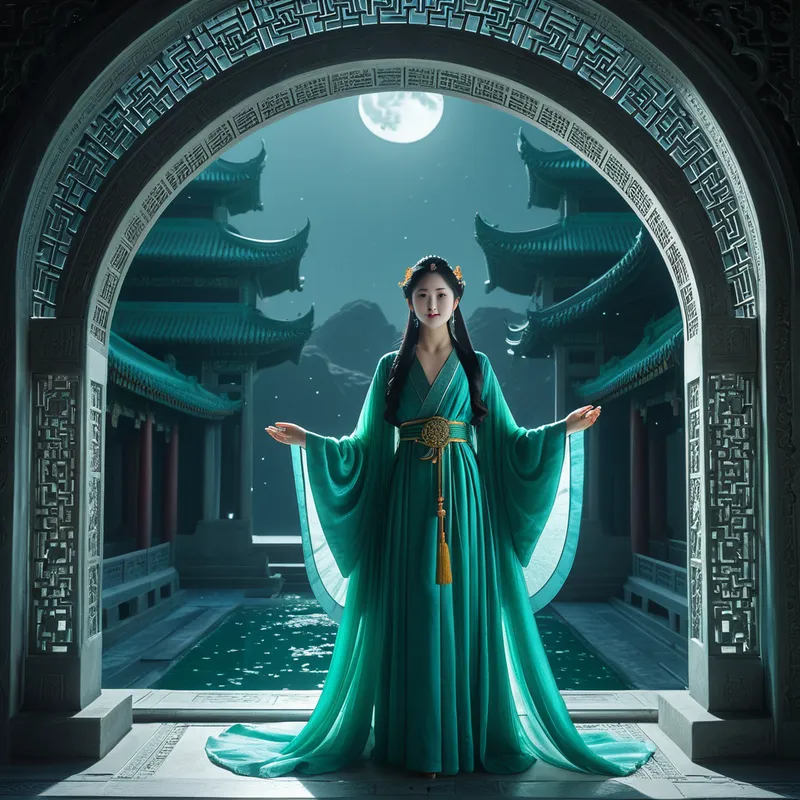
She arrived not in a field of stars, but in a palace of perpetual frost, the Guanghan Palace. Its beauty was desolate, its silence absolute. And there, at the heart of this frozen splendor, a gate formed—not of wood or stone, but of condensed moonlight and longing. The Moon Gate. It was a perfect circle, a window of shimmering mercury, through which she could see the distant, blue jewel of the world, and the tiny, heartbreaking figure of Hou Yi gazing up, night after night, his bow now useless against this final, most painful separation.
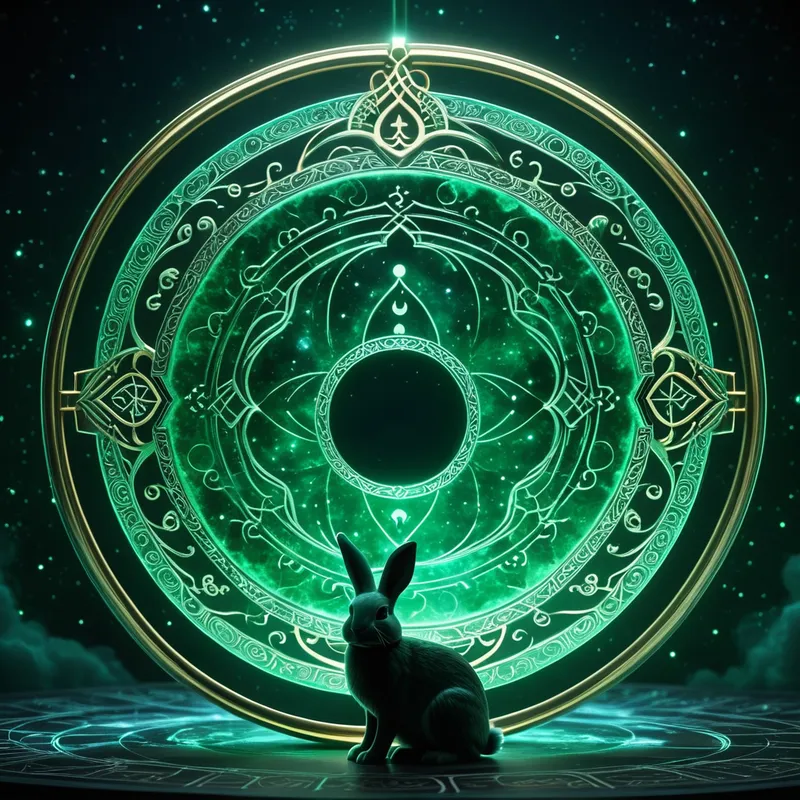
He built her a garden of sweet cakes and fruits, offering them to the moon, a feast for a ghost. She, in turn, was given only the company of a jade rabbit, pounding the herbs of eternity in an endless, futile labor. The gate stood between them, a testament to a love that achieved the divine only to discover that divinity is the loneliest country of all.
Cultural Origins & Context
The myth of Hou Yi and Chang'e, with the Moon Gate as its poignant symbol, is not a single, fixed story but a tapestry woven from ancient threads. Its earliest fragments appear in texts like the Shijing and are elaborated in later works such as the Huainanzi. It was never merely a celestial romance; it functioned as a foundational etiological myth, explaining the moon's phases, the origin of the Mid-Autumn Festival, and the moon's stark, beautiful desolation.
Passed down through oral tradition, poetry, and festival rituals, the tale was told by village elders during the Zhongqiu Jie, as families gathered under the fullest moon of the year. It served as a societal mirror, reflecting Confucian values of loyalty and the tragic consequences of disorder (the stolen pill), while also touching on Daoist themes of the tension between earthly attachment and transcendental aspiration. The Moon Gate became the ultimate symbol of that tension—a barrier that defines the sacred separation between the mortal and the immortal, the human and the divine.
Symbolic Architecture
The myth’s power lies in its stark, perfect symbols. Hou Yi, the archer, represents the focused, solar consciousness—the heroic ego that acts upon the world, solves crises, and seeks achievement. Chang'e embodies the lunar principle—the receptive, intuitive, and ultimately mysterious psyche. The single pill of immortality is the treasure of wholeness, the Self, which cannot be possessed by the conscious ego alone.
The Moon Gate is the threshold of individuation, visible only after a fateful choice has severed the conscious from the unconscious.
Chang'e's ingestion of the pill is not simply theft or betrayal; it is the unconscious claiming the transformative potential that the conscious mind (Hou Yi) is not yet ready to integrate. Her flight is the inevitable withdrawal of the soul's contents into the realm of the unconscious (the moon) when approached incorrectly—with greed, fear, or in isolation. The gate, then, is the symbol of the now-conscious divide. It is the recognition of a profound inner separation. Hou Yi’s earthly offerings are the ego’s continued attempts to relate to what it has lost, while Chang'e’s frozen palace is the state of a complex held in splendid, but sterile, isolation.
The Dreamer's Resonance
When this myth stirs in the modern dreamer, it often manifests as dreams of unreachable lovers, of watching a beloved figure recede through a door or a window that seals shut, or of finding oneself in beautiful but emotionally cold, isolated places. The somatic experience is one of literal weightlessness or grounding loss—a feeling of floating away, or conversely, of being rooted to the spot while something essential departs.
Psychologically, this is the process of experiencing a nascent soul-image (the Chang'e figure) becoming autonomous and retreating into the unconscious. It signals that a part of the psyche that was once connected to the ego (the Hou Yi figure) has been activated by a "pill"—a potential for deep change, perhaps a new insight, love, or creative power—but has been "swallowed" by unconscious anxiety or possessiveness. The dreamer is left with the longing and the gate: the conscious awareness of a profound inner split and the yearning for reconciliation.

Alchemical Translation
The individuation process modeled here is not one of heroic conquest, but of tragic recognition and ultimate transformation through enduring the tension of opposites. Hou Yi’s initial journey is the first half of life: heroic action, earning rewards, securing one's place. The crisis of the pill is the mid-life turning point, where the quest for achievement reveals its shadow: the potential for eternal isolation.
The alchemical work begins not with storming the Moon Gate, but with learning to make offerings to it.
The modern individual’s "alchemical translation" involves several stages. First, one must cease firing arrows—stop the heroic, forceful attempts to reclaim or control the lost content (the repressed feeling, the abandoned creativity, the complex). Second, one must, like Hou Yi, build the garden and make the offerings. This is the conscious, ritualistic work of tending to the longing—through active imagination, art, journaling, or therapy—honoring the separated part without demanding its return. Finally, one must come to see that the Gate itself is not a barrier, but an interface.
The ultimate transmutation is the realization that Chang'e on the moon and Hou Yi on the earth are two poles of a single psyche. The longing is the connection. The full moon under which offerings are made is the moment when the light of consciousness fully illuminates the contents of the unconscious, and the Gate becomes, for a fleeting instant, transparent. In that moment, the individual does not cross over, but understands that wholeness (immortality) lies in sustaining the sacred relationship between the two realms, in becoming the living bridge that contains both the archer’s resolve and the goddess’s sorrow. The psyche no longer seeks a single pill, but learns to breathe the rare air of the threshold itself.
Associated Symbols
Explore related symbols from the CaleaDream lexicon: