Mono no aware Myth Meaning & Symbolism
The poignant awareness of life's fleeting beauty, felt in the fall of a cherry blossom or the fading light, as a path to profound acceptance.
The Tale of Mono no Aware
Listen, and let the wind carry you to a world where time is measured not in hours, but in heartbeats, not in years, but in the blooming and falling of petals. This is not a story of gods with thunderbolts, but of the human soul brushing against the silk of existence.
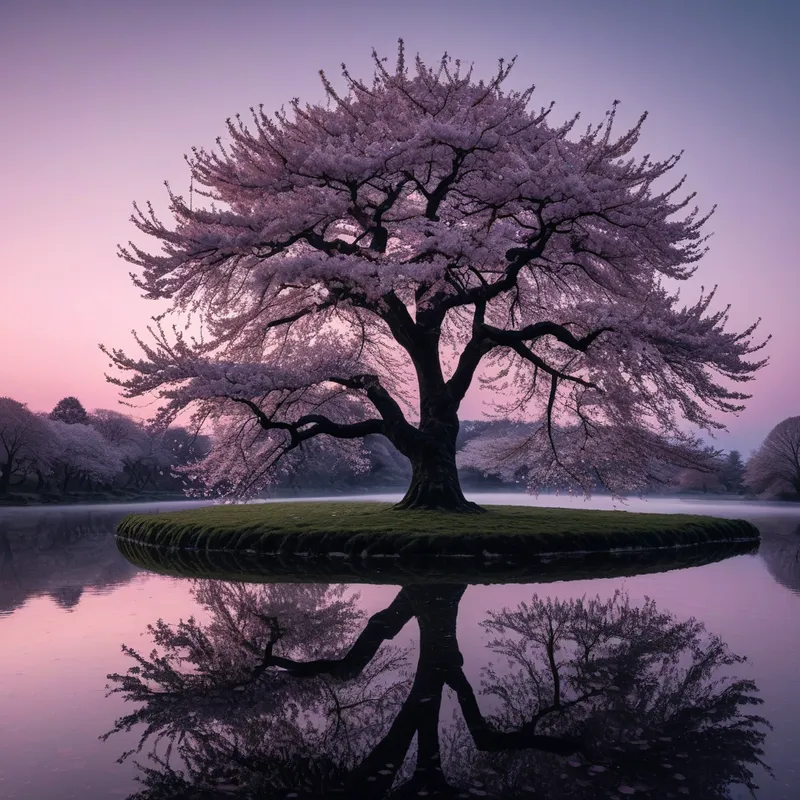
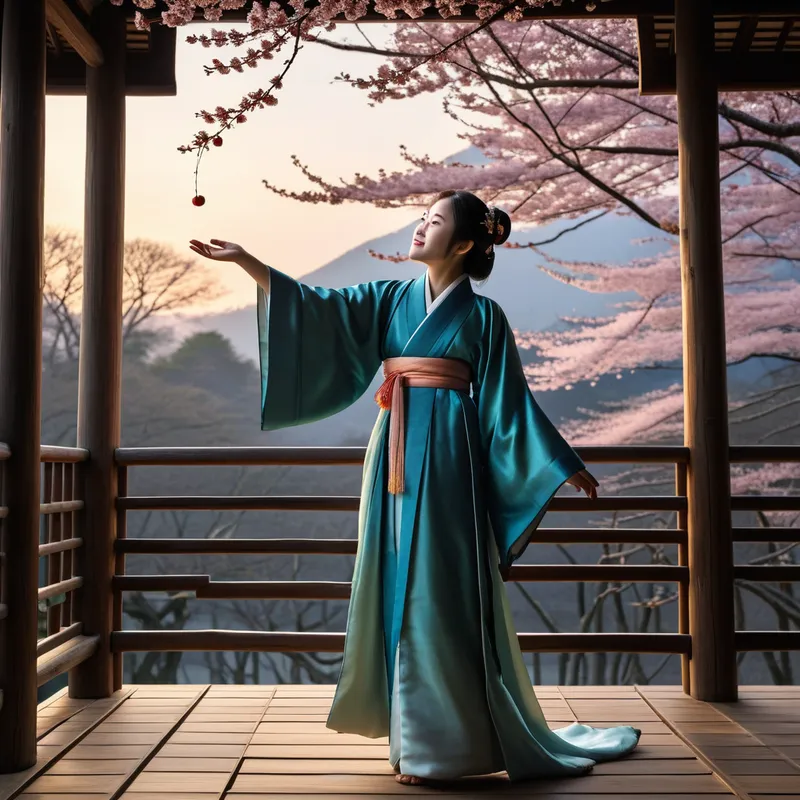
In the soft, grey light of a spring dawn, the world holds its breath. In a garden of moss and ancient stone, a single cherry tree, a Gohonmatsu, stands in silent vigil. Its branches are heavy with promise, a cloud of buds tight as clenched fists. A woman, Lady Murasaki, kneels on the wooden engawa, her robes the color of twilight. She has watched this tree for a lifetime of springs. She knows its every knot, the way the morning sun catches its highest branch first.
The conflict is not one of clashing swords, but of a silent, internal tide. As the sun climbs, a warmth touches the buds. One, then another, surrenders its secrecy. A petal unfurls, delicate as a moth's wing, blushing with a pink so faint it seems to borrow its color from the sky's own memory. The tree erupts into a symphony of silent white and pink. Lady Murasaki feels a sharp, sweet pang in her chest—a fullness that is also an emptiness. This is the moment of perfect beauty, and she knows, with a certainty deeper than bone, that it has already begun to die.
The rising action is the slow, inevitable drift. A breeze, gentle as a sigh, stirs the branches. A petal detaches. It spirals down, a slow, dancing descent against the deep green of the pine. Then another. And another. Soon, the air is filled with them, a silent, fragrant snow. They coat the moss, float on the surface of the stone basin, catch in Lady Murasaki's ink-black hair. She does not weep, but her eyes hold the entire, fleeting spectacle. She watches the sunlight dapple through the thinning blossoms, listens to the almost-sound of their falling. The conflict resolves not in an answer, but in a deeper question held within the heart. The tree, now half-dressed in green and half in memory, stands as it did before. But the woman on the veranda is changed. She has felt the exquisite pinch of the world's turning. She has held the beautiful ghost of a moment in the cup of her awareness, and in letting it go, has been filled by its passing. This is the tale. This is the feeling. Mono no aware.
Cultural Origins & Context
This "myth" is not a narrative of deities, but a cultivated sensibility, a foundational pillar of the Japanese aesthetic and spiritual worldview. Its roots sink deep into the fertile soil of Shinto, which perceives the sacred—kami—in the transient beauty of the natural world: a waterfall, a striking rock, a venerable tree. The cherry blossom, or sakura, became its supreme emblem.
The concept was crystallized during the Heian period (794-1185), particularly within the refined court culture depicted in masterworks like Murasaki Shikibu's The Tale of Genji. Here, aristocratic life was steeped in poetic sensitivity. Seasonal changes were not merely observed; they were felt, composed upon, and woven into the fabric of social and romantic life. The practice of hanami evolved from this, a communal ritual of celebrating beauty precisely because it is brief. It was passed down not by bards around a fire, but by poets, diarists, and playwrights in kana, who taught a society to see the profound in the perishable. Its societal function was to provide an emotional and philosophical framework for accepting flux, loss, and the natural cycle of life and death, fostering a bittersweet harmony with the world.
Symbolic Architecture
At its core, Mono no aware is an archetypal encounter with Time itself, not as a linear force, but as a cyclical, pervasive presence in all things. The cherry blossom is the perfect symbol because its beauty is inseparable from its demise. It represents the peak moment of life, love, glory, or happiness—a moment that, by its very nature, contains the seed of its own ending.
To feel Mono no aware is to stand at the precise intersection of joy and sorrow, where the heart expands to hold both the beauty of what is and the ache for what cannot last.
Psychologically, it symbolizes the ego's confrontation with the reality of impermanence. The initial "pang" is the ego's resistance, its desire to cling to the perfect moment. The resolution—the quiet, deep feeling—is the soul's acceptance, a surrender that is not defeat but a profound alignment with the fundamental truth of existence. It is the recognition that depth, meaning, and even love are often most intensely felt against the backdrop of their inevitable passing. The falling petal is not a symbol of mere loss; it is the visible trace of a process, the graceful arc of surrender that makes space for the next becoming.
The Dreamer's Resonance
When this mythic pattern surfaces in modern dreams, it rarely appears as a cherry tree. Instead, it manifests as the somatic feeling of poignant transience. One might dream of a childhood home, vividly real and warm, while simultaneously knowing in the dream that it was demolished years ago. The dreamer feels a crushing, beautiful nostalgia within the dream itself. Or they may hold a precious, glowing object that begins to dissolve into light in their hands, filling them with a mix of wonder and grief.
These dreams signal a psychological process of non-attachment in formation. The psyche is working to metabolize a change, a loss, or the simple passage of time. The somatic "pang" is the old self-structure protesting. The dream is a safe container to feel the full, bittersweet complexity of letting go, practicing the alchemy of turning clinging into cherishing. It is the unconscious rehearsing the graceful acceptance of life's cycles, teaching the dreamer that to feel the sadness of an ending is not a failure, but a testament to the value of what was.

Alchemical Translation
The individuation process modeled by Mono no aware is one of the most subtle and essential: the transmutation of attachment into appreciation, and of grief into depth. The modern ego, often driven by a hunger for permanence—in relationships, status, or experience—views impermanence as an enemy to be defeated. This myth offers a different path.
The first stage is Awareness (The Bloom): Consciously noticing the beautiful, fragile moment—a peak experience, a deep connection, a period of peace. The second is the Crucible (The Falling Petal): Allowing the accompanying pang of sadness, the visceral knowledge of its temporality, to be fully felt without immediate negation or distraction. This is the alchemical fire.
The alchemical gold is not the captured moment, but the expanded capacity of the soul to hold the entire cycle—birth, bloom, fall, and decay—as a single, sacred gesture.
The final stage is Integration (The Moss-Covered Garden): The realization that the beauty was not diminished by its passing, but was defined by it. The psychic energy that was tied to clinging is released, not into emptiness, but into a quieter, wiser, more compassionate engagement with the present. The individual no longer lives in fear of the end, but learns to walk through the world with a "looser grip," seeing the ghost of future memory in present beauty, and thus loving it more truly, more freely. They become, like the sage archetype, a witness to the flowing world, finding eternal solace in the acceptance of eternal change.
Associated Symbols
Explore related symbols from the CaleaDream lexicon: