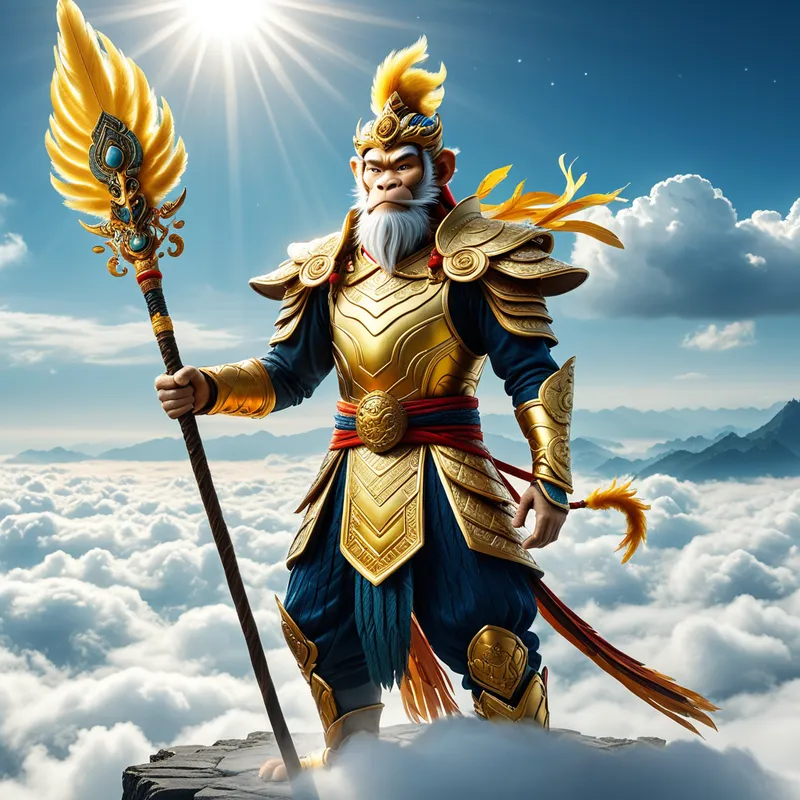
Monkey King Myth Meaning & Symbolism
A celestial monkey rebels against heaven, is imprisoned, and finds redemption through a sacred journey, embodying the struggle for freedom and self-mastery.
The Tale of Monkey King
Listen, and hear the tale of the stone that dreamed.
From a chaos egg of heaven and earth, a stone was born on the Huaguo Shan. Nurtured by the wind, it cracked open, and from it sprang a creature of luminous eyes and restless limbs—a stone monkey. He became king, ruling his tribe with joy, yet a cold dread settled in his heart: the dread of death. So, he left his mountain, sailing on a crude raft across endless seas, seeking the way of immortality.
For years he searched, until he found the cave of the immortal Patriarch Subhuti. There, he learned the arts of transformation: the Seventy-Two Changes, and the cloud somersault that could traverse one hundred and eight thousand li in a single leap. He named himself Sun Wukong. But his pride was his flaw. He showed off his powers, was cast out, and returned to his mountain a demigod.
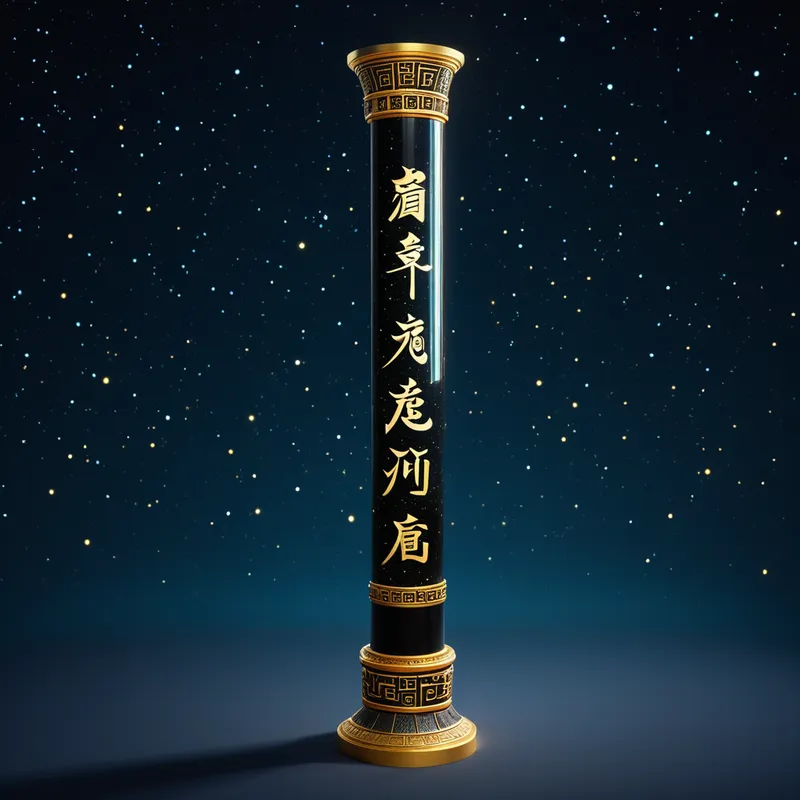
He needed a weapon. He plunged into the oceans, to the palace of the Dragon King Ao Guang. There, he found it: an iron pillar that anchored the seas. It obeyed his thought, shrinking to the size of a needle or expanding to pierce the heavens. This was the Ruyi Jingu Bang. Armed and arrogant, he scrubbed his name from the ledgers of death in the underworld. Heaven trembled.
To placate him, the Jade Emperor gave him a title: Bimawen. When Monkey discovered the deception, his rage was a celestial fire. He declared himself Qitian Dasheng and warred against the heavens. He fought the heavenly army, bested the Prince Nezha, and ate the Peaches of Immortality. No god could subdue him.
Finally, the Buddha himself was summoned. Buddha laid a wager: if Monkey could leap from his palm, Heaven would be his. Monkey somersaulted across the cosmos, reaching pillars he thought were the edge of creation. He marked them as proof. But they were but the fingers of the Buddha’s hand. He had never left. For his hubris, Buddha’s palm became a mountain of five elements, pressing down upon him for five hundred years.
Centuries later, a sound broke his prison: the footsteps of the monk Tang Sanzang. To atone, Monkey was freed to protect this pious man on a journey west to fetch sacred scriptures. A golden circlet was placed upon his head, a gift from Guanyin; when the monk chanted a sutra, it tightened, a pain to tame the wild mind. Through eighty-one trials—demons of greed, illusions of desire, swamps of doubt—the rebel learned duty. The trickster learned compassion. The stone that dreamed finally awoke. At journey’s end, having conquered the demons without and within, Sun Wukong was crowned a Buddha: the Douzhan Shengfo.
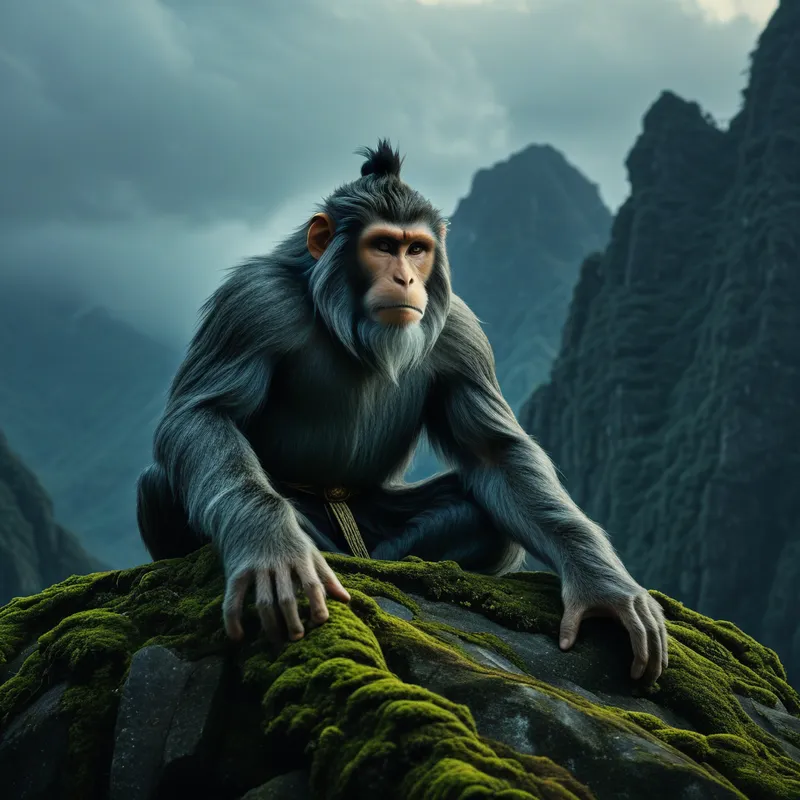
Cultural Origins & Context
The epic of the Monkey King is the vibrant heart of the 16th-century novel Journey to the West, attributed to Wu Cheng’en. It did not spring from a void but is a grand synthesis. It weaves together ancient Chinese folklore of monkey spirits, centuries of popular oral storytelling about the historical monk Xuanzang’s perilous 7th-century pilgrimage to India, and profound layers of Taoist alchemy and Buddhist doctrine.
Told in tea houses, performed in operas, and later broadcast through television and film, the story functioned on multiple levels. For the masses, it was a thrilling adventure of a beloved, cunning underdog challenging a rigid celestial order. For the literati and monastic communities, it was an allegorical manual. The journey west was an internal pilgrimage; the demons were manifestations of personal vice; the scriptures were enlightenment itself. Monkey’s arc from chaos to discipline mirrored the ideal path of harnessing one’s primal energy (qi) toward spiritual realization, a core aim in both Taoist and Chan (Zen) practice.
Symbolic Architecture
Sun Wukong is the ultimate symbol of the unintegrated shadow and the raw, creative life force. He is id, ego, and spirit in their most untamed form.
The stone birth signifies consciousness emerging from the unconscious, the prima materia of the soul. He is the initial, brilliant, but chaotic spark of self-awareness.
His powers are metaphors for psychic potential. The Seventy-Two Changes represent the adaptability of the ego and the persona’s ability to navigate the world. The cloud somersault is the boundless, often reckless, speed of thought and ambition. The Ruyi Jingu Bang, which obeys his will and changes size, is the quintessential symbol of the empowered will itself—a tool that can be a delicate instrument of focus or a weapon of massive destruction.
His rebellion is not mere anarchy, but the necessary, painful rupture of the individual spirit against the collective, conformist “Heaven” of societal expectations, familial duties, and internalized rules. The mountain prison is the inevitable consequence: the crushing weight of depression, stagnation, or enforced containment that follows a period of unchecked inflation.
The golden fillet is the law of consequence, the binding agreement with reality and the higher Self (the monk). True discipline is not external suppression, but the internalization of a guiding principle that transforms chaos into directed power.
The Dreamer's Resonance
When the Monkey King pattern stirs in the modern unconscious, it often manifests in dreams of exhilarating, chaotic freedom followed by sudden constraint. You may dream of flying effortlessly between skyscrapers, only to be snared by invisible wires. You may be a brilliant trickster in a boardroom, outwitting everyone, then find the doors locked, the walls closing in.
Somatically, this can feel like a restless, buzzing energy in the limbs—a need to move, to break out, coupled with a tension headache, a literal “tightening ring” around the skull. Psychologically, you are likely in a potent but precarious phase of asserting your individuality. The Monkey King dream is a signal from the psyche: your raw talent, ambition, and rebellious spirit are active, but they lack integration. You are at the precipice where unchecked potential risks creating its own prison through overreach, burnout, or social alienation. The dream is the psyche’s dramatic enactment of the conflict between the desire for absolute autonomy and the need for a meaningful container.

Alchemical Translation
The myth models the complete individuation process. Monkey begins in a state of unconscious unity with nature (the stone, the mountain). His first awakening is into ego-consciousness, but it is a monstrous, inflated ego—the “Great Sage Equal to Heaven.” This inflation must be crucified under the mountain of reality, a long, dark night of the soul where the ego is humbled.
The journey with the monk is the alchemical opus. The monk represents the emerging Self, the higher guiding principle that is not the ego. The eighty-one calamities are the necessary trials that temper the spirit. Each demon conquered is a complex integrated: greed, wrath, deception, lust for power.
The final transmutation is not the destruction of the Monkey, but his enlightenment. The victorious rebel does not cease to be; he becomes conscious. His boundless energy is no longer spent fighting heaven, but is placed in service to a purpose beyond himself.
For the modern individual, the alchemy is clear. We must first acknowledge and own our inner Monkey—our rebelliousness, our cleverness, our desire for recognition and immortality. We must let it have its early triumphs and learn from its inevitable “mountain” failures—the failed projects, the broken relationships, the periods of depression that follow grandiosity. Then, we must find our “monk,” our guiding principle (be it a calling, a relationship, a creative work, or a spiritual practice) that provides a direction for our power. We accept the “golden fillet” of commitment, discipline, and consequence. Through this devoted journey, the chaotic, brilliant stone of our potential is gradually polished into the luminous, conscious Buddha-nature, where the rebel finally finds his true kingdom.
Associated Symbols
Explore related symbols from the CaleaDream lexicon: