Monastic Herbalists Myth Meaning & Symbolism
A myth of monks who tended a secret garden, learning the language of plants to heal bodies and souls, guarding wisdom between prayer and wilderness.
The Tale of Monastic Herbalists
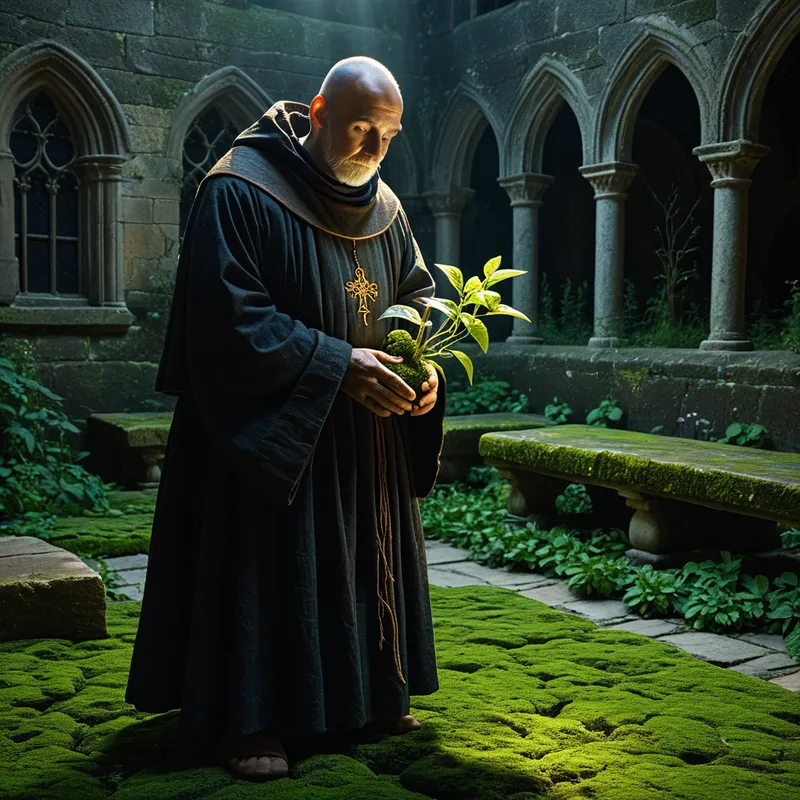
Listen, and hear a tale not of knights and dragons, but of silence and soil. In the heart of the Dark Ages, when the world was forest and fear, islands of stone rose from the mist: the monasteries. Within their high walls, a different kind of warrior took up arms. His battlefield was the physic garden, his sword a trowel, his scripture the veined leaf and the knotted root.
These were the herbalists. By day, they chanted the hours, their voices weaving through cold stone. But in the hours between Lauds and None, they walked the cloister garth, now transformed. Here, rosemary stood sentinel for memory, sage for wisdom, and foxglove—a deadly beauty—waited with its secret power to steady the frantic heart. They learned from crumbling codices and from the whispered lore of the local folk who came to their gates, bearing sickness and old stories.
The great conflict was not against a beast, but against the Ignorantia—the great forgetting. It was the shadow that said the body was a prison to be despised, that the earth was mere dross. The herbalist’s struggle was to hold a terrifying, beautiful truth: that the divine spoke through the hum of a bee on lavender, through the fever-breaking sweat induced by willow bark, through the poison that in precise measure became a cure. His rising action was the slow, patient dialogue with life itself. He would sit for hours, observing how the mandrake favored shade, how the woundwort closed flesh as if stitching with green thread.
The resolution came not with a roar, but with a quiet sigh in a dim infirmary. It was the moment the herbalist, after nights of prayer and study, compounded a balm that cooled a burning brow, or a tincture that brought a dying man back from the threshold. In that moment, the wall between spirit and matter, between chapel and garden, dissolved. The healing was the prayer. The plant was the word made flesh. They became the keepers of the green thread that stitched heaven to earth, soul to body, and the lonely human back into the living, breathing body of the world.
Cultural Origins & Context
This is not a single myth with named gods, but a pervasive cultural narrative born from the very fabric of early medieval European life. It emerged in the 6th to 12th centuries, in Benedictine, Cistercian, and later Franciscan monasteries. These were the era’s databases, hospitals, and universities. The narrative was passed down not by bards, but through practice: in the herbal, the infirmary ledger, the oral teachings from master to novice in the garden.
Its societal function was multifaceted. It justified the monastic accumulation of practical, "pagan" natural knowledge within a Christian framework, framing it as natural theology. It provided a model for the ideal healer—one bound by oath, humility, and devotion. For the common folk, the monastic herbalist was a liminal figure, a bridge between the authoritative faith of the Church and the ancient, earth-bound magic of the hedgerow. He sanctified local wisdom by transcribing it onto vellum, and disseminated learned medicine by applying it at the village gate.
Symbolic Architecture
At its core, the myth symbolizes the cultivation of the interior garden. The walled cloister is the bounded psyche, protected from the chaotic wilderness of the unconscious and the world's brutalities. Within this sanctuary, the work of discernment—separating healing wheat from poisonous tares—begins.
The herbalist’s true labor is not upon the earth, but upon the nature within. Each plant is a complex of the soul: a memory, a trauma, a potential, a poison awaiting its correct application.
The Panacea they seek is not just a physical cure-all, but the integration of opposites: spirit and matter, faith and reason, wild nature and human order. The mandrake, with its humanoid form and deadly scream, represents the primordial, instinctual self that must be respectfully uprooted and integrated with great care. The garden itself is a living mandala, a map of the cosmos and the soul, where every element has its place and purpose.
The Dreamer's Resonance
To dream of the monastic herbalist is to dream of a calling to inner healing and sacred knowledge. The dreamer may find themselves in a walled garden, often overgrown or in need of tending, symbolizing neglected aspects of the psyche or untapped wisdom. The somatic feeling is often one of focused, quiet urgency—a "green ache" to understand, to sort, to heal.
This dream pattern emerges when the conscious mind is ready to engage with its own materia medica: the raw, often chaotic emotional and psychological material that holds the key to healing. The figure of the herbalist is the emerging Senex or inner guide, who does not fight monsters but listens to symptoms. The dream signals a process of moving from being afflicted by one's inner life to becoming a curator of it. The act of pruning, planting, or compounding in the dream points to a need for discernment and intentional combination of life experiences.
Alchemical Translation
The myth models the alchemical process of individuation perfectly. The initial state is nigredo: the "Dark Ages" of the psyche, a state of suffering, confusion, or one-sided spirituality that denies the body and the earth.
The monastery is the vas or alchemical vessel—the disciplined container of meditation, introspection, and study. Here, the prima materia (the base matter of the soul) is the wild, uncategorized flux of experience and instinct, symbolized by the untamed forest. The herbalist's work is the separatio and coniunctio: carefully identifying different psychological complexes (the plants), understanding their properties (through prayer/reflection and experience/experiment), and then combining them into a healing aurum non vulgi—the "gold not of the crowd," which is a unique, integrated self.
The ultimate transmutation is the realization that the healer and the healed, the knower and the known, are one. The garden is not outside the monk; the monk has become the living garden.
For the modern individual, this translates to creating a disciplined inner sanctuary—through journaling, therapy, art, or ritual—where the wild elements of one's personality and history can be patiently examined, honored, and integrated. It is the move from seeking salvation from the world to finding wholeness through a conscious, healing relationship with all that one is and has been. The goal is not sainthood, but sovereignty: becoming the wise keeper of your own soul's intricate, flourishing plot.
Associated Symbols
Explore related symbols from the CaleaDream lexicon: