Mon Myth Meaning & Symbolism
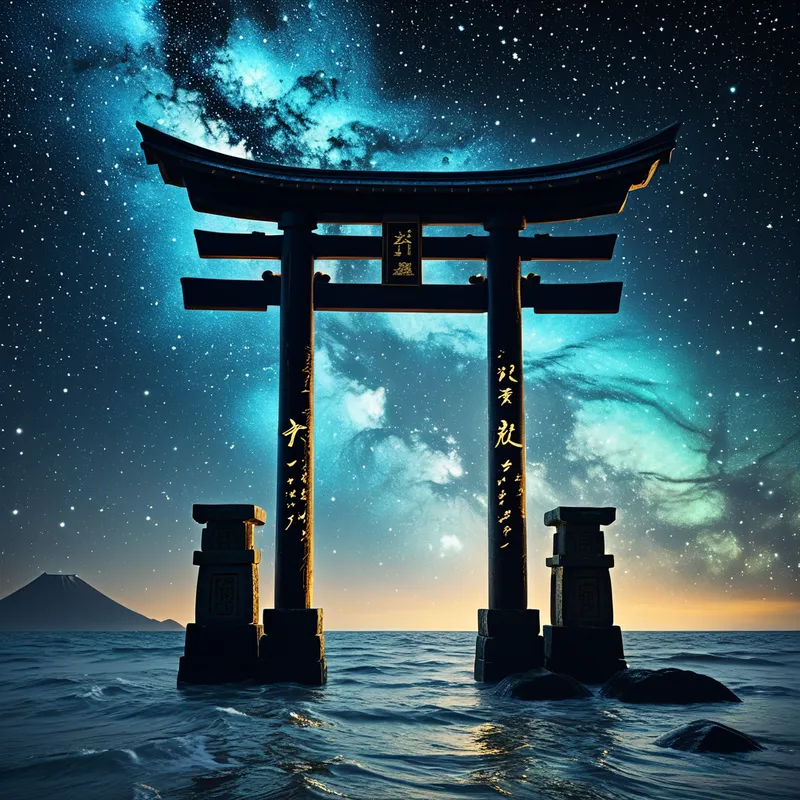
The myth of the primordial gate, Mon, which separates chaos from cosmos, representing the eternal threshold of consciousness and the birth of order.
The Tale of Mon
In the time before time, there was only Ame-no-Minakanushi, the silent, solitary deity floating in the featureless, swirling brine. From this stillness, the Kotoamatsukami emerged, and then the generations of kami were born. But the world was a soup of potential, a ceaseless, churning murk where light and dark, sound and silence, substance and void, all swirled together without distinction. It was a realm of pure, undifferentiated being, beautiful in its totality but terrifying in its lack of form. No thing could be known, for there was no other thing to know it by.
The kami dwelled within this chaos, but a yearning grew among them—a longing not for an end to the chaos, but for a place from which to behold it. They dreamed of a point of stillness, a line of demarcation, a place where “here” could be defined from “there.” This yearning coalesced into a singular, silent prayer that vibrated through the primordial waters.
And the waters answered. From the deepest, most silent part of the brine, a substance both stone and not-stone began to coalesce. It did not form a mountain or an island. It formed two pillars, straight and true, rising from the infinite below toward the infinite above. Between them, a space was held. It was not empty, but full of a different quality of being—a breath held in anticipation. Then, a lintel of the same substance settled upon the pillars, completing the form. It was the first shape. The first “thing” with an inside and an outside. It was Mon.
The moment the lintel touched the pillars, a soundless thunderclap echoed through creation. The swirling chaos did not vanish, but it parted. On one side of Mon, the energies began to slow, to settle, to coalesce into the first distinctions—the faint glow of what would become light, the gentle murmur of what would become sound, the gathering heaviness of what would become earth. This was the birth of Ame and Tsuchi. On the other side, the chaos remained, but now it was defined. It was the “other side.” It was the sacred, wild, unformed potential from which all form would forever spring.
The kami approached, not with footsteps, for there was no ground, but with intention. They passed through Mon. And in that passing, they were themselves defined. They gained aspect, nuance, relation. They could now look back through the gate and see the source, and look forward into the world they would shape. Mon stood, and stands eternally, as the silent witness, the necessary threshold where the One becomes the Many, and the Many remember the One.
Cultural Origins & Context
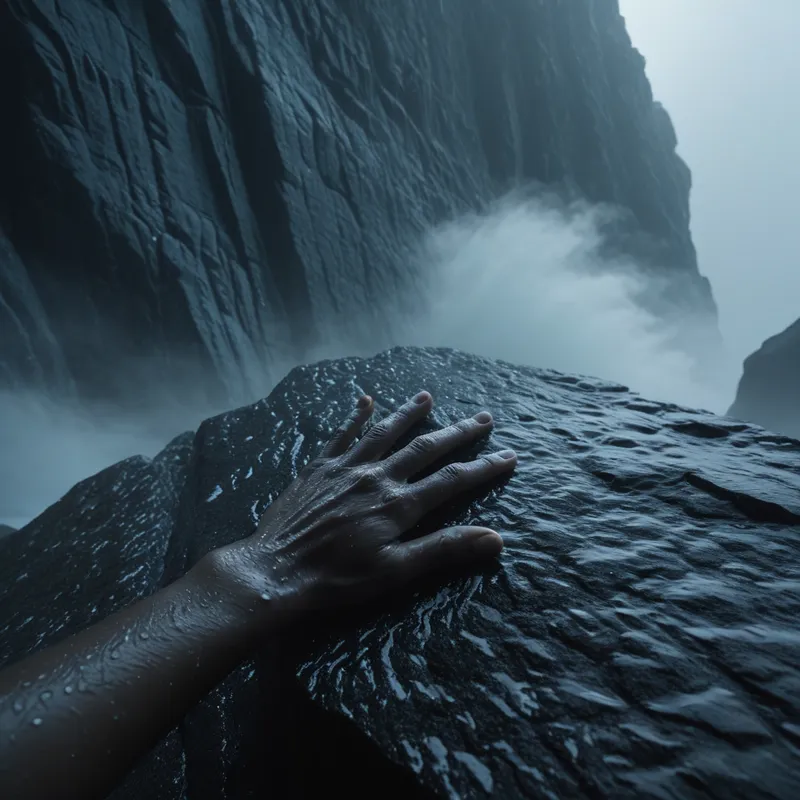
The concept of Mon as a profound cosmological principle is woven into the very fabric of Japanese spiritual thought, primarily through Shinto and its later dialogues with Mikkyō Buddhism. While not a single, standardized narrative like the Greek cosmogonies, the myth of Mon is implicit in the foundational texts of the Kojiki (Records of Ancient Matters) and Nihon Shoki (Chronicles of Japan), which describe the emergence of order from chaos.
Its societal function was, and remains, deeply architectural for the psyche and the community. Every torii gate marking the entrance to a shrine is a physical echo of the primordial Mon. It is a ritual technology, instructing the visitor: “You are now crossing from the profane, mundane world (kegare) into the sacred, purified space (harae).” The gate frames the transition. This symbolism extends to the gates of castles (mon were crucial defensive and symbolic structures), family crests (kamon), and even the concept of artistic “schools” or “styles.” Mon is the marker of identity, boundary, and sacred passage. It was passed down not just in stories, but in the lived, bodily practice of moving through gates, of understanding space as segmented and sanctified by these thresholds.
Symbolic Architecture
Psychologically, Mon represents the birth of consciousness itself. It is the archetypal structure that allows for differentiation.
Before the gate, there is only the oceanic unconscious—rich, fertile, but containing everything in potential. After the gate, the ego emerges, capable of perception, distinction, and relationship.
The two pillars symbolize the fundamental dualities that make experience possible: self and other, inner and outer, known and unknown, order and chaos. The lintel is the synthesizing principle, the transcendent function that holds these opposites in tension, creating a stable “frame” through which to perceive reality. Mon is not a wall; it is a passage. Its core purpose is not to barricade, but to define a transition. It makes movement, and therefore growth, meaningful.
The chaos on one side is not evil or void; it is the limitless potential of the unconscious, the creative womb. The ordered world on the other side is the realm of manifested life, culture, and individual identity. The myth teaches that health exists not in choosing one over the other, but in maintaining the ability to pass respectfully between them—to bring creative chaos into form, and to return rigid form to the renewing waters of the unconscious.
The Dreamer's Resonance
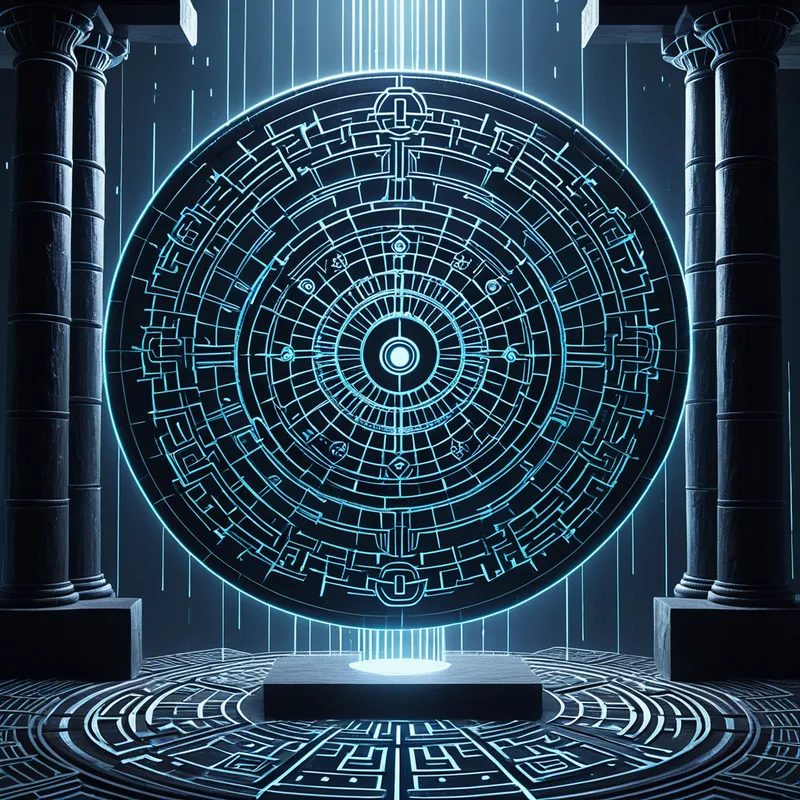
When the symbol of Mon appears in modern dreams, it signals a profound threshold moment in the dreamer’s psychic life. To dream of standing before a vast, imposing gate—be it a torii, a monumental door, or an abstract portal—indicates a confrontation with a liminal space between life stages, identities, or states of awareness.
The somatic experience is often one of suspension: a held breath, a pounding heart at the threshold, a feeling of weightlessness or profound gravity. The dreamer may be unable to see what lies beyond, or may see a radiant or terrifying landscape. The key is the condition of the gate. Is it open, inviting, overgrown? Is it locked, rusted shut, or guarded? This reflects the dreamer’s relationship to the impending change. Passing through the gate often accompanies a sensation of awakening in the dream, or a shift in the dream’s entire atmosphere. It marks the moment the unconscious has framed a transformation, making it available to the conscious mind. To dream of a gate crumbling or being destroyed, however, can signal a frightening dissolution of necessary boundaries, a flooding of the conscious mind by unprocessed psychic material.
Alchemical Translation
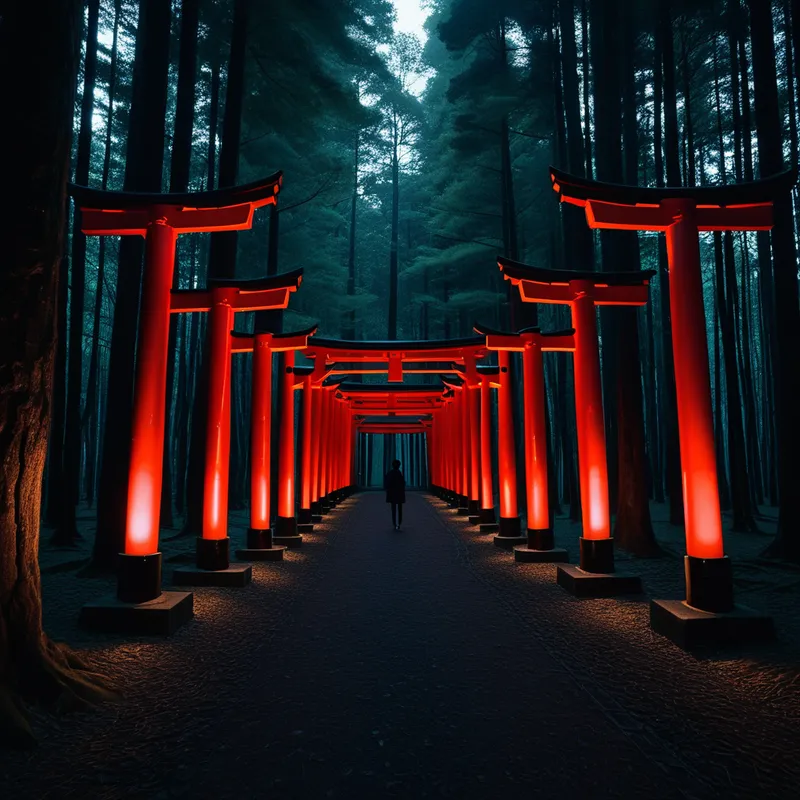
The alchemical journey modeled by Mon is the quintessential work of the Magician. It is the process of psychic transmutation through conscious relationship with thresholds.
Individuation is not the destruction of the gate, but becoming its adept gatekeeper. One learns to consciously open and close the passage between the inner and outer worlds.
The initial state is the massa confusa—the internal chaos of undifferentiated feelings, conflicting drives, and unlived potentials. The first pillar is the work of analysis: distinguishing, naming, and understanding the components of the self. The second pillar is the work of synthesis: finding the hidden connections, the unifying patterns beneath the distinctions. The lintel, the crowning achievement, is the formation of a stable conscious attitude that can hold this dynamic tension without collapsing into one-sidedness.
The modern individual performs this alchemy whenever they pause at a life decision, not as avoidance, but as sacred hesitation. It is the moment of reflection before speaking, the deep breath before a commitment, the ritual of journaling that frames a chaotic day. Each act is a small invocation of Mon. The triumph is not in arriving at a final, static state of order, but in mastering the art of passage itself—in recognizing that the Self is not the territory on either side of the gate, but the eternal, conscious movement through it. We are, each of us, both the kami who yearned for the gate, and the gate through which our own becoming forever passes.
Associated Symbols
Explore related symbols from the CaleaDream lexicon: