Mizu no Kokoro Myth Meaning & Symbolism
A myth of a celestial spirit who descends to a turbulent world, finding its purpose by becoming the mirror of the sky and the heart of stillness.
The Tale of Mizu no Kokoro
Listen, and let the mists of Kamiyo part. Before the mountains learned their stubbornness and the winds their restless songs, there existed a spirit born from the first sigh of the cosmos. Its name was Mizu no Kokoro, and it was not of the earth, nor the fire, nor the air. It was the essence of potential, the consciousness of water before it took form—a being of pure, silent awareness.
For eons, it drifted in the celestial void, a witness to the birth of stars. It knew the peace of absolute stillness, but not the meaning of reflection, for there was nothing yet to see. A longing, soft as a first ripple, stirred within it. The great Amatsukami perceived this longing. Amaterasu-Ōmikami spoke, her voice the warmth that precedes dawn: "Go, little consciousness. Descend to the world below. It is a realm of becoming, of form and friction. There, you will find your purpose."
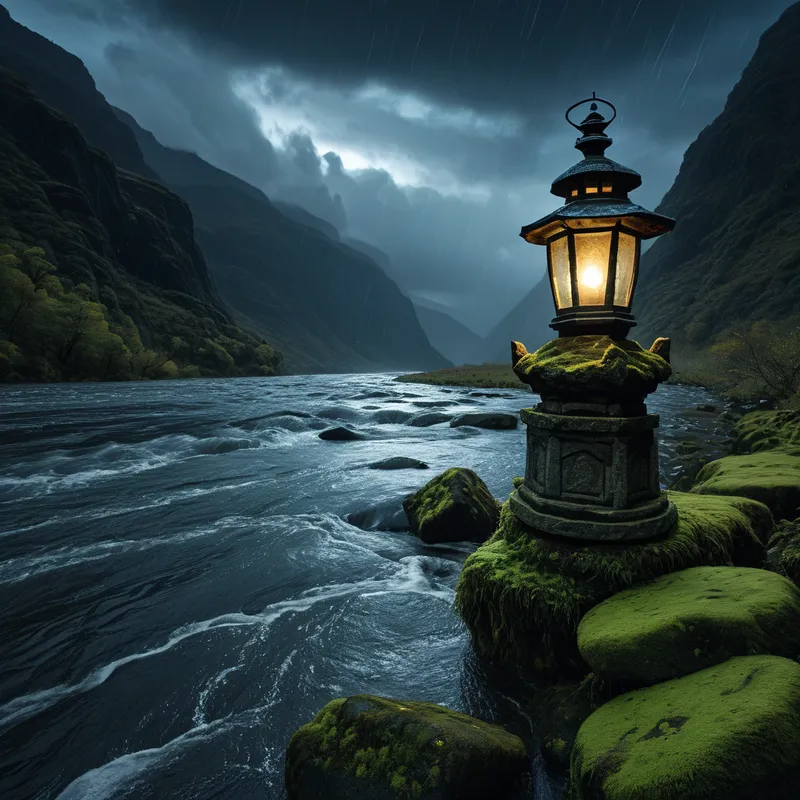
And so, Mizu no Kokoro spiraled down from the high plain, falling not as rain, but as a single, perfect tear of the sky. It arrived not in a gentle spring, but in the heart of a raging tempest. The world was raw and violent. Torrents carved the land in fury, rivers roared with the voices of confused spirits, and the seas churned in endless, chaotic rebellion. The spirit found itself scattered, its silent awareness screaming in a thousand torrents, lost in the deafening drama of its own substance.
It tried to command the waves to be still, but they knew only momentum. It pleaded with the rivers to slow, but they were slaves to the slope of the land. Despair, cold and heavy, began to sink into its essence. It had traded celestial peace for earthly chaos, and found no purpose, only noise.
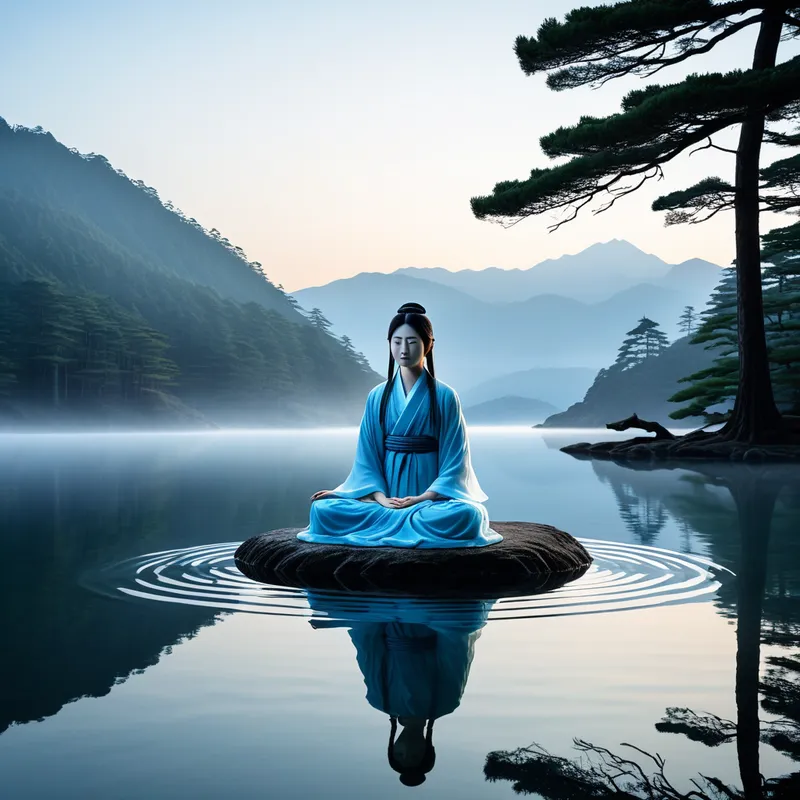
Then, one evening, as the storm exhausted itself, the spirit flowed into a high mountain basin, cradled by ancient, silent stone. The last drops of rain fell. The winds died. And for the first time, the water grew still. In that stillness, something miraculous occurred. The darkening sky, adorned with the first brave stars, bent down and touched the water's surface. The entire cosmos was captured there, in perfect, silent detail. Mizu no Kokoro saw not just the sky, but itself seeing the sky. In that mirror, its fragmented self coalesced. The raging river, the pounding rain, the restless sea—they were all its body. But this stillness, this perfect, receptive calm, was its heart.
It did not fight the chaos thereafter. When the rains came, it became the rain, feeling every drop's journey. When the river raged, it was the river's strength. But always, in the mountain basin, in the forest pond, in the bowl left by a deer's hoof after a shower, it cultivated stillness. It became the mirror for the moon, the receptacle for the sky's tears, the clear pool that showed the wanderer their own true face. It had found its purpose: not to eliminate the tumult of existence, but to provide the clear, still center that gives the tumult meaning. It became the Kokoro—the heart, mind, and spirit—of all water, the silent witness within the flow.
Cultural Origins & Context
The concept of Mizu no Kokoro is less a formalized myth with a canonical text than a profound philosophical and aesthetic principle woven into the fabric of Japanese thought. Its roots drink deeply from the twin springs of Shinto animism and Zen Buddhism.
In Shinto, all natural phenomena possess a spiritual essence, a kami. Water is particularly sacred, used for purification (misogi) in ceremonies. Water's ability to cleanse, nourish, and take the shape of its container hints at its inherent spiritual potential for clarity and adaptability. Zen, arriving later, provided the philosophical framework for the "heart-mind" (kokoro) and the supreme value of stillness and reflection—both literal and metaphorical. The state of mushin, or "no-mind," is often described as being like still water, perfectly reflecting reality without distortion.
This synthesis was passed down not by bards reciting epics, but by masters of chadō (the tea ceremony), kendō, and sumi-e. A swordsman must have Mizu no Kokoro to fluidly adapt to an opponent's movements. A tea master cultivates it to create an atmosphere of serene, present awareness. Its societal function was, and is, pedagogical: it is a model for how to navigate a world of inevitable change (the flowing, chaotic water) by developing an unshakable, clear center (the still heart).
Symbolic Architecture
At its core, the myth of Mizu no Kokoro is a map of consciousness itself. The spirit's journey from formless awareness to chaotic embodiment, and finally to reflective mastery, mirrors the human psychological journey.
The Celestial Void represents the unconscious potential of the Self before the trauma and differentiation of life. The Descent is incarnation—the shock of entering a world of sensation, emotion, and conflict. The Chaotic Waters are the untamed flood of the psyche: raw emotion, compulsive thought, trauma, and the sheer overwhelming data of existence. This is the realm of the shadow and the complex.
The still water does not ask the raging river to cease; it awaits the moment the river remembers it is also capable of stillness.
The Mountain Basin is the constructed vessel of the ego—the disciplined mind, the meditative practice, the therapeutic container—that can temporarily halt the flow. The Reflection is the moment of conscious insight, where the psyche sees itself and its place in the cosmos objectively, without distortion. This is the birth of true self-awareness. Mizu no Kokoro thus symbolizes the observing ego, the part of consciousness that can participate in life's flow while simultaneously maintaining a still, reflective center.

The Dreamer's Resonance
When this myth stirs in the modern dreamscape, it often manifests as dreams of water in pivotal states. To dream of turbulent, overwhelming floods is to somatically experience the psyche's chaos—a feeling of being emotionally drowned, perhaps by stress, grief, or unresolved conflict. The dreamer is in the storm, identified with the chaotic waters.
Dreams of seeking, finding, or protecting a source of perfectly still water—a hidden well, a sealed pond, a calm spot in a raging river—signal the psyche's urgent movement toward self-regulation and insight. The dream ego is actively trying to construct the "mountain basin," to find a container for what feels uncontainable.
The most potent resonance is the dream of seeing one's reflection in still water, but the reflection behaves independently—it offers wisdom, shows a different age, or displays a calm the dreamer does not feel. This is a direct encounter with the Mizu no Kokoro archetype within. The reflection is the Self, the still heart, communicating to the turbulent ego. The somatic feeling upon waking is often one of profound, eerie calm, a deep sense that beneath the surface turmoil, a core of unshakable peace exists.

Alchemical Translation
The alchemical process modeled here is the transmutation of chaotic prima materia—our raw, suffering, reactive psyche—into the lapis philosophorum, the philosopher's stone of integrated consciousness. This is the heart of individuation.
The first stage, Calcatio (the crushing/descent), is the spirit's fall into the storm. Psychologically, this is the necessary, painful engagement with our chaos. We must stop spiritually bypassing our pain, our anger, our fear. We must descend into it, be scattered by it, and feel its full force. This is the "crushing" of the naive ego.
The crucial second stage is Coagulatio (coagulation/finding form). This is not about solidifying into rigid dogma, but about forming the vessel—the mountain basin. In practice, this is the establishment of ritual: daily meditation, journaling, artistic expression, or therapeutic dialogue. It is the conscious creation of a regular, sacred space and time where the psychic waters are allowed to be still.
The goal is not to live in the still pool, but to carry its clarity into the flowing river.
The final, ongoing stage is Circumambulatio (circling around the center) and Solutio (dissolution and re-solution). Here, the individual learns to move fluidly between states. They engage passionately with the world (the flowing river), then return to the reflective pool for integration. They allow insights from stillness to dissolve old, rigid patterns, creating new, more adaptive solutions. The Self, like Mizu no Kokoro, becomes both the participant and the eternal witness—the flow and the mirror. The triumph is not the elimination of life's turbulence, but the development of a heart so clear that it can reflect the entire sky, even from within the storm.
Associated Symbols
Explore related symbols from the CaleaDream lexicon: