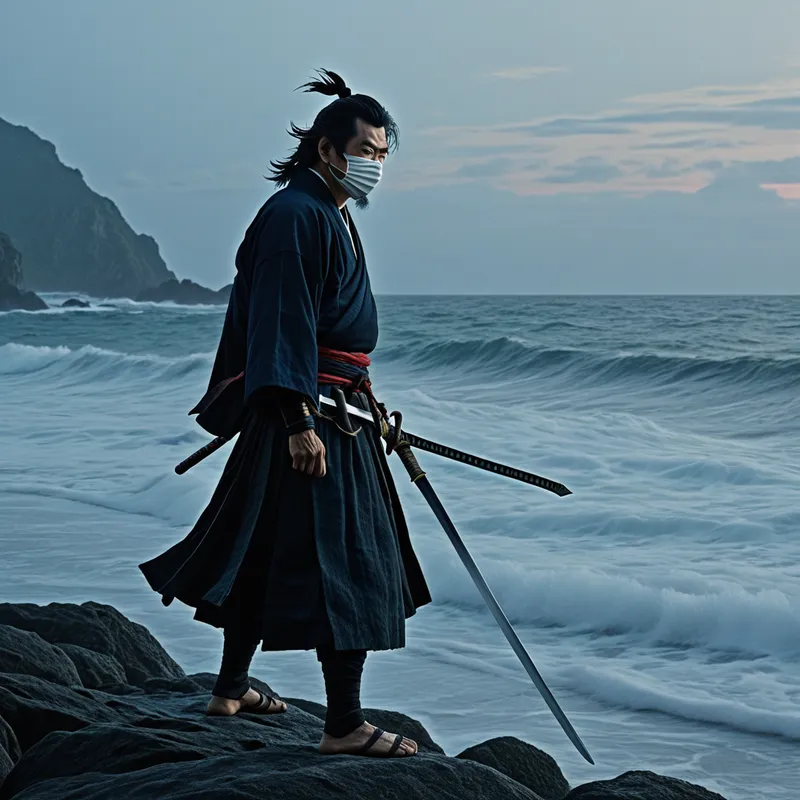
Miyamoto Musashi Myth Meaning & Symbolism
The tale of a wandering swordsman who masters the sword to transcend it, forging a path from brutal survival to enlightened artistry and ultimate peace.
The Tale of Miyamoto Musashi
Listen, and hear the tale that is not merely a story of a man, but the journey of a spirit through fire and void.
In the twilight of an age of war, when the land of Sengoku bled from a thousand cuts, a boy was born to the sword. His name was Shinmen Takezo, a wild thing of the mountains, all rage and instinct. Orphaned by strife, he became a creature of the borderlands—neither fully of the village nor fully of the wilderness. His first kill came young, a taste of iron and finality that set him on a path with no map save the one written in blood.
He renamed himself Miyamoto Musashi, and the road became his home. He was a storm given human form, a ronin with no master but his own relentless will. He walked the dusty paths and mountain passes, a solitary figure with two long swords at his hip—the katana and the wakizashi—a heresy to the single-sword style, a living embodiment of duality. He sought out masters, not for teaching, but for testing. Over sixty duels, they say, from frenzied brawls in temple yards to solemn meetings at dawn. Each victory was a stone laid on the path, but each left the taste of ashes. He fought not just men, but schools of thought, the very concept of style itself. He was the unbounded stream against the carved canal.
Then came the summons to Ganryujima. Sasaki Kojiro, the "Demon of the Western Provinces," wielder of the monstrously long Monohoshi Zao, awaited him. The sea churned grey around the tiny island. Kojiro stood in perfect, elegant form, his blade a sliver of focused death. Musashi arrived late, paddling in a crude boat, having carved his sword from an oar. He had moved beyond steel. In that moment, with the sun poised on the water's edge, two worlds clashed: Kojiro's perfected, singular technique against Musashi's adaptive, empty mind. The fight was the space between two heartbeats. Musashi struck, and Kojiro fell. The victory was absolute, yet it was here, at the peak of his martial fame, that the true turn began.
The storm within him began to still. He laid down the sword of conflict and took up the brush, the chisel, the pen. He built a tea house, designed a garden, painted in swift, sure strokes—crows on a bare branch, a shrike on a reed. He wrote Go Rin No Sho, not as a manual of killing, but as a treatise on the Way. In a cave named Reigandō, he faced his final and greatest opponent: his own nature. The wild boy Takezo, the invincible duelist Musashi, was forged in that final solitude into something else entirely—a sage. He died not on a blade, but sitting upright in meditation, having returned the duality of self and other, life and death, to the great, singular void from which it came.

Cultural Origins & Context
The figure of Miyamoto Musashi occupies a unique space, straddling the hard ground of history and the elevated plains of legend. He was a historical person, born in the late 16th century, whose life coincided with Japan's tumultuous transition from the warring states period to the relative peace of the Edo period. This context is crucial. Musashi's early life was that of a ronin from the dying age of battlefield chaos, while his later years were spent in a society seeking order, philosophy, and artistic cultivation.
His myth was not born in ancient temples but was crafted from his own writings, particularly Go Rin No Sho, and from the oral traditions and kōdan (storytelling) of the Edo period. These storytellers took the skeleton of his duels and clothed it in dramatic detail, transforming a brilliant, difficult man into a kensei (sword-saint). His legend served a societal function: he became the archetypal self-made man, a symbol of ultimate practical mastery (jutsu) evolving into a spiritual path (dō). In a peaceful society where the samurai's martial role was bureaucratized, Musashi's myth preserved the ideal of disciplined, inward-focused strength and the integration of warrior values with artistic and philosophical depth. He modeled a way to carry the sword's spirit into an era of peace.
Symbolic Architecture
At its core, the myth of Musashi is a profound allegory for the conquest and integration of duality, leading to a state of transcendent wholeness.
His signature two-sword style, Niten Ichi-ryū, is the primary symbol. It is not merely a fighting technique but a cosmological statement. The two swords represent all fundamental polarities: aggression and receptivity, activity and passivity, self and other, life and death, the conscious and the unconscious mind. Musashi did not choose one over the other; he wielded both, making the interaction between them his "Way."
The master does not fight the shadow, nor become it. He learns its weight, its balance, and makes its darkness a part of his stance.
His entire journey maps the evolution of consciousness. The wild youth Takezo is pure, untamed Id—survival instinct and raw power. The duelist Musashi is the disciplined Ego, testing its boundaries against the world. The artist and sage is the emergent Self, having assimilated the power of the instincts and the discipline of the ego to create and contemplate. His weaponry evolves from steel, to a wooden oar, to a calligraphy brush—each representing a higher level of sublimation. The final writing of his treatise in a cave signifies the ultimate internalization of the journey; the wisdom is mined from the depths of his own being and offered back to the world.

The Dreamer's Resonance
When the pattern of Musashi stirs in the modern dreamscape, it signals a profound interior conflict reaching a critical point of resolution. The dreamer is not simply facing an external challenge, but is engaged in a psychic duel.
To dream of training endlessly with a sword speaks to a period of intense, perhaps obsessive, self-discipline aimed at mastering a skill or aspect of the self. Dreaming of forging a sword indicates the conscious effort to shape one's own will or purpose. The central motif—the duel itself—is the somatic experience of a core inner conflict: perhaps between career and calling, logic and intuition, or a rigid personal code versus a newfound, adaptable truth. The dream may feature a formidable, shadowy opponent who is ultimately revealed to be a reflection of the dreamer's own unintegrated power or fear.
The resolution in the dream is key. A victory fought with rage leaves a residue. A victory achieved through a sudden, almost effortless insight—like Musashi's oar-sword—points toward a transcendent solution emerging from the unconscious. The subsequent dream imagery of putting down the sword to paint or write signifies the psyche's movement from a state of conflict to a state of creation, where the energy once used for internal battle is now available for authentic expression.
Alchemical Translation
The myth of Musashi provides a stark, powerful model for the alchemical process of individuation. His life is the opus—the great work—of transforming base instinct into spiritual gold.
The nigredo, the initial blackening and confrontation with the shadow, is his brutal early life and his countless duels. He consciously engages with his own destructive capacity, personified in his opponents. The albedo, the whitening and purification, begins after his climactic duel with Kojiro. The outer enemy is defeated, allowing the inner work to commence. He withdraws from the world, symbolized by his retreat to Reigandō cave. Here, in solitude, the citrinitas (yellowing) occurs: the illumination of crafting art and philosophy, the light of conscious understanding applied to his experiences.
The sword that cleaves also defines. In mastering the instrument of separation, one glimpses the nature of the whole from which all things are cut.
Finally, the rubedo, the reddening and culmination, is his authorship of Go Rin No Sho and his serene death. This is the stage of wisdom and completion. He has transmuted the raw, leaden experience of violence and survival into the golden wisdom of strategy, art, and peace. He returns his hard-won consciousness to the universe, not as a conqueror, but as a contributor. For the modern individual, this translates to the journey of mastering one's own inner conflicts (the "swords"), not to vanquish a part of oneself, but to integrate those opposing forces. The goal is not to become an invincible fighter, but to become so whole that the need for fighting dissolves, and one's energy is freed for the creation of meaning—whether in art, relationship, or a simple, mindful life. The path is from fragmentation, through disciplined conflict, to serene, creative unity.
Associated Symbols
Explore related symbols from the CaleaDream lexicon: