
Mist of Niflheim Myth Meaning & Symbolism
The primordial mist from which all creation and destruction emerges, a cold void of potential that precedes and follows all life.
The Tale of Mist of Niflheim
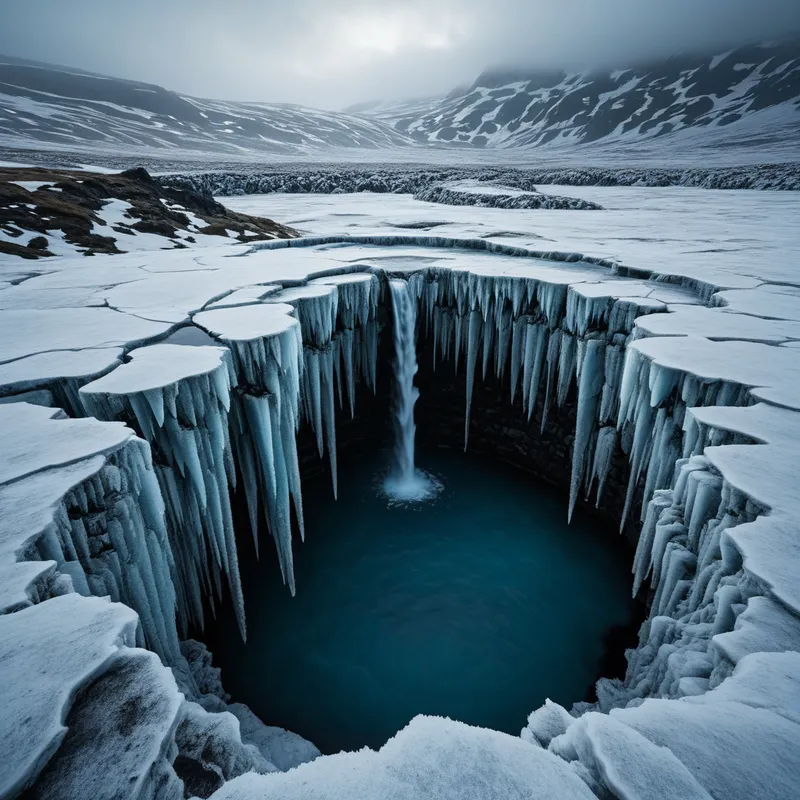
Listen, and feel the cold that is not of winter, but of before winter. Before sun, before soil, before breath. In the time before time, there was only the Ginnungagap, the yawning void, a mouth of silence and potential. And from the uttermost north, a realm stirred into being—not through fire or fury, but through a slow, inevitable exhalation of absence. This was Niflheim, the Home of Mist.
Its essence was not land or water, but a creeping, crystalline fog, a mist so profound it was the very substance of cold itself. It hung in the void, eternal and still, a kingdom of inertia. From its heart, from a well named Hvergelmir, eleven rivers sprang. But these were not rivers of life-giving water; they were rivers of Élivágar, of ice-streams, flowing with the sluggish certainty of glaciers, carrying the essence of primordial frost out into the Ginnungagap. Their flow was not a sound, but a feeling—a deepening chill that settled into the bones of the universe.
To the south, born from a spark in the void, lay the counter-realm: Muspelheim, a land of flame and molten stone, guarded by the fiery giant Surtr. And in the center, the void waited. The rivers of Élivágar crept ever southward, their mist and rime spreading like a silent plague. Where the bitter breath of Niflheim met the radiant heat of Muspelheim, in the very heart of Ginnungagap, a miracle of conflict occurred.
The hoarfrost melted. But it did not simply become water; it became sweat. The dripping rime, touched by the spark of life from the south, quickened. And from that weeping ice, from that union of unmoving cold and restless fire, the first being stirred. This was Ymir, the hermaphroditic frost giant, ancestor of all giants. And as Ymir slept, more life sweat from its limbs: a male and a female giant emerged from its armpit, and one of its legs begat a son with the other. So life, in its most primal, monstrous, and fecund form, was born from the meeting of Mist and Flame.
The mist of Niflheim was the mother-stuff, the raw, cold potential from which the clay of the world was formed. When the gods Óðinn and his brothers slew Ymir, they fashioned the earth from its flesh, the mountains from its bones, the sea from its blood. But Niflheim remained. It was not destroyed, only pushed to the roots of things. It became the foundation, the underworld, the place where the great root of the Yggdrasil stretches into the freezing spring Hvergelmir. It is the realm of Hel, where those who die of sickness and age reside. The mist is always there, at the beginning and at the end, waiting to receive what the fire has spent.
Cultural Origins & Context
The myth of Niflheim is preserved primarily in two 13th-century Icelandic texts, the Prose Edda of Snorri Sturluson and the earlier, poetic fragments of the Poetic Edda. Snorri, a Christian scholar writing centuries after the Norse conversion, systematized these myths, but the core imagery—the primordial ice, the dripping rime giving birth to a giant—feels ancient, a product of a world intimately acquainted with the creative and destructive power of cold.
This was not a story told for mere entertainment around the fire; it was a cosmological anchor. For a people living in a landscape sculpted by ice, where winter was a dominant, personified force, Niflheim provided an origin for that ever-present reality. The myth functioned to explain not only where the world came from, but also the fundamental nature of existence as a tense, dynamic balance between opposing forces: fire and ice, action and inertia, life and entropy. It placed their lived experience of harsh winters and fleeting summers into a grand, dramatic, divine narrative. The mist was the “before,” the formless potential that both precedes creation and awaits at dissolution’s end, a concept that gave a profound, if chilling, order to the cosmos.
Symbolic Architecture
Niflheim’s mist is the ultimate symbol of the prima materia—the primal, undifferentiated substance of the universe and the psyche. It is not evil, but prior to the categories of good and evil. It is pure potential, cold, silent, and inert. It represents the unconscious in its most fundamental state: not the personal unconscious of repressed memories, but the collective, impersonal ground of being, the psychic substrate from which all forms—thoughts, images, instincts—eventually crystallize.
The mist is the blank page, the silent mind before the first thought, the fertile void that must be penetrated by the spark of consciousness to bring anything into being.
The rivers of Élivágar symbolize the first movements within this stillness, the initial currents of latent energy or instinct flowing out from the core. Their meeting with Muspelheim’s fire is the archetypal moment of conjunctio oppositorum—the union of opposites. This is not a peaceful merging, but a dynamic, creative conflict. Life, in the form of Ymir, is born from this tension. Psychologically, this mirrors how consciousness (fire, light, differentiation) emerges from and constantly engages with the unconscious (mist, darkness, unity). All creative acts, all new psychic structures, are born from such an encounter.
Furthermore, Niflheim’s role as the location of Hel reveals its function as the realm of dissolution. What rises must eventually settle; what is formed must return to formlessness. The mist represents the necessary return to the source, the psychic entropy that balances growth, the cold truth that all individual forms are temporary condensations of a more eternal, amorphous whole.
The Dreamer’s Resonance
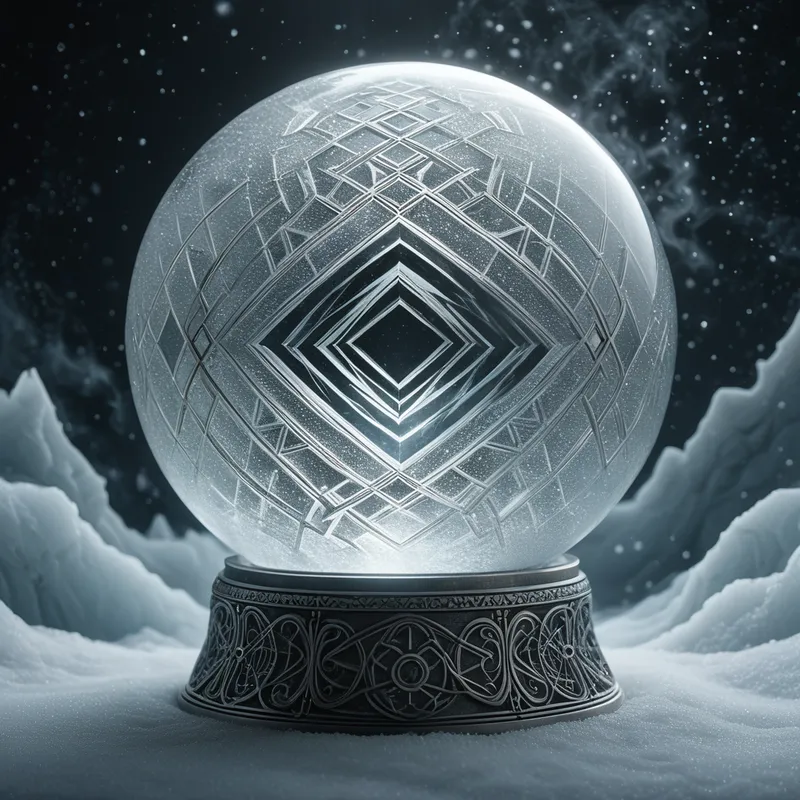
When the mist of Niflheim seeps into modern dreams, it rarely appears as a mythological landscape. Instead, it manifests as an atmosphere, a somatic experience. One dreams of being lost in a featureless grey fog in a familiar city, where street signs are illegible and sounds are muffled. There is a profound sense of disorientation, of cold isolation, and of time slowing to a crawl. The dreamer may feel paralyzed, unable to move or call out, gripped by a silent, pervasive dread that lacks a specific object.
This dream-state signifies a psychological return to the prima materia. It is an encounter with a formless period in the psyche, often preceding a major life transition, a creative endeavor, or a depressive episode. The ego, the fire of conscious identity, is being enveloped by the cold mist of the unconscious. The familiar structures of life (the city in the dream) are still present but rendered meaningless. This is not a nightmare of pursuit, but one of erasure. The somatic feeling of cold and paralysis points to a withdrawal of libidinal energy, a psychic hibernation. The dreamer is undergoing a necessary, if terrifying, dissolution of old patterns and identities, being returned to the raw, unshaped potential of Niflheim before a new “Ymir”—a new complex or life-direction—can be formed.

Alchemical Translation
The myth of Niflheim models the first and most crucial stage of psychic transmutation: the nigredo, or blackening. In alchemy, this is the stage of putrefaction and dissolution, where the base material is reduced to its original, chaotic state. For the modern individual on the path of individuation, this is the experience of being plunged into the mist.
It occurs when our conscious attitudes, our carefully constructed persona, and our life narratives fail us. A career ends, a relationship dissolves, a belief system crumbles. We are cast back into a state of inner chaos, confusion, and cold despair. We feel orphaned from our own lives. This is the ego’s experience of Niflheim—a loss of all form, direction, and warmth.
The alchemical work begins not with striving, but with surrendering to the mist. The fire of the will must be banked to allow the cold truth of the unconscious to rise.
The transformative process lies in enduring this state without fleeing into premature meaning or false warmth. One must stay with the disorientation, the cold silence, and the formless potential. This is the “frost before the giant.” In this space, the old, rigid structures of the psyche (the “ice”) begin to melt from a new, inner spark—not the ego’s will, but the slow, persistent heat of the Self, the central archetype of wholeness. From this inner conjunctio, a new form of life, a new understanding, a new creative impulse (the new “Ymir”) can slowly coalesce. The mist does not disappear; it becomes the foundation. The individual learns that their solid identity is a temporary formation upon an eternal, cold sea of potential, and from that sobering knowledge comes a profound resilience and a truly creative power, born not from avoidance of the void, but from a conscious relationship with it.
Associated Symbols
Explore related symbols from the CaleaDream lexicon: