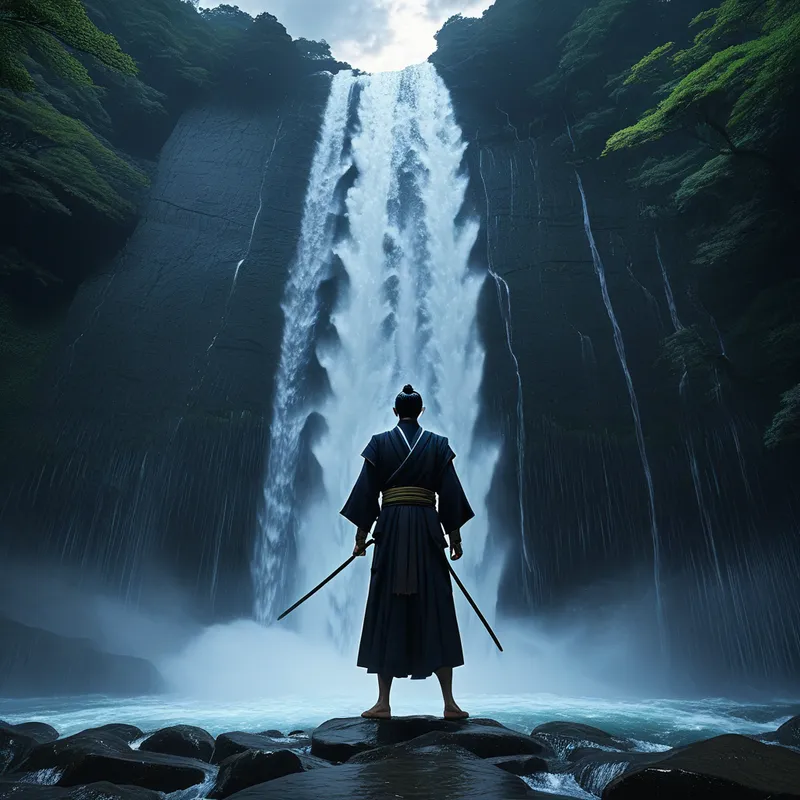
Misogi Myth Meaning & Symbolism
The primal myth of Izanagi's purification after Yomi, birthing deities from washed-away impurities, establishing the sacred ritual of water cleansing.
The Tale of Misogi
Listen, and hear the tale of the first great cleansing, the moment the world was washed anew. The air was thick with the stench of death, a clinging miasma that choked the light. Izanagi-no-Mikoto fled, his heart a drum of terror, from the sunless halls of Yomi-no-kuni. Behind him, the shrieks of his once-beloved, Izanami-no-Mikoto, now a wrathful and corrupted queen, echoed like stones down a deep well. He had seen her in her decay, and the sight had seared his soul. He blocked the pass to the living world with a mighty boulder, her final curse ringing in his ears.
But the pollution did not stop at the border. It was upon him, in him—a tangible, greasy film of death and defilement, the kegare of the underworld. It weighed down his limbs and clouded his divine spirit. He could not return to the world of light bearing this stain. His very presence would poison the creation he had helped to birth.
So he journeyed, a haunted figure, to the edge of the world, to a place called Tachibana-no-Odo on the river Hi-no-Kawa. Here, the waters roared in a torrent of pure, crashing power. Without ceremony, driven by a primal need, Izanagi waded into the current. The cold was a shock, a blade against his skin. He immersed his whole body, scrubbing at the unseen filth.
And as the sacred waters flowed over him, a miracle of transmutation occurred. The kegare did not merely dissolve; it became the substance of new life. From the filth washed from his left eye, there sprang, radiant and fierce, Amaterasu-Ōmikami, her light banishing the shadows in his heart. From his right eye, the contemplative Tsukuyomi-no-Mikoto was born. And from the cleansing of his nose, the impetuous and powerful Susanoo-no-Mikoto surged forth.
With each immersion, more deities manifested from the discarded impurities: from his jewelry, from his garments. The act of desperate purification had become an act of profound creation. Stepping from the river, reborn and weightless, Izanagi declared this practice—Misogi—the sacred way to restore purity and balance. The first pollution had given birth to the very ritual that would forever after cleanse it.
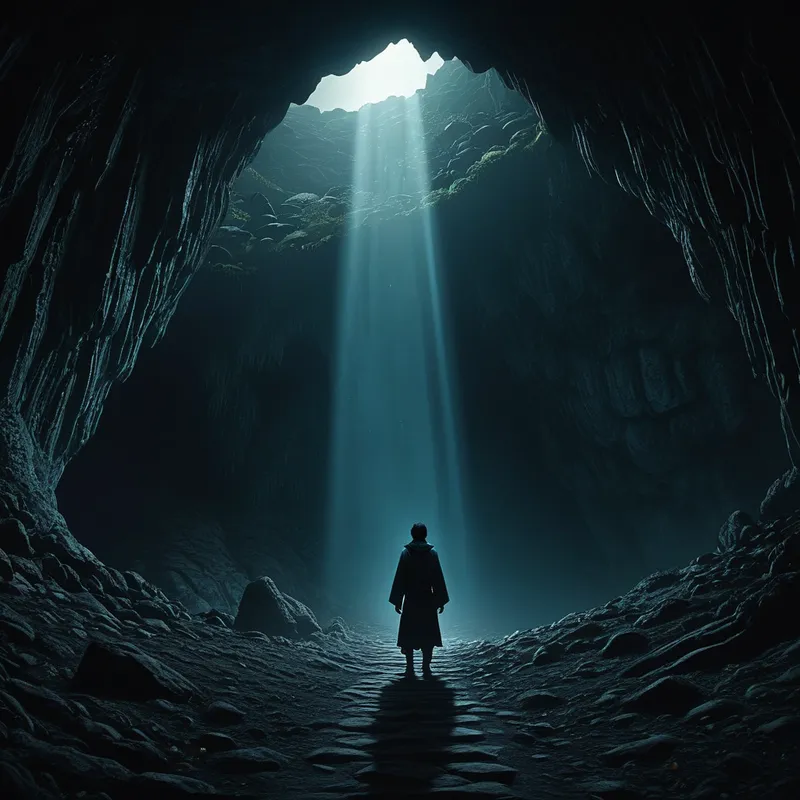
Cultural Origins & Context
This foundational narrative is recorded in Japan's oldest chronicles, the Kojiki (712 CE) and the Nihon Shoki (720 CE). It is not merely a story but a koto-dama, a narrative imbued with spiritual power that explains and sanctifies a central pillar of Shinto practice. Shinto, the "way of the kami," is fundamentally concerned with the dynamic between purity (kiyome) and pollution (kegare). Kegare is not sin in a moral sense, but a natural state of spiritual entropy—accumulated through contact with death, blood, illness, or even mundane exhaustion.
The myth of Izanagi's Misogi provided the divine precedent (hatsu-hon) for all subsequent ritual purification. It was told and retold by court ritualists (kannushi) and embodied in practices ranging from the grand Ōharae (Great Purification) ceremonies performed for the nation to the simple act of rinsing hands and mouth at a temizuya (water ablution pavilion) before approaching a shrine. It established water, especially flowing water, as the primary medium for restoring harae, the state of ritual purity necessary to commune with the kami and participate harmoniously in life.
Symbolic Architecture
At its core, Misogi is a myth about the alchemy of the unwanted. Izanagi's journey is the universal psychic movement from contamination to clarity, from the burden of the past to the creative potential of the present.
The shadow is not destroyed; it is washed, and in the washing, its substance is transmuted into a new form of light.
The Yomi represents the unconscious, specifically the personal and collective shadow—the repository of all we have rejected, feared, or forgotten. Izanagi's flight is the ego's traumatic encounter with this repressed material. The kegare clinging to him symbolizes the psychological "stickiness" of such encounters; we carry the residue of our shadows with us.
The river is the flowing, dynamic process of consciousness itself. Immersion is not a gentle baptism but an often violent confrontation. The myth insists that true purification requires full submersion—a total, somatic engagement with the cleansing process. The most profound symbolism lies in the birth of the kami. Amaterasu (the sun), Tsukuyomi (the moon), and Susanoo (the storm) are not created from Izanagi's "pure" essence, but specifically from the washed-away impurities. This reveals a radical psychological truth: our greatest gifts, our guiding luminaries and driving energies, are often forged in the crucible of what we initially deem waste, trauma, or shame.

The Dreamer's Resonance
When the pattern of Misogi stirs in the modern dreamer, it often manifests as dreams of water in overwhelming, transformative contexts. One may dream of being caught in a torrential downpour that washes away a layer of skin, revealing new flesh beneath. Or of standing under a waterfall that strips away not dirt, but heavy, dark clothing or even a second, suffocating body. The somatic experience is key: the dreamer feels the weight being lifted, the constriction dissolving.
Psychologically, this dream motif signals a deep, unconscious process of katharsis. The psyche is initiating a purge of accumulated kegare—which today might be experienced as burnout, moral fatigue, the residue of toxic relationships, or the clinging grief of a loss. The dream is not an intellectual analysis but a somatic ritual performed in the theater of the unconscious. It prepares the dreamer for a waking-life release, a necessary shedding of an old psychological state that has become polluted and burdensome. The conflict in the dream is between the desire to remain on the bank (in familiar suffering) and the imperative to plunge into the cold, unknown current of change.

Alchemical Translation
For the individual on the path of individuation, the myth of Misogi models the essential, non-negotiable stage of mortificatio and ablutio—the dying of the old attitude and the washing of the psychic vessel. The modern seeker's "Yomi" may be a period of depression, a career failure, or the end of a relationship—any experience that leaves one feeling spiritually contaminated and exiled.
The ritual is the container that makes the chaos bearable. The act of intentional immersion transforms passive suffering into active purification.
The alchemical translation involves consciously creating one's own "Hi-no-Kawa." This is the disciplined practice—whether therapy, meditation, artistic expression, or physical ritual—that allows for a full confrontation with and processing of the shadow material. One must, like Izanagi, intentionally "wash" by bringing the contents of the personal Yomi into the flowing stream of awareness.
The triumph is not in returning to a naive, pre-fall state of innocence. That is impossible. The triumph is in the transmutation. The grief, anger, or shame (the kegare), when fully experienced and consciously processed, does not vanish. Instead, it loses its toxic, clinging quality and is reborn as a source of inner authority (Amaterasu), reflective wisdom (Tsukuyomi), and vital, transformative energy (Susanoo). The modern Misogi is the realization that our wholeness depends not on rejecting our journey through the dark, but on having the courage to be cleansed by it, thereby discovering that the very substance of our wounds can become the source of our most sacred creations.
Associated Symbols
Explore related symbols from the CaleaDream lexicon: