Mirror of Karma Myth Meaning & Symbolism
A mythic mirror reveals the unvarnished record of one's deeds, compelling a confrontation with the self and the law of cause and effect.
The Tale of Mirror of Karma
Listen, and let the silence between the words speak. In the realms that border waking and dream, where the architecture of reality is woven from intention and consequence, there stands a hall that is no hall. It is a space of pure potential, a chamber at the axis of the Samsara. Here, the air is not air, but a condensation of memory. The light does not fall; it emanates from within all things, casting no shadow save one—the shadow of the self yet to be faced.
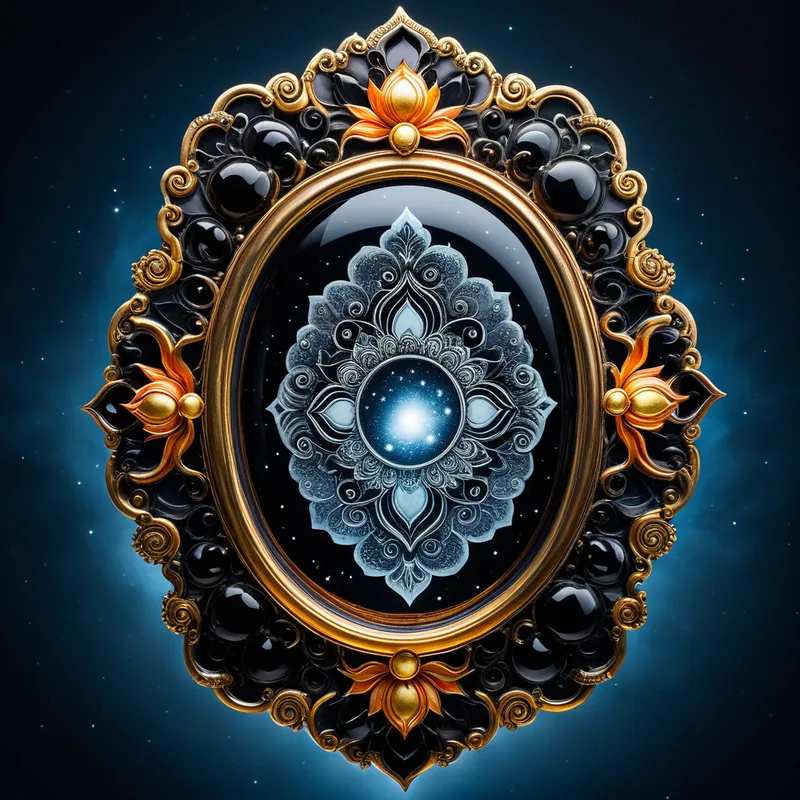
At the heart of this non-place rests the Karma-Darpana, the Mirror of Karma. It is not a thing of glass and silver, but a living aperture, a pool of liquid obsidian held in a frame of orichalcum and weeping jade. It does not wait. It simply is, as inevitable as breath.
They come to it—not as bodies, but as essences, as streams of consciousness flowing from one life to the next. A king, whose mind still echoes with the cheers of crowds, approaches. He seeks his glorious destiny. The mirror’s surface, still and dark as a midnight lake, stirs. It does not show his proud face. Instead, it blooms with light, revealing not his coronation, but the face of a farmer whose land he seized, the hollow eyes of a soldier who died for a whispered slight. The king’s essence recoils, a silent scream in the luminous void. The mirror shows only what is, the unbroken chain of cause and fruit.
Next, a woman whose life was one of quiet desperation. She expects a ledger of failure. The mirror darkens, then clears. It shows her hand offering a crust of bread to a starving dog, the genuine warmth in her eyes as she comforted a weeping child—small moments forgotten by her, but etched in the fabric of the real. A warmth, subtle as a first dawn, radiates from the image. The mirror is pitiless in its compassion; it records the thorn and the rose with equal fidelity.
The drama is not in battle or quest, but in the unbearable intimacy of this revelation. There is no judge but the one who looks. No sentence is passed that is not already contained within the action itself. The mirror is the moment of perfect, unmediated truth. The rising action is the tremor of recognition, the dissolution of the story the self has told itself. The resolution is not spoken; it is absorbed. The essence, having seen its own reflection in the ledger of its deeds, turns away—not to forget, but carrying that reflection into the next becoming. The hall is silent once more, holding only the echo of a lesson learned, or perhaps, destined to be learned again.
Cultural Origins & Context
The myth of the Mirror of Karma is not a single, canonical scripture, but a pervasive archetypal motif woven through the tapestry of Jataka tales, Abhidharma commentaries, and the vibrant iconography of Mahayana and <abbr title="The "Diamond Vehicle," a major branch of Buddhism">Vajrayana Buddhism. It finds explicit mention in texts describing the Bardo, the liminal state after death. In the Tibetan Book of the Dead (Bardo Thödol), the luminous, potentially terrifying visions of the afterlife are described as projections of one's own mind, a karmic cinema where the self is both projector and audience.
This myth was propagated not from a single pulpit, but through the oral teachings of lamas, the vivid depictions in temple murals (often showing Dharmapalas or Bodhisattvas like Avalokiteshvara presiding over the halls of judgment), and in meditation guides. Its societal function was profoundly ethical and psychological. It externalized the abstract doctrine of karma into a tangible, unforgettable image. It served as a moral compass, certainly, but more deeply, as a tool for introspection. It taught that the ultimate judge is not a celestial bureaucrat, but the unflinching reality of one's own accumulated intentions and actions. The mirror democratized accountability; it awaited prince and pauper alike.
Symbolic Architecture
The Mirror is the ultimate symbol of psychic integration. It represents the totality of the unconscious, not as a dark cellar of repressed desires, but as a perfect, impersonal record. It is the anima/animus and the shadow made simultaneously visible.
The Mirror of Karma does not judge; it merely presents. The judgment is the tremor in the soul of the one who gazes upon their own creation.
The polished surface symbolizes the mind in its purest state of Samadhi—clear, undisturbed, and capable of reflecting phenomena exactly as they are, without distortion. The images that arise are our Sankharas, the latent karmic formations. The frame, often ornate with cosmic symbology, represents the structured, manifest world (Samsara) itself, which holds and is defined by this law.
Psychologically, the figure gazing into the mirror is the ego confronting the Self. The ego's narrative—"I am a king," "I am a failure"—is shattered. What is revealed is the larger, more complex pattern of the psyche's activity over time. The "hero's journey" here is inward; the boon is not a weapon or treasure, but self-knowledge so complete it necessitates a death of the old self-construct.
The Dreamer's Resonance
When this myth stirs in the modern dreamscape, it rarely appears as a literal Buddhist mirror. It manifests as dreams of being exposed, of hidden cameras, of one's phone gallery displaying unknown, compromising photos. It is the dream of looking into a bathroom mirror and seeing not your face, but a scene from a childhood argument where you were cruel. It is the dream of a ledger, a spreadsheet, or a social media feed that meticulously lists every half-truth and unkind thought.
These dreams signal a somatic and psychological process of karmic reckoning. The psyche is forcing a review. It often occurs during life transitions—the end of a relationship, a career change, a period of depression or anxiety. The body may respond with night sweats, a racing heart upon waking, or a profound sense of shame or dread. This is not punishment, but pressure. The unconscious is presenting the bill for ignored actions, repressed memories, or lived inauthenticity. The dreamer is being taken to their own inner hall of mirrors. The process is one of brutal honesty, where the ego's defenses are bypassed, and the shadow demands acknowledgment.
Alchemical Translation
The alchemical process modeled by this myth is not the creation of gold, but the forging of consciousness. It is the opus of individuation through radical self-acceptance.
The first stage is mortificatio—the death of the persona. Gazing into the Mirror is this death. The polished ego-identity is shattered by the revelation of the shadow's content. The king must see the tyrant; the saint must see the secret pride. This is a necessary dissolution.
The lead of our ignored actions must be dissolved in the acid of truthful reflection before the gold of wisdom can be precipitated.
The second stage is solutio—dissolution in the waters of truth. The dreamer, or the mythic voyager, must remain in that unbearable gaze, allowing the shock to wash over them, to dissolve the rigidity of their self-story. This is the meditation on emptiness (Sunyata), seeing the interdependent, non-solid nature of the "self" that performed those actions.
The final stage is coagulatio—the re-forming. The essence turns from the mirror, not to escape, but to integrate. The seen karma is not erased; it is metabolized. It becomes conscious. With consciousness comes choice. The transformed individual moves forward, not as a flawless being, but as one who carries the mirror within. Their actions become more intentional, for they know each one is an etching on the inner glass. The law of cause and effect ceases to be a external threat and becomes the very principle of mindful creation. The individual becomes, in a sense, the sage—not one who is perfect, but one who sees clearly, acts consciously, and understands that every moment is both a consequence and a cause, reflected in the eternal now of the karmic glass.
Associated Symbols
Explore related symbols from the CaleaDream lexicon: