Miraj Myth Meaning & Symbolism
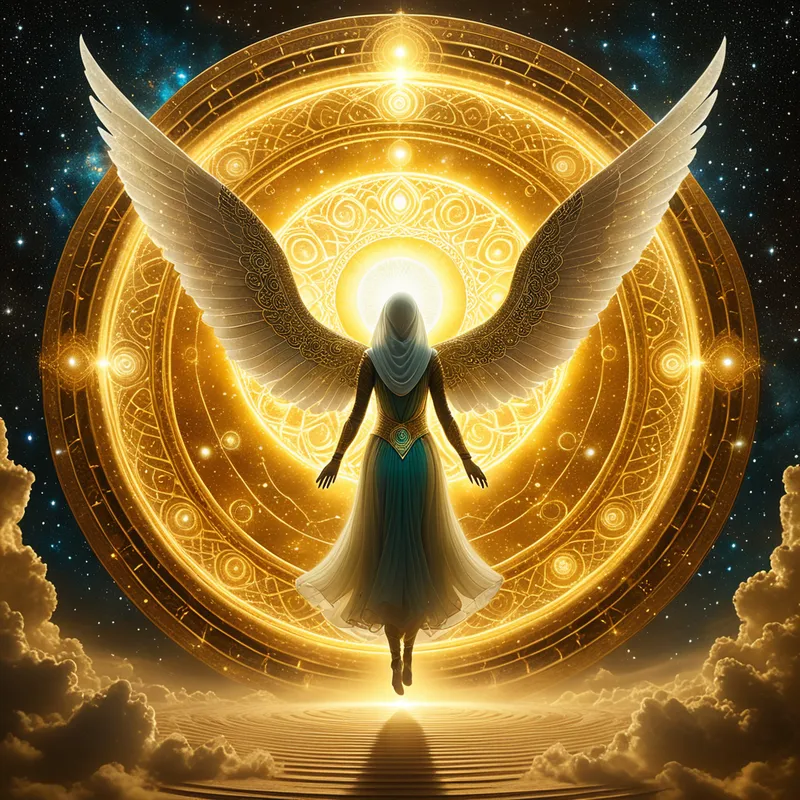
The Prophet's mystical night journey from Mecca to Jerusalem and through the heavens, a map of the soul's ascent to divine unity.
The Tale of Miraj
In the deep well of a desert night, when the world holds its breath and the stars press close, a mystery unfolded. In the sacred sanctuary of Mecca, the heart of the Prophet Muhammad, peace be upon him, was heavy with the weight of a seeking world. He slept, but his sleep was a door.
Then came the visitor, not with sound, but with presence. The archangel Jibril (Gabriel), a being of fathomless light, parted the fabric of the mundane. With a touch that was both a wound and a blessing, he opened the Prophet’s chest, washing his heart in snow brought from the highest heaven, sealing it with the light of faith. This was not a beginning of journey, but a preparation of the vessel.
And then, the steed appeared—Buraq, more magnificent than any earthly creature. Its body shone like a pearl, its wings were spread for flight, and its face held the beauty of human knowing. In a single bound, it carried the Prophet from the Kaaba to the distant, sleeping city of Jerusalem. The wind of worlds rushed past, cities blurring into streaks of fire below, the dome of rock rising to meet them like a moon from the earth.
At Al-Aqsa, a congregation of the luminous dead awaited. Abraham, Moses, Jesus, and all the chain of prophets stood in silent prayer. He led them. Then, from that sacred stone, the ladder to the unseen was unfurled.
Ascension. The first heaven, a dome of hammered silver, where Adam greeted him, turning his gaze between the multitudes of his children to the right in bliss, and to the left in sorrow. Higher, to the second heaven, of burnished gold, where Yahya (John the Baptist) and Isa (Jesus) stood as brothers. The third, of pearl, where Yusuf (Joseph) shone with a radiance that captured the moon. The fourth, of white gold, where Idris resided. The fifth, of silver, where Harun (Aaron) kept his vigil. The sixth, of ruby and garnet, where Musa (Moses) wept, for he saw what was to come for the Prophet’s community.
And then, the seventh heaven, a dome of ineffable light, the realm of Ibrahim (Abraham), leaning against the Bait al-Ma'mur. Beyond even this lay the Sidrat al-Muntaha. Its leaves were like the ears of elephants, its fruits like vessels, and it was veiled in colors no eye could describe. Here, the very laws of creation—time, space, form—dissolved into the humming radiance of divine command.
And then, the Veil. And then, the Presence. Alone, beyond even Jibril, who could go no further, the Prophet entered the ultimate intimacy. Words were exchanged, gifts were given—the five daily prayers, distilled from an initial command of fifty through the compassionate intercession of Musa. The return was a swift descent, a return to the sleeping body on the earth, as dawn broke over Mecca. The bed was still warm. The night had lasted but a moment, and yet an eternity.
Cultural Origins & Context
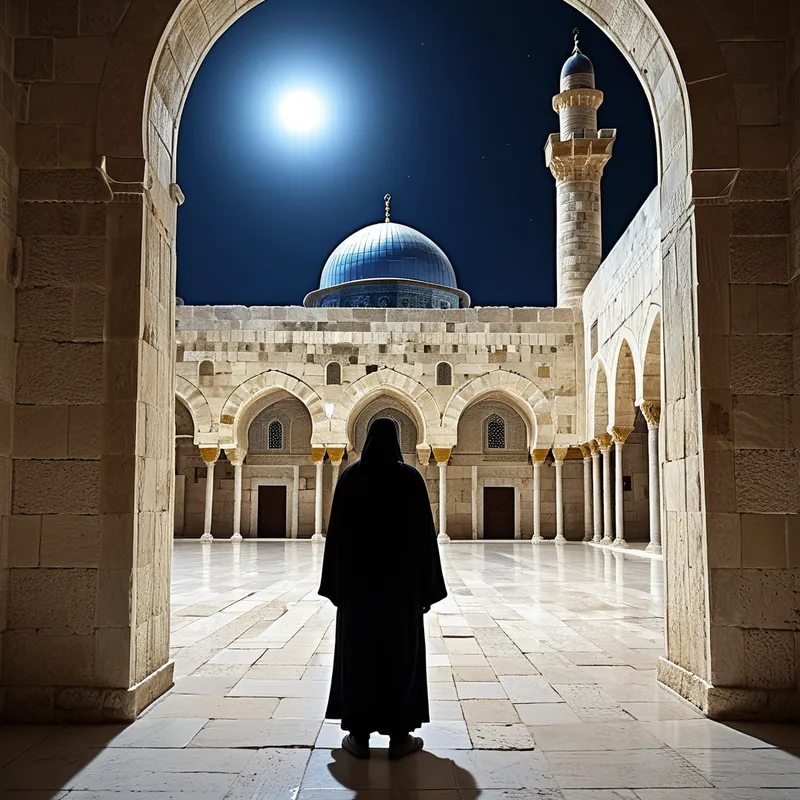
The account of al-Isra' wal-Mi'raj is anchored in the Qur'an (Surah Al-Isra 17:1) and elaborated in the Hadith literature. For the early Muslim community, it was a profound test of faith—a literal, physical journey that defied earthly logic, affirming the Prophet’s unique station. It served as a divine consolation during the "Year of Sorrow," following the deaths of his protector uncle and his beloved wife Khadijah.
Within Sufism, the myth was not merely a historical event but the archetypal blueprint for the inner life. It was passed down not just as narrative, but as a living map in the oral teachings of sheikhs, in the ecstatic poetry of Rumi and Hafez, and in the meditative practices of orders. Its societal function was dual: it solidified the spiritual centrality of Jerusalem and the continuity of prophecy, while for the mystic, it provided a symbolic lexicon for the soul’s journey (suluk) from the bondage of the ego (nafs) to the annihilation (fana) and subsistence (baqa) in the Divine.
Symbolic Architecture
The Miraj is the ultimate symbolic drama of ascent. It is not a flight from the world, but a journey through the layers of the self to the world’s transcendent core.
Buraq represents the purified body and imagination—the vehicle that must be tamed and directed for spiritual travel. Its human face signifies the intelligence required for the journey; its wings, the aspiration that lifts the soul beyond its limits.
The seven heavens are not places, but states of consciousness. They are the successive stations (maqamat) of the heart, each presided over by a prophet who embodies a specific spiritual quality—Adam’s repentance, Jesus’s compassion, Moses’s awe. To meet them is to integrate their essence.
The Sidrat al-Muntaha is the boundary of all human knowledge and perception. It is the point where the mind’s categories are overwhelmed by direct experience, where "the eye neither swerved nor swept wrong" (Qur'an 53:17). Beyond it lies the Unseen (al-Ghayb).
The negotiation over the prayers is profoundly psychological. It symbolizes the divine law being tempered by divine mercy, and the human condition being met with compassionate realism. The prayer becomes the daily, grounded Miraj for the believer—a mini-ascension that tethers the transcendent experience to the rhythm of earthly life.
The Dreamer's Resonance
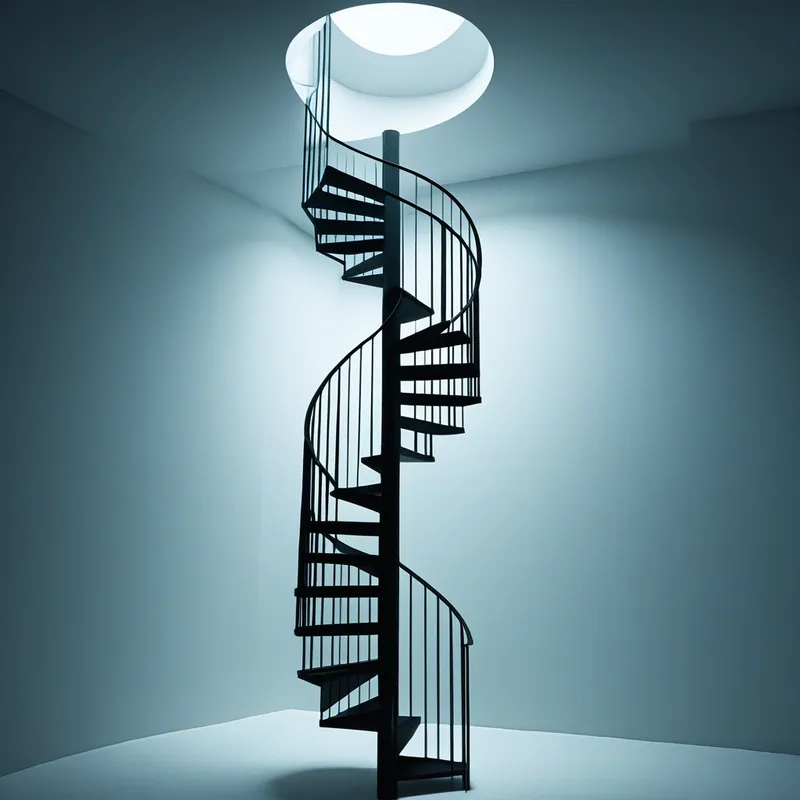
When this myth stirs in the modern unconscious, it rarely appears as a literal religious tableau. Instead, it manifests as the dream of ascent. One dreams of finding a hidden staircase in their own home, of flying over familiar landscapes that become strangely sacred, of meeting wise, ancestral figures in elevated places. There is often a somatic component—a feeling of weightlessness, of the heart expanding, or conversely, of a terrifying, vertiginous pull upwards.
Psychologically, this signals a process of sublimation—the libido or life-energy is turning away from purely earthly engagements and seeking a higher synthesis. The dreamer is confronting the "vertical" dimension of their psyche. The fear that accompanies it (like Moses’s weeping) is the ego’s anxiety at being transcended. The profound peace that can follow is the soul touching, however briefly, a state of inner unity that resolves earthly contradictions. It is the psyche’s innate imperative to seek its source.
Alchemical Translation
In the alchemy of individuation, the Miraj models the process of achieving the Self. The journey begins with the nigredo—the cleansing of the heart in Mecca, a confrontation with one’s shadow and preparation. The flight on Buraq is the active imagination, the imaginatio, lifting complex material into consciousness.
Each heaven is an encounter with an archetypal aspect of the psyche that must be acknowledged and integrated. To meet the "prophet" within is to consciously assimilate the guiding principles they represent: the foundational self (Adam), the transformative spirit (Jesus), the moral lawgiver (Moses).
The ultimate goal is not to collect these aspects, but to pass beyond them to the unus mundus—the unified world where all opposites coincide. The Sidrat al-Muntaha is the lapis, the Self, the point of maximum complexity and simplicity. To stand there is to achieve a consciousness that can hold paradox, that sees the divine pattern in the profane details of life.
The return is the critical, final stage—the rubedo or reddening. The treasure hard to attain must be brought back and embodied. The five daily prayers translate to the disciplined, daily practice of mindfulness, gratitude, or ethical action that roots the transcendent experience in the here and now. The Miraj teaches that the highest ascent is worthless if it does not transform the descent. The true sage is not one who dwells forever in the seventh heaven, but one who walks the earth with the humility, compassion, and presence forged in the encounter with the Absolute.
Associated Symbols
Explore related symbols from the CaleaDream lexicon: