Minos Myth Meaning & Symbolism
A king's divine bargain births a monstrous legacy, weaving a tale of justice, labyrinthine deception, and the inescapable cost of power.
The Tale of Minos
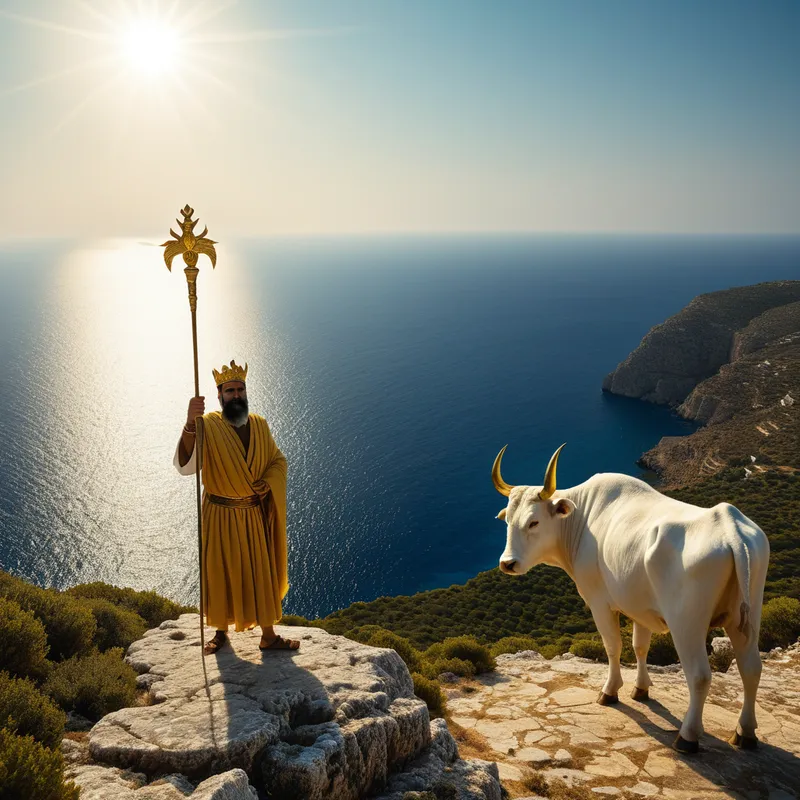
Hear now the tale of a king born from the sun and the sea, a ruler whose name became a whisper of law and a scream of terror. It began not with a crown, but with a plea. Zeus, in the form of a magnificent white bull, carried the Phoenician princess Europa across the waves to the island of Crete. There, she bore him sons: Minos, Rhadamanthys, and Sarpedon. When the old king died, Minos claimed the throne, declaring the gods themselves favored his reign. To prove it, he prayed to Poseidon, asking that a bull emerge from the sea, which he would then sacrifice in the god’s honor.
The sea foamed and parted. Forth came a creature of such staggering beauty and power it stole the breath from every throat—a bull pure as sea-foam, with hide that shone like polished marble and horns of coiled pearl. This was the Cretan Bull. But when Minos beheld its perfection, a covetous fire ignited in his heart. He could not bring himself to spill its sacred blood. He hid the divine bull among his herds and sacrificed another in its place.
The salt-air of Crete grew heavy with divine offense. Poseidon’s wrath was not a thunderclap, but a slow, cruel poison. He afflicted Minos’s queen, Pasiphaë, with a monstrous and unquenchable desire—a passion for the very bull her husband had stolen. Consumed, she enlisted the genius of the exiled artisan Daedalus, who built for her a hollow wooden cow, so realistic it deceived the beast. From this unholy union was born a child: a creature with the robust body of a man and the great, shaggy head and neck of a bull. They named him Asterion, but the world would know him as the Minotaur.
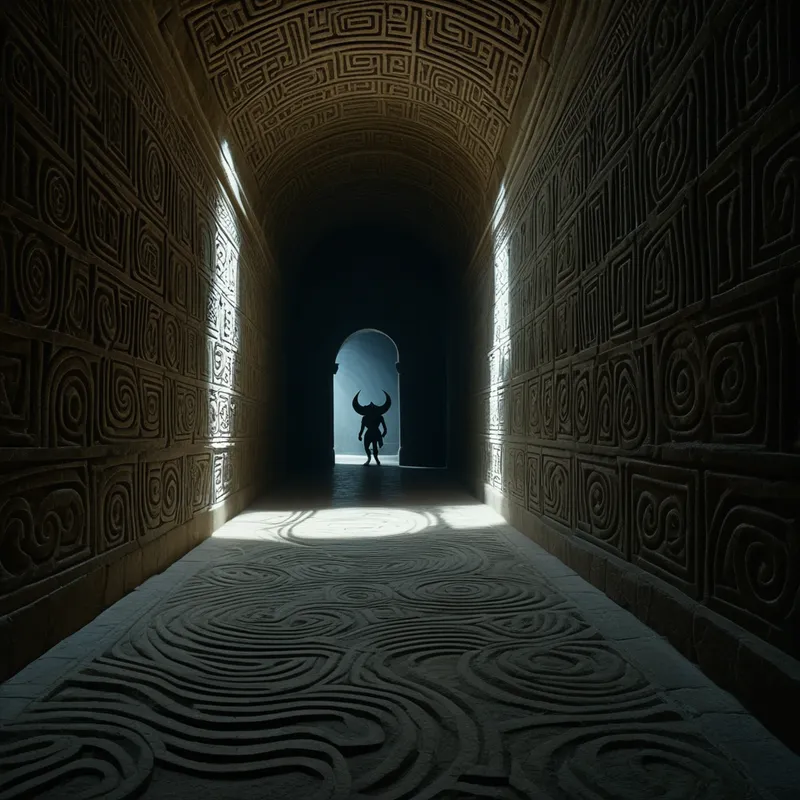
Shame and horror curdled in Minos’s palace. The king’s sin had birthed a living nightmare. Again, he summoned Daedalus, not to create, but to conceal. “Build a prison,” commanded Minos, “from which nothing that enters may ever find its way out.” And so Daedalus constructed the Labyrinth, a winding, confounding prison of stone, a geometric madness where the Minotaur roamed, fed on the flesh of tributes.
For Minos’s power had grown vast, and his justice was iron. When his son, Androgeos, was killed in Athens, the king laid a bitter siege upon the city. His terms for peace were ghastly: every nine years, Athens must send seven youths and seven maidens to be cast into the Labyrinth, a feast for the monster within. The cycle of retribution turned, a wheel of despair.
Until a hero from Athens, Theseus, volunteered as tribute. In Crete, Minos’s own daughter, Ariadne, seeing the hero, was seized by love and pity. She went to Daedalus, who gave her the answer to the maze: a simple skein of thread. Ariadne gave it to Theseus, who tied one end to the entrance, ventured into the echoing darkness, found the slumbering Minotaur, and slew him. Following the thread back to the light, he broke the cycle, escaping with Ariadne.
Minos’s rage was boundless, directed not at the hero, but at the architect. He imprisoned Daedalus and his son, Icarus, in the very Labyrinth they had built. But a mind that could build a prison could escape it. With feathers and wax, Daedalus crafted wings, and they flew from Crete—a flight that would end in another tragedy.
Minos pursued Daedalus relentlessly across the known world, a king obsessed. His journey ended in Sicily, in the court of King Cocalus. There, seeking the craftsman, Minos devised a test: he presented a spiral seashell and challenged anyone to thread a string through its entire coiled chamber. Cocalus, secretly harboring Daedalus, gave the shell to him. The genius tied a thread to an ant, which navigated the inner spirals, solving the puzzle. Revealed, Daedalus’s location was betrayed. But Cocalus’s daughters, benefiting from Daedalus’s inventions, favored the artisan. As Minos bathed in their palace, they poured boiling water or oil upon him, scalding the great king to death. Thus fell the son of Zeus, not in battle, but in a bath, his relentless pursuit and inflexible justice finally meeting a treacherous, steaming end.
Cultural Origins & Context
The myth of Minos is a foundational layer in the complex archaeology of Greek identity. It emerges from the blurred boundary between memory and myth, where the Bronze Age Minoan civilization (a name given by modern archaeologists from the myth) provided a haunting, half-remembered backdrop for later Greek storytellers. For the classical Greeks, Crete was a land of ancient, pre-Olympian mystery. Minos was not merely a legendary king; he was a culture hero, credited with establishing the first naval empire and, most importantly, the first codified laws, which he received directly from his father Zeus in a sacred cave.
This dual nature—the wise lawgiver and the tyrannical oppressor—reflects the Greek ambivalence toward power, tradition, and the “other.” The myth was propagated through the epic cycles, tragic plays, and historical works of authors like Herodotus and Thucydides. It served a societal function as a cautionary tale about the source and use of authority. Law must be divinely inspired, but the ruler who perverts that sacred contract—who keeps the divine gift for himself—unleashes chaos (the Minotaur) that ultimately consumes his own house and requires horrific sacrifices to maintain. The myth justified Athenian hegemony by framing their rival Crete’s legendary king as a monstrous oppressor, while also exploring the terrifying responsibilities of justice and the price of order.
Symbolic Architecture
At its heart, the myth of Minos is a profound drama of the psyche’s negotiation with the foundational forces of Order and Chaos. Minos himself symbolizes the conscious ego, the ruler who seeks to establish a coherent, lawful identity (“I am king by divine right”). The Cretan Bull is the raw, divine, instinctual power (libido) offered by the deeper Self (Poseidon). To integrate this power requires a sacred sacrifice—the acknowledgment and channeling of one’s primal nature into one’s conscious structure.
The first sin is not theft, but the failure to perform the sacred sacrifice. It is the hoarding of divine energy for the persona’s glory.
By refusing to sacrifice the bull, Minos commits the archetypal act of spiritual greed. He attempts to possess the numinous power without undergoing the transformative ritual it demands. The repressed, un-sacrificed instinct does not vanish; it erupts in the unconscious (Pasiphaë’s desire) and gives birth to the Shadow in its most terrifying form: the Minotaur, the beast-man, the confused and ravenous hybrid of civilized and primal selves. The Labyrinth is then the brilliant, tortuous structure of rationalization, denial, and complex psychology we build to contain the monster of our own making—a prison that also becomes our identity.
The tributes from Athens represent the continual cost of this repression: the periodic sacrifice of one’s vitality (youths) and soulful connections (maidens) to feed the hidden shame. Theseus, aided by Ariadne’s thread (the connecting clue of insight or love), represents the heroic consciousness that can descend, confront, and integrate the shadow. Yet, Minos’s pursuit of Daedalus shows the ego’s relentless desire to punish the creative intellect that both enables its grand designs and reveals its secrets.
The Dreamer's Resonance
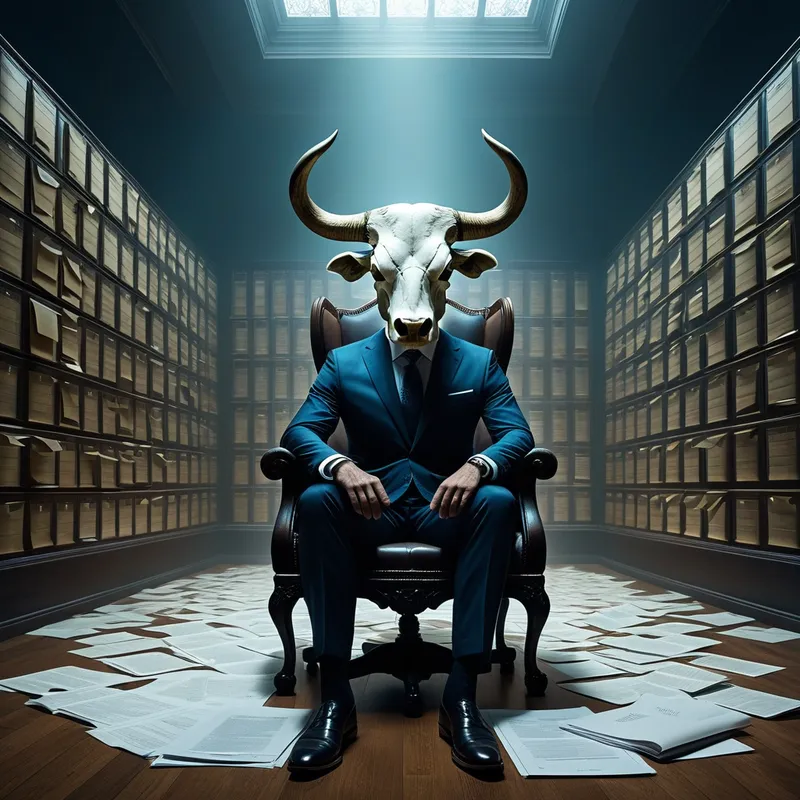
When the pattern of Minos stirs in the modern dreamer, it often manifests as a somatic experience of being trapped in a complex, inescapable system. One may dream of endless bureaucratic corridors, recursive software code, or a mansion with rooms that lead back into themselves. The feeling is one of profound frustration and existential futility. The Minotaur may appear not as a literal monster, but as a looming deadline, a suffocating debt, a tyrannical boss, or a repetitive, addictive behavior that feels both part of oneself and utterly alien.
Psychologically, this is the process of confronting a life structure built on an initial refusal. Perhaps the dreamer chose a career path (the kingship) but refused to sacrifice a core passion (the bull) to truly serve it, leading to a monstrous, hidden resentment (the Minotaur) that now demands constant energy to manage. The dream is signaling that the labyrinthine defenses are failing. The body feels the weight of the un-lifted sacrifice—tightness in the chest (the confined bull), headaches (the maze walls), or a roiling gut (the monster in the basement). The psyche is demanding a Theseus moment: the courage to take up the thread of one’s true desire or trauma and follow it into the center of the maze, no matter how dark.
Alchemical Translation
The alchemical journey modeled by Minos’s myth is the transmutation of the prima materia of inherited power and instinct into the gold of authentic, responsible sovereignty. The process begins with the Nigredo, the blackening: the receipt of the divine bull (the call to a greater life) and its subsequent betrayal through ego-inflation (the refusal to sacrifice). This creates the inner chaos and shame (the Minotaur).
The Labyrinth is not the problem; it is the psyche’s ingenious, if tortuous, solution to a problem of its own creation. Individuation requires not destroying the maze, but mastering its pattern.
The Albedo, the whitening, is the arrival of the clarifying thread—often through love (Ariadne), insight (therapy), or creative intellect (Daedalus’s clue). It is the moment of seeing the pattern in one’s own chaos. The Rubedo, the reddening, is the fierce, bloody confrontation with the Minotaur. This is not about killing a part of oneself, but about slaying the autonomy of the complex—ending its rule as a separate, feeding entity. The monster must be recognized as one’s own disowned power and reintegrated.
The final stage is the death of the old king. Minos’s scalding in the bath is a potent image of dissolution. The rigid, pursuing ego-identity, fixated on control and blame, must be dissolved in the waters of the unconscious. Only then can a new form of rulership emerge. The successor is not Theseus (the hero who leaves), but perhaps Rhadamanthys, Minos’s brother, who became a wise judge in the Underworld. This points to the ultimate alchemical goal: to move from being an earthly tyrant, projecting one’s shadow onto others and demanding tribute, to becoming an internal judge, one who can weigh the soul’s matters with wisdom gleaned from having built, inhabited, and transcended the deepest labyrinths of the self. The law moves from an external imposition to an internal, discerning truth.
Associated Symbols
Explore related symbols from the CaleaDream lexicon: