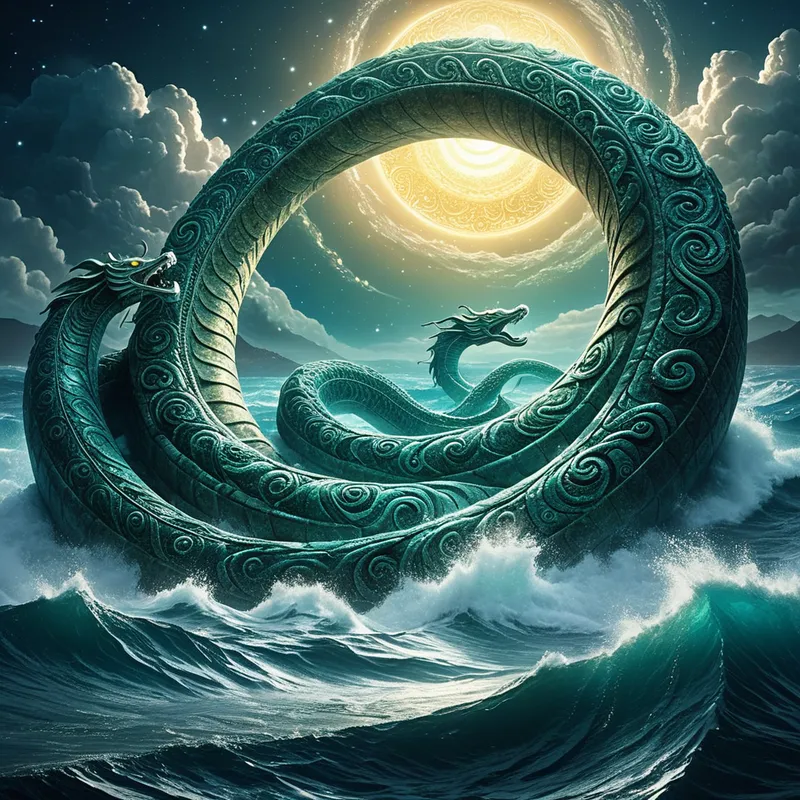
Milky Ocean Churning Myth Meaning & Symbolism
Gods and demons churn the cosmic ocean for immortality, birthing poison and nectar in a profound allegory of psychic integration and wholeness.
The Tale of Milky Ocean Churning
Listen, and let the world’s first sound—the deep, resonant hum of creation—fill your bones. In a time before time, the cosmos was weary. The Devas had grown weak, their radiance dimmed by the relentless shadow of the Asuras. The universe itself felt the ache of imbalance, a longing for a potency lost. From this primordial fatigue, a plan was whispered by the great preserver, Vishnu. To restore the cosmic order, to obtain the nectar of immortality—Amrita—they would have to perform the impossible. They would have to churn the ocean of milk, the Kshirasagara.
But this was no task for one side alone. The Devas, for all their light, lacked the raw, tensile strength. The Asuras, for all their might, lacked the subtlety of purpose. An uneasy, breathtaking alliance was forged. They uprooted the great mountain Mandara and set it upon the back of Kurma, the cosmic tortoise, to serve as a pivot in the watery abyss. Then, they summoned the king of serpents, the mighty Vasuki, and coiled him around the mountain. The Devas took the tail end. The Asuras, greedy and proud, seized the head.
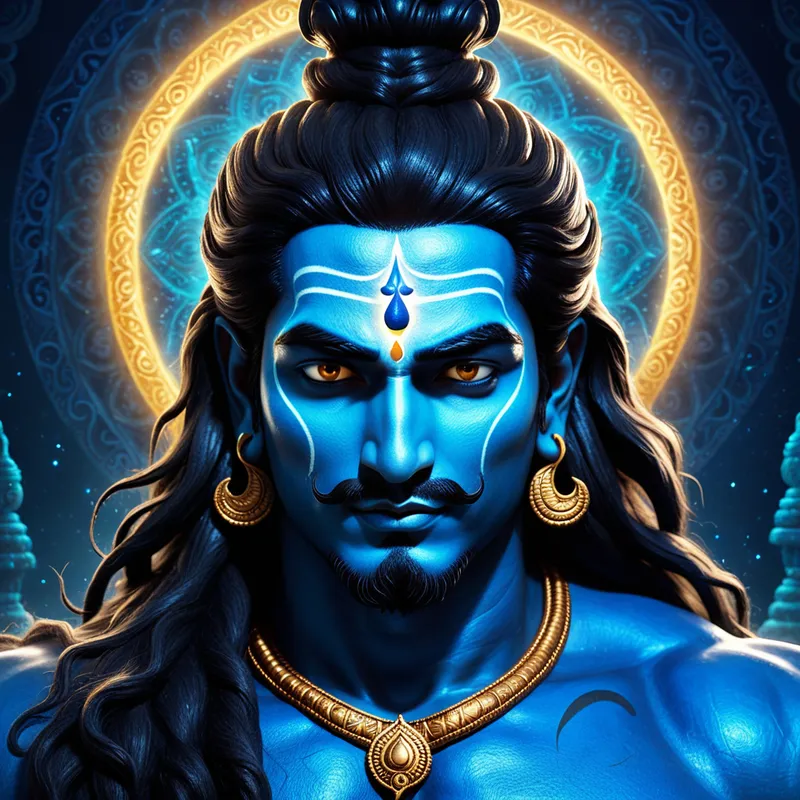
And so the churning began. A groaning, a creaking of celestial scales, a heave that stirred the foundations of reality. The mountain spun, grinding against the tortoise’s shell. Vasuki roared, exhaling plumes of smoke and fire that scorched the Asuras, while the Devas were cooled by the winds from his tail. For a thousand celestial years, they pulled. The ocean, agitated, began to yield its secrets—but not the one they sought. First came a deadly poison, Halahala, dark and viscous, a fume that threatened to unmake all creation. In terror, they called to Shiva, the great yogi. Moved by compassion for a trembling world, he gathered the poison and drank it, holding it in his throat, which turned forever blue. Thus, he became Neelakantha.
Emboldened, the churning resumed. From the white depths emerged wonders: the wish-fulfilling cow Kamadhenu, the goddess of wine Varuni, the moon Chandra, taken by Shiva for his hair. Then came Lakshmi, radiant, born from the ocean’s heart, who chose Vishnu as her consort. Finally, the physician of the gods, Dhanvantari, emerged bearing the glowing pot of Amrita.
Seeing the prize, the fragile alliance shattered. The Asuras snatched the pot. Vishnu, the master strategist, took the form of the enchanting Mohini. Distracting the Asuras, she secured the nectar for the Devas. They drank, and their sovereignty was restored. The cosmos breathed a sigh of balance, but a balance forever marked by the blue throat of the poison-drinker and the eternal tension between light and shadow.
Cultural Origins & Context
This myth, known as the Samudra Manthan, is one of the most seminal and frequently depicted narratives in Puranic literature. It appears in its most elaborate form in texts like the Mahabharata and the Vishnu Purana, composed and expanded over centuries, from around 300 BCE to 1000 CE. It was not merely a story for entertainment but a cosmological and sociological blueprint. Recited by bards and sages, it served to explain the origin of numerous divine beings and celestial objects, embedding them within a coherent cosmic history.
Its societal function was profound. It modeled a core dharmic principle: that even opposing forces are necessary for creation and that ultimate good (the nectar of order) often arises only after confronting and integrating ultimate danger (the poison of chaos). The myth justified the hierarchical but interdependent relationship between the Devas and Asuras, reflecting the eternal human struggle between higher aspirations and base instincts. It was rendered in temple sculptures, classical dance, and miniature paintings, making its symbolic architecture a living part of the cultural psyche, a story told to illustrate that creation is always an act of strenuous, collaborative turmoil.
Symbolic Architecture
The Samudra Manthan is a masterful allegory of the psyche's journey toward wholeness. Every element is a symbolic actor in the drama of consciousness.
The Milky Ocean is the unconscious itself—the vast, undifferentiated, creative potential from which all psychic content emerges. It is the pleroma, the substance of soul. The Mountain is the axis mundi, the spine of focused effort, the disciplined ego-structure necessary to navigate the depths. The Serpent is primal energy, kundalini, the libidinal and often ambivalent force that powers transformation.
The churning is the central act of analysis, introspection, and deep psychological work. It is the difficult, sustained effort to bring the contents of the unconscious to the surface of awareness.
The Gods and Demons represent the polarized aspects of the self: the conscious, spiritual aspirations (Devas) and the unconscious, shadowy drives for power, pleasure, and possession (Asuras). The myth insists that both are required to turn the axis. Ignoring the shadow yields no power; being ruled by it yields only destruction. The first-born Poison is the shadow material that inevitably surfaces first in any deep psychological undertaking—the repressed trauma, the shame, the rage. Shiva’s act is the quintessential model of containment, not annihilation. He transmutes the poison by holding it, making it a part of his divine identity.
The subsequent treasures are the positive potentials that emerge once the poison is integrated: creativity (Kamadhenu), ecstasy (Varuni), beauty and sovereignty (Lakshmi). The final prize, Amrita, is the achieved state of psychic integrity or individuation—a taste of timeless essence. Yet, the myth is wise; the nectar is immediately contested. Wholeness is not a static possession but a dynamic state requiring continual discernment (Vishnu as Mohini).
The Dreamer's Resonance
When this myth stirs in the modern dreamer, it signals a profound somatic and psychological process of integration. One may dream of being on a vast, turbulent sea, engaged in a strenuous, repetitive task with an unlikely or antagonistic partner. There may be a sense of immense effort with no immediate reward, a labor that feels both cosmic and deeply personal.
The body might echo this in feelings of tension, of being "torn" between opposites, or a tightness in the throat—a somatic memory of Shiva’s sacrifice. The dreamer could encounter a radiant figure offering a cup (Dhanvantari) only to have it snatched away, or find themselves captivated by a deceptive beauty (Mohini) that leads to a crucial choice. These dreams often occur during life periods of intense internal conflict, therapy, or creative gestation, where one is "churning" through old patterns to birth something new. The psyche is performing its own Samudra Manthan, and the dream is the report from the depths of what is emerging: first the poison, then, potentially, the nectar.
Alchemical Translation
For the modern individual seeking wholeness, the myth maps the alchemical process of psychic transmutation with startling precision. The initial agreement to churn is the commitment to self-work, the conscious decision to engage with one's depths. The alliance with one's inner "demons"—the acknowledged greed, anger, lust, or fear—is essential. One cannot pull the mountain of transformation with the "gods" of our good intentions alone; we need the raw, compulsive energy of the shadow to provide the necessary torque.
The opus, the great work, begins not with light, but with the acknowledgment and engagement of darkness. The serpent-power must be harnessed, not exiled.
The eruption of the poison is the critical stage. In our lives, this is the crisis point—the old wounds surfacing, the destructive patterns repeating, the depressive or anxious collapse. The alchemical instruction from Shiva is not to reject this poison, but to "drink" it, to consciously take it in and contain it. This is the act of holding the tension of opposites without being destroyed by it, allowing it to be metabolized. The blue throat is the visible scar of transformation, the proof that the poison has been encountered and integrated, becoming a source of protective power rather than death.
Only after this containment do the true treasures arise: the enduring creative source (Kamadhenu), the capacity for joy (Varuni), and inner value and harmony (Lakshmi). The final elixir, the Amrita, is the realization of the Self—a sense of timeless, essential identity that is no longer at the mercy of inner conflict. Yet, the myth warns that this realization is fragile. The ego (the Asuras) will always try to claim this wholeness for its own aggrandizement. Thus, the final alchemical stage is the cultivation of discernment (Vishnu's transformative trickery), the ability to distinguish between the authentic Self and the ego's counterfeit, ensuring the nectar serves the totality of the psyche, not just one faction within it. The churning never truly ends; it is the eternal process of a conscious life.
Associated Symbols
Explore related symbols from the CaleaDream lexicon: