Mictlantecuhtli Myth Meaning & Symbolism
The story of Quetzalcoatl's descent into Mictlan to retrieve the bones of humanity, facing the trickery and finality of the skeletal Lord of the Dead.
The Tale of Mictlantecuhtli
Listen. The sun has fallen for the fourth time. The world is water and silence. The gods, weary and adrift, look upon the void and know a new age must be born. But to create humanity, the clay of the previous world is not enough. Something harder, something that remembers, is needed. The bones of the ancients.
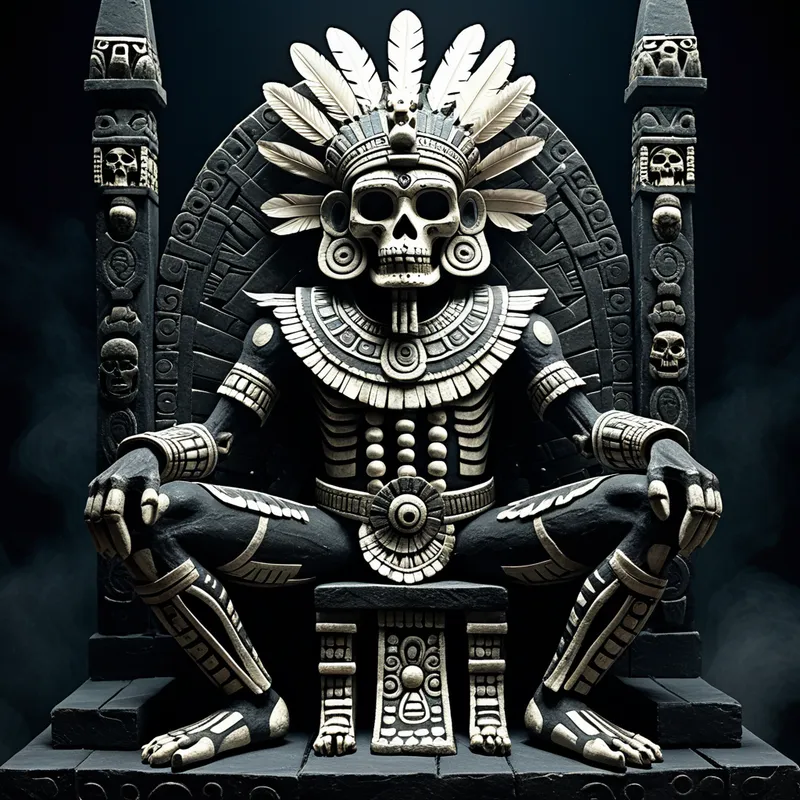
Only one place holds such relics: Mictlan, the deepest silence, the land of the fleshless. And only one being rules that sunless kingdom: Mictlantecuhtli, the Lord of the Dead. His realm is not of fire or torment, but of absolute stillness. The air is dust. The light is memory. He sits upon a throne of obsidian and bone, his form a skeleton adorned with paper banners and starless eyes, a silent king in a kingdom of echoes.
To him descends Quetzalcoatl, the Plumed Serpent, the bringer of wind and dawn. He comes not as a conqueror, but as a petitioner in the land where all petitions end. The journey through the nine layers of Mictlan is a tale of its own—a descent past rushing rivers and mountains that clash, through fields of obsidian wind and places where the very air is forgotten.
Finally, in the ultimate dark, Quetzalcoatl stands before the bone-throne. Mictlantecuhtli does not rage. He speaks in the sound of a closing tomb. "Why do you trouble my rest, Quetzalcoatl? What business has the morning star with the eternal night?"
"I have come for the precious bones," says Quetzalcoatl, his voice a soft wind in the stagnant air. "The bones of the ones who came before. I will take them to Tamoanchan, and from them, a new people will be born."
The Lord of the Dead considers. A smile, perhaps, in the creak of a jawbone. "So be it. You may have them. But you must fulfill a condition. You must circle my realm four times, sounding this conch shell trumpet."
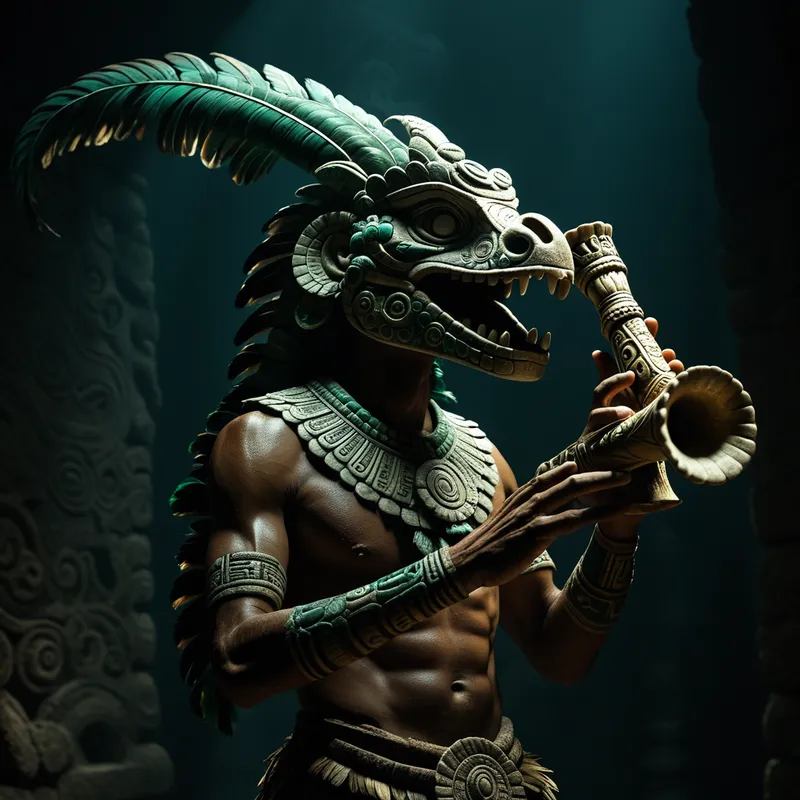
He offers a shell—a magnificent, spiraled conch. But it is a trick. The shell has no mouthpiece, no hole to sound a note. It is a vessel of silence. Quetzalcoatl accepts. He walks the vast, dark plains, the bones of the dead whispering under his feet. He puts the shell to his lips and blows. Only the hollow sigh of his own breath answers.
Undeterred, he calls upon the worms of the earth. They burrow, carving a passage through the shell's heart. He summons the bees, the tzitzimime of the air, and they swarm into the spiral, filling it with a living, humming breath. He raises the shell again. This time, it sings—a low, mournful, resonant blast that shatters the perfect silence of Mictlan, a sound of life in the land of death.
The sound echoes through the nine layers, and Mictlantecuhtli, for the first time, knows surprise. But a lord does not yield easily. He grants the bones. As Quetzalcoatl gathers them in a sacred bundle and begins his ascent back to the world of light, the Lord of the Dead commands a pit to be dug in his path. Quetzalcoatl, startled, stumbles. The precious bones scatter. They are pecked at, broken, and mingled by quail that descend in a frenzy.
Yet Quetzalcoatl gathers what remains. He collects the fragments, the broken relics of the past. He sprinkles them with his own blood, drawn in sacrifice. From these broken, blood-anointed bones, mixed and imperfect, humanity is born. We are not made of whole cloth, but of shattered history, redeemed not by perfection, but by the vital essence poured into our fractures.
Cultural Origins & Context
This myth was the sacred prelude to the Aztec understanding of human existence. It was not a mere story but a foundational charter, recited by priests and wise men (tlamatinime) during ceremonies related to death, renewal, and the origins of the Fifth Sun, the current world age. The Aztec cosmos was cyclical and fragile, sustained by sacrifice. The myth of Mictlantecuhtli and Quetzalcoatl established the core truth of this reality: life is literally born from engagement with death.
The tale functioned as a map of the soul's journey after death, for most people traveled to Mictlan, a four-year voyage through challenging landscapes to finally dissolve into nothingness in Mictlantecuhtli's presence. It also served as a divine justification for the practice of autosacrifice—the shedding of one's own blood—as the act of Quetzalcoatl that animated the inert bones mirrored the human duty to nourish the gods with their vital energy. The myth framed existence itself as a precarious gift, won through cleverness, perseverance, and a necessary pact with the ultimate finality represented by the skeletal lord.
Symbolic Architecture
Mictlantecuhtli is not a devil or a figure of evil, but the archetypal personification of the irreducible fact of death, decay, and the unconscious substratum from which consciousness emerges. His realm, Mictlan, is the psychological underworld—the collective unconscious where all forgotten memories, repressed instincts, and ancestral patterns reside as "bones."
The bones are the hard, enduring structures of experience, the psychic DNA of the past, inert until animated by the breath (spirit) and blood (life force) of consciousness.
Quetzalcoatl's journey is the heroic descent of the ego or the seeking consciousness into this profound depth. The trick with the conch shell represents the core challenge: how to give voice to the voiceless, to make the unconscious conscious. The intact shell is the sealed, inscrutable nature of the deep self. The worms and bees symbolize the patient, instinctual, and often chaotic work of analysis and imagination that bores through resistance and fills the empty form with a living sound—the first note of integration.
The scattering of the bones is a crucial moment of "creative failure." Wholeness is not retrieved; it is shattered and reconstituted. This symbolizes the inevitable fragmentation of the ego's ideal self when it encounters the shadow. The resulting humanity is plural, mixed, and flawed—a far more authentic image of the psyche than any perfect, monolithic creation.
The Dreamer's Resonance
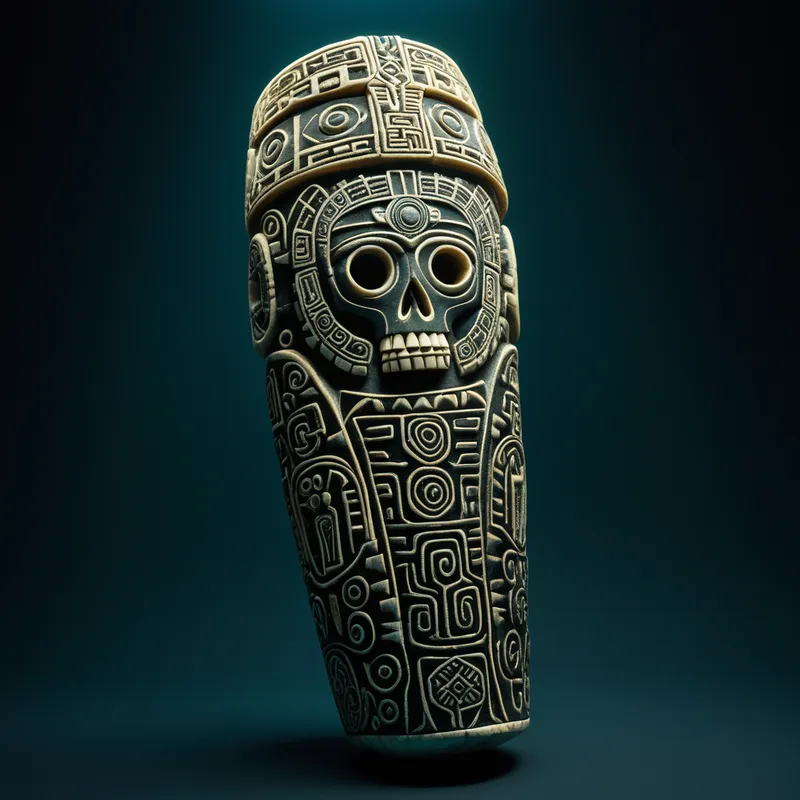
When this myth stirs in the modern dreamer, it often manifests as dreams of deep, labyrinthine basements, forgotten catacombs, or encounters with serene yet imposing skeletal figures. The somatic feeling is one of profound silence, weight, and coolness. There is rarely panic, but a solemn, awe-filled dread.
Psychologically, this signals a necessary confrontation with one's own "Mictlan"—the buried aspects of the self deemed dead: old griefs, abandoned talents, ancestral traumas, or the simple, terrifying fact of one's mortality. The dreamer is being called to perform the work of Quetzalcoatl: to descend, not to conquer, but to retrieve something precious and foundational. The feeling of being tested with an impossible task (the silent conch) reflects life's presenting of paradoxical challenges that require innovative, non-linear thinking, often involving help from ignored instincts (the worms, the bees).
Alchemical Translation
The alchemical process mirrored here is Nigredo, the blackening, the descent into the prima materia of the soul. Mictlantecuhtli is the keeper of that raw, base material—the bones, the unadorned truth.
Individuation is not about becoming perfect, but about becoming complete. It requires gathering the scattered, broken pieces of our history and animating them with the lifeblood of present awareness.
The modern individual's "journey to Mictlan" is the voluntary engagement with shadow work, therapy, or any profound introspection that leads to the core wounds and structures of the personality. The "trick" of the lord is life's inherent resistance to this process—the depressions, the distractions, the sense of futility. To sound the conch is to find one's unique voice and purpose through the engagement with darkness, not by avoiding it.
The ultimate "alchemical translation" is the realization that our vitality and creativity are born precisely from this dialogue with our inner Mictlantecuhtli. We do not defeat death or the unconscious; we acknowledge its lordship, perform the necessary rites (the labor of consciousness), and in doing so, we are granted the fragments from which a more authentic, resilient, and truly alive self can be assembled. We are, all of us, children of broken bones and sacred blood.
Associated Symbols
Explore related symbols from the CaleaDream lexicon: