
Mermaid's Conch Myth Meaning & Symbolism
A mermaid's love for a mortal leads to a cosmic sacrifice, her soul and voice forever bound within a conch shell on the shore.
The Tale of Mermaid's Conch
Listen, and you will hear it still, in the hollow breath of the sea-wind through caves, in the mournful sigh of the tide pulling back from the shore. It is the story of the Mermaid and her Conch.
In the sunless, pressure-crushing deeps where light is a forgotten dream, there lived a mermaid of unparalleled voice. Her songs were the currents that guided the whales on their ancient paths, the lullabies that calmed the leviathans in their trenches. She was Nerissa, and her domain was the silent, weighty majesty of the abyss. Yet, her heart beat to a rhythm not of the deep, but of the surface—a frantic, sun-dappled pulse she heard in the distant crash of waves against the world above.
One night, drawn by a longing she could not name, she ascended. Breaking the silver skin of the moonlit sea, she beheld a sight that stilled her song. A young fisherman, Kaelen, was singing a ragged, human tune to the stars, his voice cracking with loneliness and the salt of the air. It was not beautiful, not like her crystalline harmonies. It was raw, real, and it pierced her deeper than any abyssal cold. In that moment, the orderly cosmos of the sea fractured. The pull of the depths warred with a terrifying, gravitational love for this fragile, singing creature of air and dust.
She returned night after night, hidden in the cove’s shadows, her own voice locked in her throat, listening. To love him was forbidden, a crime against the Laws of Kind. A mermaid’s soul is of the water; a mortal’s, of the earth and air. To bridge this divide was to invite dissolution. Yet, love does not heed law. One evening, as a storm clawed the horizon, Kaelen’s boat was swallowed by the fury. Without a thought, Nerissa acted. She fought the raging sea itself, her tail a powerful whip against the chaos, and dragged his unconscious form to the shore.
But the act had been witnessed. The Old Ones of the Tide rose around her, their forms of swirling foam and ancient coral. “You have touched the mortal world with intent. You have placed one life above the balance of the deep. Your voice, which was ours to command, is forfeit.”
There was no trial. The sentence was immediate. As Kaelen stirred on the sand, Nerissa felt the song ripped from her being—not just the sound, but the very capacity for it. In its place, a profound, echoing silence. Yet, her love, her essence, refused to be extinguished. As the Old Ones sought to pull her back into the featureless deep forever, she made her choice. With a final, soundless cry, she pressed her hands to her chest. From the space where her heart and voice had intertwined, she drew forth her luminous soul, not of water, not of air, but of pure longing. She poured it into a single, empty conch shell upon the shore.
The shell glowed with an inner sea-light, then fell dark and solid. Nerissa’s physical form dissolved into sea foam, returning to the ocean from which she came. But her soul remained, bound forever to the shore, trapped within the spiral of the conch. When Kaelen, weeping, lifted the shell to his ear, he did not hear the ocean. He heard her—her lost song, her unspoken love, the entire tragedy of their impossible connection—a haunting, beautiful echo forever caught between two worlds.

Cultural Origins & Context
The myth of the Mermaid’s Conch is a migratory story, found in fragments and variations across coastal communities from the North Atlantic to the South Pacific. It belongs not to one nation, but to the collective “Global Folklore” of humanity’s relationship with the sea’s edge—that liminal space where the known world of land meets the vast, unknown world of the ocean. It was a tale told by firelight in fishing villages, a narrative currency exchanged along trade routes by sailors and storytellers.
Its primary function was twofold. For practical societies, it served as a stern parable about boundaries: the sea gives sustenance but demands respect; to transgress its laws (by sailing too far, loving unwisely, or taking more than your share) is to risk utter loss. On a deeper, more universal level, it gave poetic form to the profound human experience of hearing the “ocean” in a shell. The tale provided a mythic etiology for this everyday miracle, transforming a natural acoustic phenomenon—the resonance of ambient noise within the shell’s cavity—into a vessel for a cosmic love story. It answered the child’s question, “What am I hearing?” with an answer that nourished the soul: you are hearing the heart of the world itself, remembering a great sacrifice.
Symbolic Architecture
The myth’s power lies in its stark, elegant symbolism. The Mermaid (Nerissa) embodies the deep, unconscious Self—the part of us that is fluid, emotional, instinctual, and vast. Her home is the abyss, the collective unconscious. The Fisherman (Kaelen) represents the conscious Ego, the part of us anchored in reality, working, striving, and often feeling isolated in its mortality.
The conch is the crucible where the soul’s longing becomes an artifact of the world. It is the solidified echo of a choice made at the cost of everything.
Their love is the irresistible, often painful, pull between these two realms—the deep Self longing to be known by the conscious mind, and the conscious mind yearning for the depth, mystery, and nourishment of the Self. The Old Ones of the Tide symbolize the psychic laws that maintain the separation of these realms for the sake of order. To unite them prematurely or forcibly is, indeed, a kind of psychic death.
The Conch Shell is the central symbol of alchemical transformation. Nerissa does not merely lose her voice; she transmutes it. Her soul-voice is no longer a free-flowing song of the deep but becomes a fixed, accessible object on the shore of consciousness. It represents the process by which raw, unconscious content (emotion, intuition, deep longing) is translated into a form that the conscious mind can perceive, hold, and understand—whether as art, insight, love, or a symptom.

The Dreamer's Resonance
When this myth stirs in the modern dreamscape, it signals a profound encounter with the theme of necessary sacrifice for integration. To dream of a mermaid who cannot speak, or of finding a conch shell that holds a haunting sound, is to dream of a part of the deep Self struggling to communicate with the waking ego.
The somatic experience is often one of constriction in the throat (the lost voice) coupled with a deep, aching longing in the chest (the soul poured out). Psychologically, the dreamer may be in a situation where expressing their deepest truth feels forbidden or too costly—perhaps in a relationship, a career, or in acknowledging a core identity. The myth plays out as the psyche’s drama: a powerful inner reality (the mermaid) loves a conscious attitude or life circumstance (the fisherman), but to make that love real requires a death of the old form. The dream is not a warning against love, but a mapping of the immense cost and strange, enduring fruit of true psychic marriage.
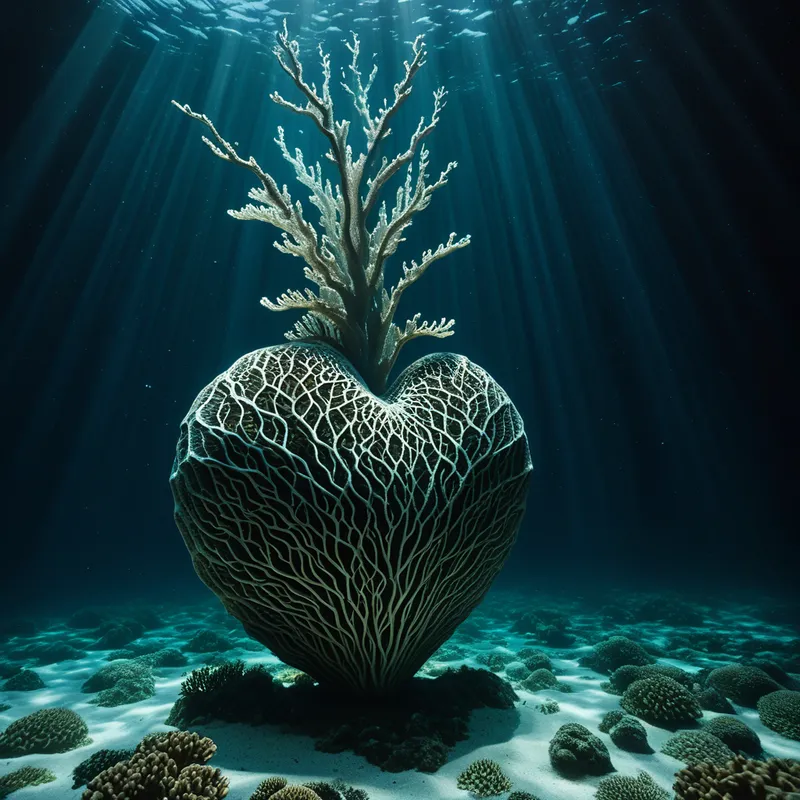
Alchemical Translation
The individuation process modeled here is not one of heroic conquest, but of tragic, beautiful transmutation. The ego (Kaelen) does not slay a dragon or win a treasure. He is saved, then left with only an echo. His task is to listen. This is the alchemical mortificatio—the necessary death of a primal state. Nerissa’s dissolution is the death of the unconscious in its pure, autonomous form. Her binding into the conch is the coagulatio—the spirit made substance.
Individuation often begins not with finding one’s voice, but with losing it, and then discovering that the silence itself has become a new kind of instrument.
For the modern individual, the “Mermaid’s Conch” process occurs when a powerful inner impulse—a creative drive, a deep love, a spiritual calling—cannot be lived out in its original, instinctual form. The world, or our own internal “Old Ones” (superego, fear, practicality), forbids it. The alchemical work is to not let that impulse simply drown or be repressed. Instead, we must perform the inner sacrifice: we must consent to its transformation. The raw, oceanic longing must be poured into a vessel—a painting, a committed relationship built on new terms, a quiet act of integrity, a poem. It becomes an “echo” of its original self, perhaps less boundless, but now tangible, communicable, and present in the world of daylight.
We all hold a conch to our ear. The roaring we hear is not just memory or physics. It is the sound of our own depth, forever calling to our surface, a testament to the love between the soul and the life it chooses to live, and the beautiful, haunting artifact that is forged in the space between.
Associated Symbols
Explore related symbols from the CaleaDream lexicon: