Merkabah Mysticism Myth Meaning & Symbolism
The perilous visionary ascent through seven celestial palaces to behold the divine Chariot-Throne, a journey of ultimate revelation and self-annihilation.
The Tale of Merkabah Mysticism
Listen, and let your soul be still. For I will tell you of a journey not of feet, but of spirit; a path not of earth, but of fire. It begins not in a sunlit field, but in the deepest chamber of the heart, where silence becomes a roar and darkness becomes a blinding sun.
The seeker, the Yored Merkavah, sits alone. The world of markets and meals falls away like a discarded garment. He fasts. He chants. He immerses himself in the sacred words, the names that are keys, the verses that are maps. His body is here, on the cold stone floor, but his intention is a spear aimed at the heavens. He seeks the Merkabah, the very Throne-Chariot of the Holy One, blessed be He.
The first step is a tearing. It is the sensation of the soul being drawn upward, through the ceiling of clay and into a realm of trembling air—the first Hekhal. Here, the guardians are not soldiers but presences, vast and formless, radiating a terror that is not of malice, but of sheer, unbearable reality. To pass, he must offer a seal—a name of power, a fragment of divine speech—burning on his tongue like a live coal.
Palace by palace, the ascent continues. Each hall is a world of its own, with gates of swirling fire and rivers of liquid diamond. In one, the air itself sings with the memories of creation. In another, mountains of black flame bow in perpetual worship. The guardians grow more terrible, more magnificent: the Chayot HaKodesh with their four faces and countless wings, the Ophanim, wheels within wheels, full of eyes, their movement the sound of universes grinding in harmony.
Doubt is a poison here. Fear is a wall. Many, it is said, turned back, their minds shattered by the beauty and the terror, unable to distinguish between revelation and madness. But our seeker presses on, his desire a single, pure note amidst the cosmic symphony. He passes through the sixth hall, a place of absolute music, where the prayers of all creation are woven into a single, luminous tapestry.
And then, he stands before the final veil: the curtain of the seventh Hekhal. Beyond it lies the impossible. The air hums with a silence that contains all sound. Here, the last and greatest guardian stands—not to block, but to test. The seeker offers not a name, but his own annihilated will. The guardian asks a question woven from light and shadow. The answer is not spoken, but become.
The curtain parts.
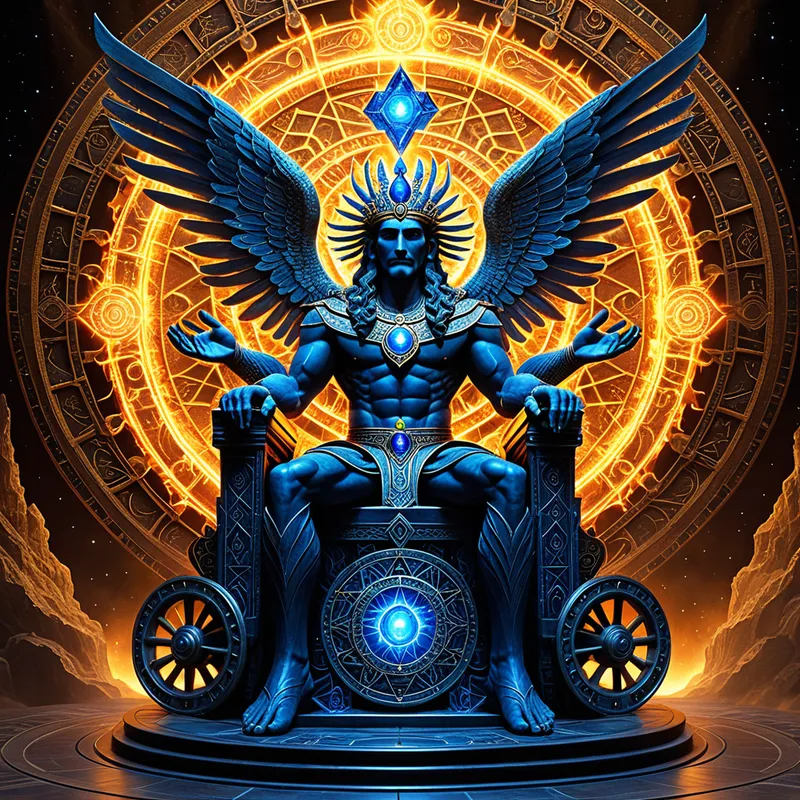
There is no chariot as mortals understand it. There is a configuration of reality, a living geometry of desire and law. The Ophanim are its motion. The Chayot are its consciousness. And above, upon a sapphire semblance of a throne, a form of unbearable intensity—the Demut K'Mar'eh Adam, the Appearance of the Likeness of a Human Form. It is the source of all structure, all direction, all love and all judgment. To behold it is to cease to behold. The seeker does not see with eyes, but is seen. He does not know, but is known. In that instant of absolute exposure, he is unmade and remade. He has descended the chariot. The journey is complete.
Cultural Origins & Context
This was not a myth for the marketplace, but for the hidden chamber. Merkabah Mysticism flourished from late antiquity (circa 100 BCE to 1000 CE) within esoteric Jewish circles, its practices and visions meticulously guarded. The primary textual sources, like the Hekhalot Rabbati and Hekhalot Zutreti, are not stories to be read, but technical manuals for a terrifyingly real spiritual technology. The practitioners, the Yordei Merkavah, were not mere philosophers; they were ascetic voyagers.
The myth was transmitted from master to initiated disciple in whispers, its power believed to reside in the precise utterance of divine names and the meticulous mental construction of the celestial topography. Its societal function was dual: it was the ultimate pursuit of individual communion with the divine, a direct experience of the Shekhinah, and it served as a reaffirmation of cosmic order. In a world of exile and political turmoil, the vision of the unwavering, majestic throne at the heart of creation was a profound psychological and theological anchor. It asserted that beyond the chaos of history was a structure of perfect, if inscrutable, justice and beauty.
Symbolic Architecture
The Merkabah is not merely a vehicle; it is the symbolic architecture of the cosmos and the psyche. The journey through the seven palaces represents the systematic purification and reordering of consciousness.
The path to the center requires passing through the guardians of your own periphery.
Each Hekhal is a layer of the self—a complex of emotions, beliefs, and psychic structures that must be consciously encountered and navigated. The terrifying angels are the personified forces of one's own inner resistance: the fear of the unknown, the arrogance of the intellect, the attachment to a familiar, smaller self. The seals and passwords are the authentic insights and hard-won integrities that allow passage beyond these self-created barriers.
The Merkabah itself is the ultimate symbol of the integrated Self (in Jungian terms, the culmination of the individuation process). The harmonious, dynamic interaction of the Chayot (instinct, feeling, consciousness) and the Ophanim (the patterns, laws, and unconscious structures of the psyche) depicts a psyche in perfect alignment. The throne is the transcendent center, the point where personal consciousness touches the archetypal ground of being.
The Dreamer's Resonance
When this myth stirs in the modern dreamer, it rarely appears as biblical angels. Instead, it manifests as dreams of profound, structured ascent. Dreams of climbing an endless, intricate staircase within a vast building. Dreams of passing through a series of sealed, symbolic doors, each requiring a specific action or realization to open. There may be dreams of complex, moving machinery—gears, elevators, or vehicles—that feel both awe-inspiring and terrifyingly precise.
Somatically, this process can feel like a pressure in the crown of the head, a sense of being "rewired," or profound disorientation as old psychic structures dissolve. Psychologically, it signals a critical phase of inner consolidation. The dreamer is navigating the layers of their own psyche, confronting internal "guardians" of trauma, fixed identity, or outmoded beliefs. The dream is a map of the individuation journey, confirming that the center—the true, authentic Self—is not a static point, but a dynamic, living reality that organizes all aspects of one's being.
Alchemical Translation
The alchemy of the Merkabah is the transmutation of scattered consciousness into a vehicle for the transcendent. The base metal is the fragmented, ego-driven personality, identified with its thoughts, roles, and passions. The seven palaces are the stages of the Opus: calcination (the ascetic fasting, the breaking down), dissolution (the terror of the guardians), separation (distinguishing self from non-self), conjunction (the offering of the seal), fermentation (the hum before the veil), distillation (the beholding), and coagulation (the return, remade).
The goal is not to become the throne, but to become a coherent vessel capable of bearing its reflection.
For the modern individual, this models the process of moving from a life driven by external pressures and internal conflicts to one oriented from an inner, numinous center. It is the work of gathering all one's disparate parts—the ambitious driver, the vulnerable child, the critical judge, the creative spirit—and aligning them into a cooperative "chariot." The conflict is the resistance of these parts to change. The triumph is not a final arrival, but the achievement of a state where one's entire being becomes a conduit for meaning, purpose, and connection to something greater than the isolated ego. One becomes, in a sense, a vehicle for the divine.
Associated Symbols
Explore related symbols from the CaleaDream lexicon: