Merkabah Myth Meaning & Symbolism
A prophet's terrifying vision of a celestial chariot-throne, revealing the layered structure of reality and the soul's journey toward divine knowledge.
The Tale of Merkabah
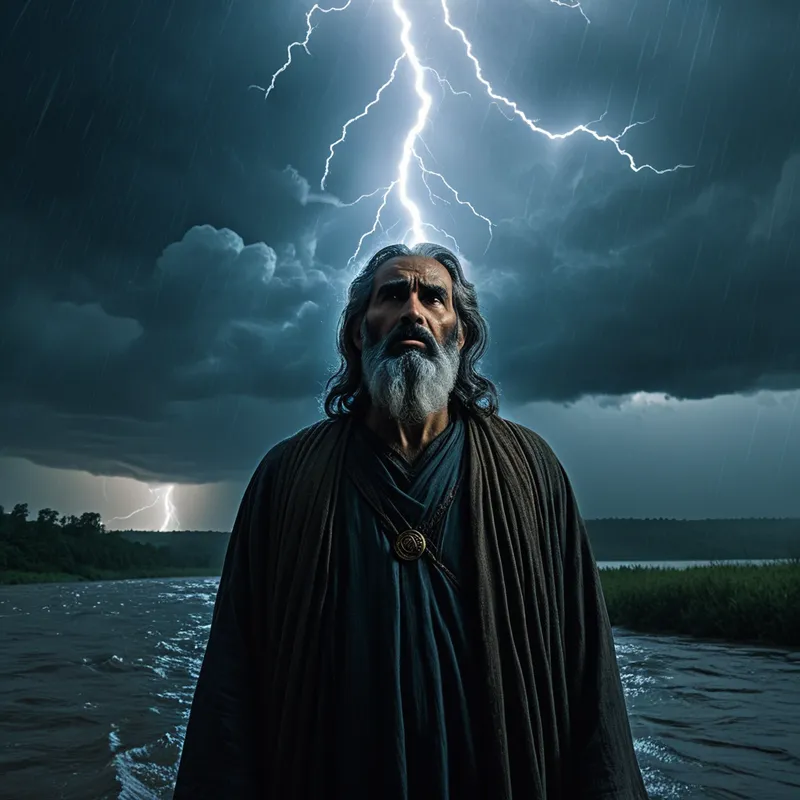
Hear now, and listen closely. The air by the river Chebar was thick with the dust of exile, a bitter taste on the tongue of a people severed from their sacred ground. The sky was not their sky; the earth, a hard and foreign clay. In this place of profound dislocation, a man named Ezekiel, priest and captive, walked with the weight of a broken world upon his shoulders.
Then, the fabric of the mundane world tore.
It began not with a sound, but with a pressure—a great wind rushing from the north, a storm cloud lit from within by a continuous fire, a glow like molten metal. The heavens themselves were rent asunder. From this terrifying aperture descended a vision that defied mortal comprehension. First came the four Chayot, the Living Creatures. They were not beasts as we know them, but colossal forms of burning coals and lightning. Each had four faces: that of a human, a lion, an ox, and an eagle, gazing outward to the four corners of creation. Their wings touched one another, and the sound of their flight was like the roar of mighty waters, like the voice of the Almighty, like the tumult of an army.
Beneath them were wheels, a Ophanim of dreadful complexity. A wheel intersecting a wheel, at right angles, rimmed with countless eyes. Where the spirit of the Creatures went, the wheels went, for the spirit of the Creatures was in the wheels. They moved as one, not turning, but translating across reality.
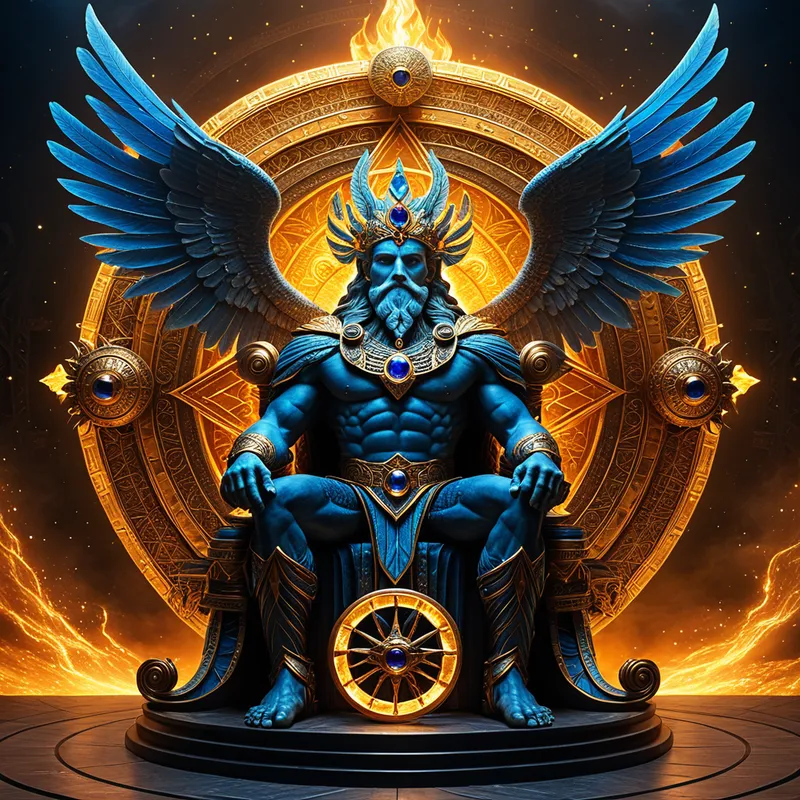
And above the heads of the Creatures was a expanse, like terrible crystal, shimmering. Above the expanse was a throne, of the appearance of sapphire. And upon the likeness of the throne was a likeness: a form like that of a man, but forged from fire and glowing amber, from the loins upward and downward. It was a radiance like a rainbow in the clouds on a rainy day. This was the appearance of the likeness of the glory of YHWH.
Ezekiel fell upon his face. The vision was not a gentle revelation but a catastrophic unveiling, an ontological quake. A voice spoke, and he was commanded to stand, to ingest a scroll of lamentation, to become a watchman. The vision of the Merkabah did not bring comfort; it conferred a terrible, electrifying purpose. It was the foundation of reality revealed not in peace, but in the storm of exile, establishing that the divine throne was not bound to a temple of stone, but moved with terrifying freedom through the cosmos and history itself.
Cultural Origins & Context
This vision is recorded in the opening chapter of the Book of Ezekiel, a text born in the crucible of the 6th century BCE Babylonian exile. This was a period of profound trauma for the Hebrew people: their temple destroyed, their monarchy ended, their land lost. The central question was existential: Where was God when the sacred center was gone?
The Merkabah vision provided a shocking answer. It emerged not from the stable center, but from the traumatized periphery. It was a mysticism of the displaced. The tradition was passed down with extreme caution, forming the core of a secretive, esoteric stream within Judaism known as Merkabah Mysticism or Hekhalot literature. These texts, composed centuries later, detailed elaborate, often perilous rituals of ascent—the "descent to the chariot"—where initiates sought to navigate the celestial palaces (Hekhalot) guarded by terrifying angels, to behold the throne itself. This was not for the masses; it was the pursuit of a scholarly, ascetic elite, a direct and dangerous engagement with the divine architecture. Its societal function was dual: to assert God’s ultimate sovereignty beyond any earthly catastrophe, and to provide a map for the most audacious human endeavor—the journey of the soul to its source.
Symbolic Architecture
The Merkabah is not merely a vehicle; it is a dynamic, multi-layered symbol of the structured cosmos and the structured soul. The four Chayot represent the foundational forces of creation—the human (reason), the lion (power), the ox (service), the eagle (transcendence)—integrated into a single, moving unity. They are the tetramorph, the four pillars of the world and the psyche.
The wheels within wheels, their rims full of eyes, symbolize the interconnectedness of all levels of reality—the spiritual and material, the macrocosm and microcosm—and the awakening of all-seeing consciousness.
The throne above the crystal firmament signifies the transcendent, utterly unknowable divine essence (Ein Sof), while the fiery human-like form upon it represents the divine presence (Kavod) that can be apprehended, however partially, by the human mind and heart. The entire construct is a metaphysical blueprint: the universe is an ordered, living system, a chariot driven by divine will, and the human soul is a microcosm of that same divine chariot, capable of ascending through its own layered levels of being.
The Dreamer's Resonance
When the pattern of the Merkabah stirs in the modern unconscious, it often manifests in dreams of profound structural revelation and disorienting ascent. One might dream of complex, humming machinery—gears within gears, luminous schematics floating in space, or suddenly understanding the hidden wiring of reality. There may be dreams of terrifying but beautiful vehicles that move without friction, or of ascending through layered, architecturally impossible buildings (the modern Hekhalot), each floor guarded by intimidating figures or puzzles.
Somatically, this process can feel like a "rewiring"—a buzzing in the crown of the head, a sense of pressure or expansion. Psychologically, it marks a crisis point where the dreamer's old worldview ("the temple") has been destroyed (exile), and the psyche is compelled to discover a new, more dynamic and terrifying order. It is the soul's intelligence attempting to map its own divine architecture, often accompanied by both awe and profound anxiety. The dream is an invitation to stand, like Ezekiel, and integrate the vision, to ingest the bitter scroll of one's own reality and speak from that charged center.

Alchemical Translation
The Merkabah myth models the alchemical process of psychic transmutation, or individuation, in its most radical form. The initial state is exile—the feeling of being severed from one's inner center, one's meaning (the destroyed temple). The catalyst is the cataclysm—the tearing open of the heavens, which in personal terms is a shattering insight, a breakdown, or a numinous experience that obliterates conventional perception.
The arduous journey through the celestial palaces is the disciplined work of introspection, confronting the "angelic" guardians of one's own psychic layers: repressed emotions, intellectual pride, spiritual arrogance, and fear.
The vision of the throne is the encounter with the Self, the central, organizing principle of the psyche that transcends the ego. It is not a comfortable union, but a terrifying confrontation with one's own ultimate nature and purpose. The final stage is not rest, but commission: the integrated individual returns, charged with a new, authoritative consciousness, to act as a "watchman" in their own world. The Merkabah thus symbolizes the ultimate triumph: the realization that the sacred center is not a place to which one returns, but a dynamic, moving structure of consciousness that one becomes. The soul does not find the chariot; the soul, in its wholeness, is the chariot, forever ascending.
Associated Symbols
Explore related symbols from the CaleaDream lexicon: