Mercury's Forum Myth Meaning & Symbolism
A myth of the god Mercury establishing the sacred marketplace, a crossroads where divine messages, mortal trade, and the soul's negotiations converge.
The Tale of Mercury's Forum
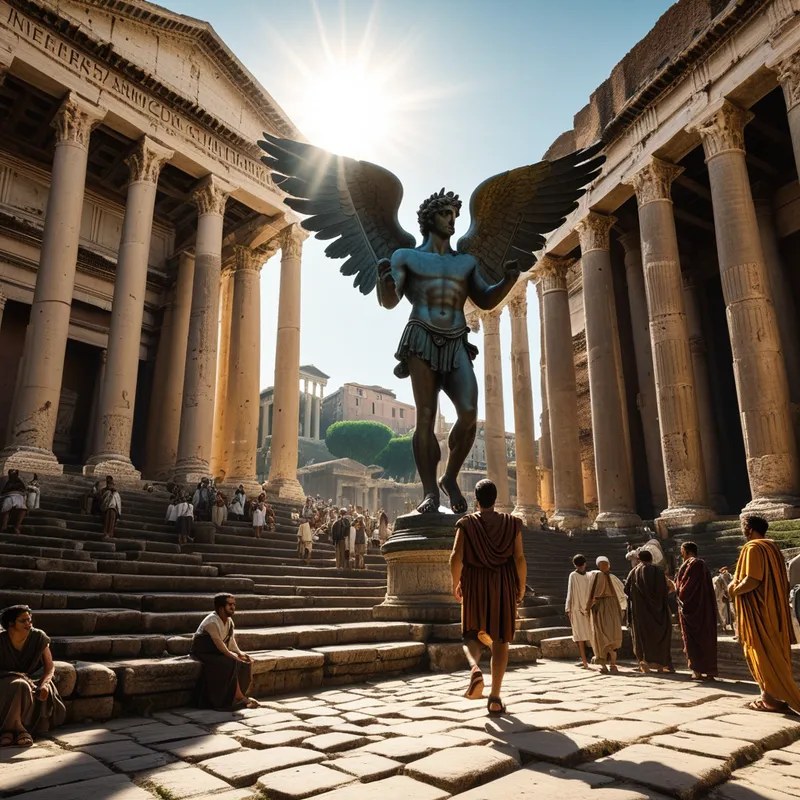
Before the first cobblestone was laid, before the first cry of a vendor pierced the morning air, there was only a crossroads of dusty earth. It was a place of potential, a silent void between the seven hills. The air here was different—charged, thin, a place where the veil between the worlds of gods and mortals wore gossamer thin. It was here that Mercury alighted, his winged sandals barely disturbing the dust.
He moved not as a conqueror, but as a catalyst. With a touch of his caduceus, he did not command stone to rise. Instead, he stirred the numen—the sacred spirit—of the place itself. He whispered to the genius loci, the spirit of the locale, a proposition. "Let this be a throat," he murmured, his voice the sound of wind through reeds and clinking coins. "A throat for the words of Jupiter to become law, for the pleas of mortals to become heard, for the grain of the field to find the hungry mouth, and the crafted pot to find the needing hand."
And the land listened. It was not built, but consecrated. The first stone, placed by no human hand, was a simple, flat altar—the Mercurial. Around it, the ground seemed to firm with purpose. Paths became defined not by walls, but by flow. Soon, the first mortal, a shepherd with a lamb to trade, felt drawn to the spot. He saw not a god in glory, but a stranger with keen eyes who helped him barter fairly with a potter from a distant hill. The bargain was struck, and with it, a spark leapt between them—more than commerce, a thread of understanding.
Word spread, not as decree, but as rumor, as compelling gossip. The farmer came with his olives, the smith with his nails, the senator with his proclamations. Mercury walked among them, now in the guise of a wealthy merchant, now a swift messenger, now a cunning thief testing the security of a stall. He taught them the sacred dance of the Forum: the offer, the counter-offer, the oath sworn upon his altar, the binding handshake. He showed them that every transaction was a conversation, every sale a story exchanged, and every contract a tiny act of faith in a shared reality. The Forum was born not from order, but from this vibrant, chaotic, divinely-sanctioned negotiation—a beating heart of words, wealth, and connection at the center of the world.
Cultural Origins & Context
The myth of Mercury's Forum is not a single, codified epic, but a foundational story woven into the very fabric of Roman civic and religious life. It emerges from the Roman genius for pragmatic spirituality. Unlike the grand, cosmic myths of creation, this was an aition for a daily reality: the marketplace. It was told by fathers to sons who would take up the family trade, by priests at the Mercuralia, and felt in the air every market day.
Its societal function was profound. It sacralized the act of commerce, lifting it from mere profiteering to a divine activity under the protection of Mercurius. The Forum Romanum was the political, legal, and commercial nucleus of Rome. By attributing its spiritual inception to Mercury, the Romans infused all activity within it—from selling grain to passing laws—with a sense of sacred trust and communication. The myth served as a psychic container for the inherent tensions of public life: competition and cooperation, truth and deception, individual gain and communal good. It reminded every citizen that their dealings were watched by the god of the threshold, ensuring that the community's lifeblood—exchange—flowed within a consecrated space.
Symbolic Architecture
At its core, the myth of Mercury's Forum is about the psychic infrastructure necessary for a conscious society and an integrated self. The Forum is not merely a marketplace; it is the archetypal crossroads made manifest, the internal temenos (sacred precinct) where different parts of the psyche meet to negotiate.
The Forum is the soul's agora, where thoughts barter with feelings, and instincts seek treaties with ideals.
Mercury, as the divine psychopomp, does not create this space from nothing, but activates its latent potential. He represents the conscious function of relating—the ego's capacity to facilitate communication between the unconscious depths (the chthonic) and the conscious world. His caduceus, with its intertwined serpents, symbolizes the balancing of opposites—buyer and seller, liar and truth-teller, mortal and divine—that must occur for any true exchange or transformation to happen. The stone altar, the Mercurial, is the symbolic anchor, the immutable point of reference (the Self) around which the chaotic yet creative dance of the personality revolves.

The Dreamer's Resonance
When this myth pattern stirs in the modern dreamer, it often manifests as dreams of vast, labyrinthine marketplaces, bustling airports, or complex communication hubs. The dreamer may be frantically searching for a specific person to deliver a message, trying to sell an item of unknown value, or lost in a crowd where every face seems to hold a fragment of a crucial deal. There is a somatic quality of urgency, of something vital needing to be transacted.
Psychologically, this indicates a process of internal negotiation and integration. The "forum" is the dreamer's psyche attempting to establish a conscious marketplace. Perhaps a repressed emotion (the "shepherd with a lamb") is seeking expression and needs to bargain with a rigid self-concept (the "potter"). Or a brilliant but unformed idea seeks the "currency" of words to be exchanged with the world. The anxiety in such dreams points to the ego's struggle to play the role of Mercury—to become the competent facilitator of these inner exchanges, fearing deception (the thief) or failure to connect. The dream is an imperative from the Self: it is time to consciously host the forum within, to allow internal parts to speak, deal, and form alliances.
Alchemical Translation
The alchemical journey modeled here is that of circulatio—the circulation and exchange that must precede any transmutation. Individuation is not a solitary, linear ascent; it is a constant, dynamic negotiation between the elements of one's being. The myth provides the blueprint for this psychic alchemy.
First, one must consecrate the crossroads—identify and honor the inner space where conflicts and potentials meet. This is the act of turning attention inward, making the psyche itself a temenos. Then, one must invoke the Mercurial spirit within: the observing, mediating consciousness that can hold opposites without premature judgment. This consciousness facilitates the "trade": the shadow offers its raw energy and instinct in exchange for the light of awareness; the persona offers its social skills in exchange for the authenticity of the soul.
The goal is not to win every internal bargain, but to ensure the market remains open, that the circulation of psychic value never ceases.
The final stage is not a static "perfection," but the establishment of a permanent, internal Forum. The integrated individual becomes a living marketplace of the soul, where thoughts, feelings, intuitions, and sensations are in perpetual, creative exchange. The caduceus is realized as the balanced nervous system itself, and the once-dusty crossroads becomes the vibrant, self-regulating center of a truly communicative and coherent existence. One becomes, in essence, both the merchant and the marketplace, the message and the messenger, grounded at one's own altar while engaged in the sacred commerce of becoming whole.
Associated Symbols
Explore related symbols from the CaleaDream lexicon: