
Menthe Myth Meaning & Symbolism
A nymph loved by Hades is transformed into the mint plant by a jealous Persephone, her essence forever fragrant and enduring in the underworld's shadow.
The Tale of Menthe
Listen, and hear the whisper that rises from the damp earth, a scent carried on the chill breath of the underworld. This is not a story of glorious heroes, but of a quiet longing that changed the very fabric of the land of the dead.
In the sunless realm of Hades, where the pale ghosts of Asphodel wander, a different kind of life persisted. Along the banks of the groaning river Cocytus, where the waters weep with the sorrow of the departed, lived a nymph named Menthe. She was not a creature of bright meadows, but of these shadowed, fertile banks. Her beauty was of the deep earth, cool and compelling, and it caught the eye of the king himself.
Hades, the stern lord of the invisible, found in Menthe a solace that the stark silence of his realm could not provide. In the hidden groves by the wailing river, a secret love grew. For a time, the underworld knew a fragrance other than dust and mourning—the fresh, sharp scent of the nymph by the water.
But the underworld has a queen. Persephone, who divides her year between darkness and light, returned from the world above to find a rival in her own domain. The whispers of the shades reached her: tales of her husband’s diverted attention, of a nymph whose presence made the dead riverbanks seem alive. A cold fury, deeper than the Styx, took root in Persephone’s heart. This was not just jealousy; it was a violation of the order of her kingdom, a challenge to her hard-won throne beside the king of ghosts.
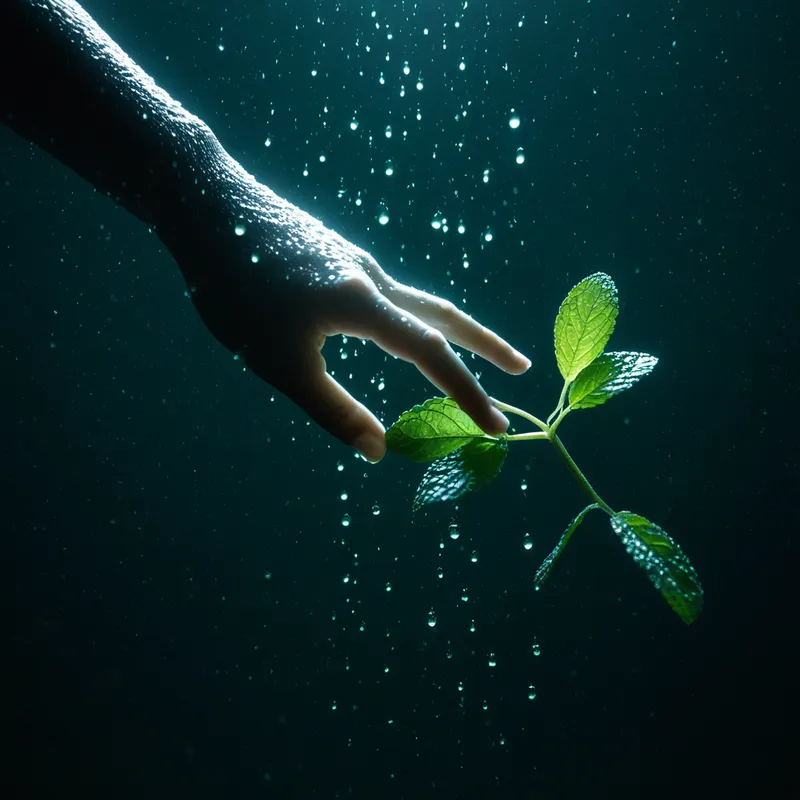
There was no dramatic battle. No thunderbolts from Zeus. The end came with a terrible, quiet finality. Confronting the nymph on her own riverbank, Persephone did not strike her down. She spoke a word of power, a decree of transformation. The very earth under Menthe’s feet turned against her. She felt her limbs grow heavy, not with flesh but with sap. Her cries were stifled as her voice became the rustle of leaves in a non-existent breeze. Her form, so loved, dissolved into the mud. From the place where she fell, a new life pushed through the gloom—a humble, tenacious plant with a scent so vibrant, so defiantly alive, it cut through the very air of death.
Hades could not reverse the will of his queen. But in his silent grief, he granted a final boon. The plant would not wither. Its fragrance would grow stronger when bruised, a perpetual reminder, a soul made into scent, forever rooted at the threshold of his realm. And so, mint was born—not in a sunlit field, but in the heart of darkness, a testament to a love that was trampled but refused to die.
Cultural Origins & Context
The story of Menthe is a late-blooming flower in the garden of Greek myth. Our primary source is the geographer Strabo, who recorded it in the 1st century BCE, though it likely circulated in local oral traditions long before. Unlike the grand Homeric Hymns or Hesiod’s Theogony, this tale belongs to the realm of aetiology—stories that explain the origin of natural phenomena, in this case, the mint plant (Mentha), and particularly its association with funerary rites and the underworld.
Its tellers were likely not epic poets in royal courts, but people close to the land: herbalists, gardeners, and participants in the Eleusinian Mysteries. The myth served a dual societal function. First, it explained why mint was used to scent funeral homes and was often planted near graves—it was a plant born of the underworld, a fitting offering to placate Plouton and honor the dead. Second, it acted as a cautionary narrative within the patriarchal structure, illustrating the peril of crossing the established queen, Persephone, and by extension, the dangerous dynamics of divine favor and marital power.
Symbolic Architecture
At its core, the myth of Menthe is an alchemical drama of essence under pressure. Menthe is not destroyed; she is transmuted. Her form changes, but her fundamental quality—her evocative, penetrating scent—is not only preserved but amplified. This is the psyche’s response to catastrophic change.
To be transformed is not to be annihilated. The soul, when crushed by circumstance, often releases its most potent fragrance.
Menthe symbolizes the part of the psyche that exists in the "underworld"—our unconscious, shadowy depths where secret loves, hidden passions, and repressed desires reside. Hades represents the pull of this depth, the fascination with what is hidden and taboo. Persephone, in her wrath, embodies the enforcing principle of the conscious order. She is the reigning complex (the Queenly attitude, the established identity) that violently rejects the intruding, destabilizing content (the secret love, the new fascination) from the depths.
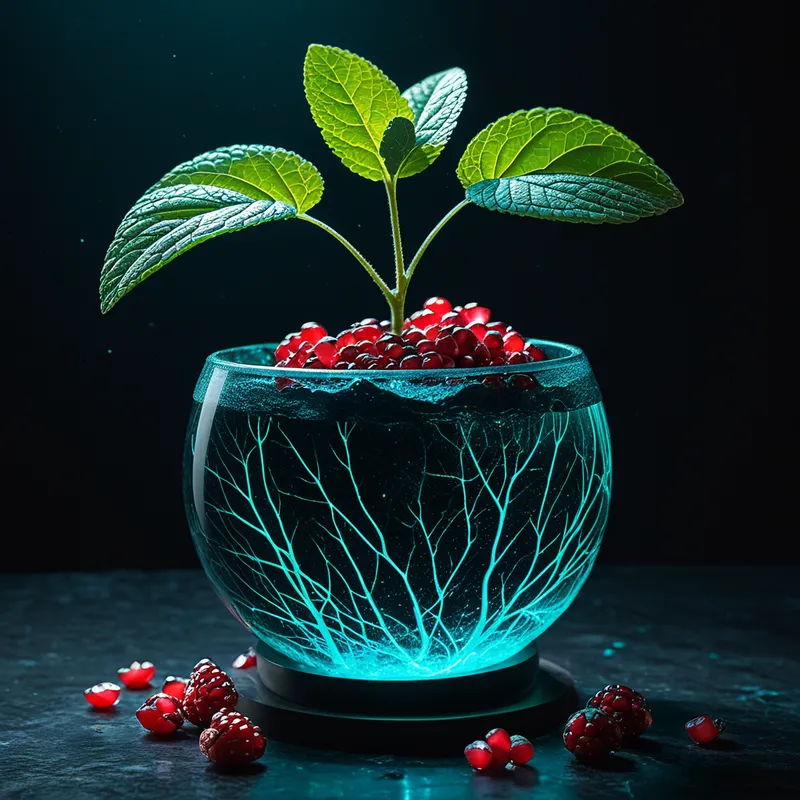
The riverbank setting is profoundly symbolic. It is the liminal space, the threshold between the water (the unconscious, emotion) and the land (the known, the solid). It is here, at the edge, that transformation occurs. Menthe’s fate tells us that what the conscious ego cannot integrate, it may metaphorically "trample," forcing it into another form of existence within the psychic ecology.
The Dreamer's Resonance
When this myth stirs in the modern dreamer, it often signals a profound process of involuntary transformation. You do not dream of mint; you dream as Menthe.
The somatic experience might be one of chilling dampness, of being rooted to a spot in a dark landscape, or a sensation of your body becoming plant-like—heavy, fibrous, growing in a direction not of your choosing. Psychologically, this is the dreamscape of a crushing defeat, a humiliation, or a profound loss where you feel your identity has been violently altered by an external, powerful force (the Persephone figure—a partner, a parent, an institution, or an inner critic).
The dream is not merely reporting the trauma. It is depicting the alchemical vessel of that trauma. The transformation into mint signifies that the core of your being, your essential "scent" or unique vitality, is not gone. It has been forced into a new, perhaps more humble, but incredibly resilient form. The dream asks: What part of you has been "trampled" but now grows back, fragrant and persistent, in the shadowed places of your life?

Alchemical Translation
The individuation journey modeled here is not one of heroic conquest, but of fragrant endurance. It is the path of the lover archetype, not in its romantic guise, but in its essential form: that which values connection, essence, and quality above all, and which undergoes metamorphosis to preserve that essence.
The first alchemical stage is separatio: Menthe is severed from her nymph-form, from her relationship, from her previous life. This is the painful, often unjust-seeming crisis. The second is mortificatio: she is "killed" or dissolved into the primal mud. In psychological terms, this is the ego’s dissolution, the feeling of being nothing, of identity crumbling.
But the crucial, third stage is where the work lies: sublimatio. Her essence rises not as a spirit, but as a scent. This is the psychic transmutation. The modern individual undergoing a "Menthe process" must learn to identify not with the lost form (the old job, the ended relationship, the former self-image) but with the enduring quality that defined it. What is your essential "scent"? Is it creativity? Compassion? Insight? The myth teaches that this quality, when pressed upon by life’s trampling feet, does not vanish. It becomes more potent, more discernible, and gains a new kind of power—the power to refresh, to awaken, to cut through the stagnant air of despair.
The final gift of Hades—allowing the mint to thrive—is the unconscious itself sanctioning this new form. The depths accept the transformed one. Your new, resilient growth is granted a permanent place in your own psychic underworld, ensuring you are never truly alien to your own darkness.
To integrate the myth of Menthe is to recognize that some of our most beautiful and useful traits are born not in the light of success, but in the dark soil of loss, jealousy, and crushing change. We are asked to become gardeners of our own underworld, tending the fragrant, tenacious growth that springs from the very spot where we were broken.
Associated Symbols
Explore related symbols from the CaleaDream lexicon: