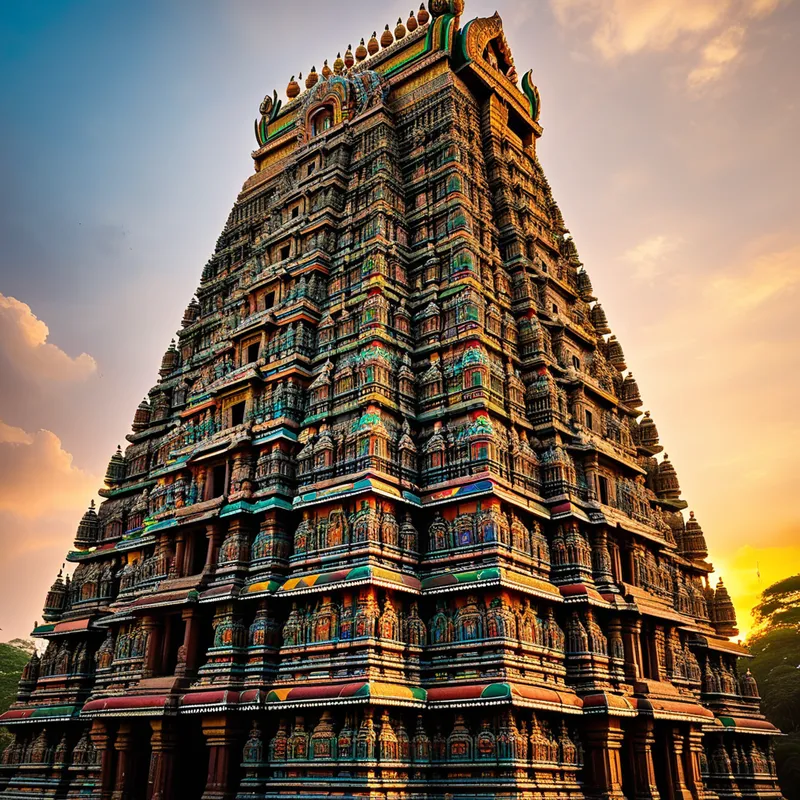
Meenakshi Temple Gopurams Myth Meaning & Symbolism
The myth of the divine marriage of Meenakshi and Sundareshvara, whose sacred union is eternally celebrated by the temple's towering, sculpted gateways.
The Tale of Meenakshi Temple Gopurams
Listen. The air in Madurai is thick with jasmine and the murmur of a thousand prayers. It was not always a city of stone and song. Once, it was a kingdom of sorrow. The pious King Malayadhwaja and Queen Kanchanamala ruled with grace, yet their hearts were a barren field, for they had no child to inherit the throne. Their prayers were not whispers but storms, shaking the heavens until the very earth trembled in response.
From the heart of a sacred fire, born of their desperate, blazing devotion, a miracle took form. Not a babe, but a girl-child of three, radiant and fierce, with three breasts and eyes that held the light of the moon and the ferocity of a fish—Meenakshi. A voice from the void proclaimed she would rule, and that her third breast would vanish only when she met her destined lord. She grew not as a princess but as a sovereign force, a warrior-queen whose conquests bent the earth to her will. She led her armies across the world, until her path led north, to the holy mountain Kailasha.
There, at the gates of the realm of Sundareshvara, her advance halted. Not by army, but by presence. Before her stood the ascetic god, Shiva, in his form as the beautiful lord. Their eyes met. In that gaze, a universe was recognized. The warrior’s sword grew heavy; the conqueror’s heart forgot its campaign. As prophesied, her third breast melted away, not in defeat, but in completion. The fierce, independent power of the goddess bowed only to its own other half, the still, boundless consciousness of the god.
The cosmos held its breath. The marriage was not a merger but a magnificent celebration of duality in union. The heavens descended to Madurai. Vishnu, as her brother, gave her away. Brahma officiated. The Gandharvas sang, and the rivers flowed with nectar. But this was not an end. It was an eternal beginning. To commemorate this divine wedding, to make the invisible union permanently visible to mortal eyes, the very landscape transformed. Towering gateways, the Gopurams, began to rise. They were not built; they were revealed, emerging from the earth like stone hymns, each sculpted figure a frozen note in the eternal song of the marriage of Shiva-Shakti. They stand to this day, not as mere entrances, but as the wedding guests who never left, forever witnessing, forever celebrating.
Cultural Origins & Context
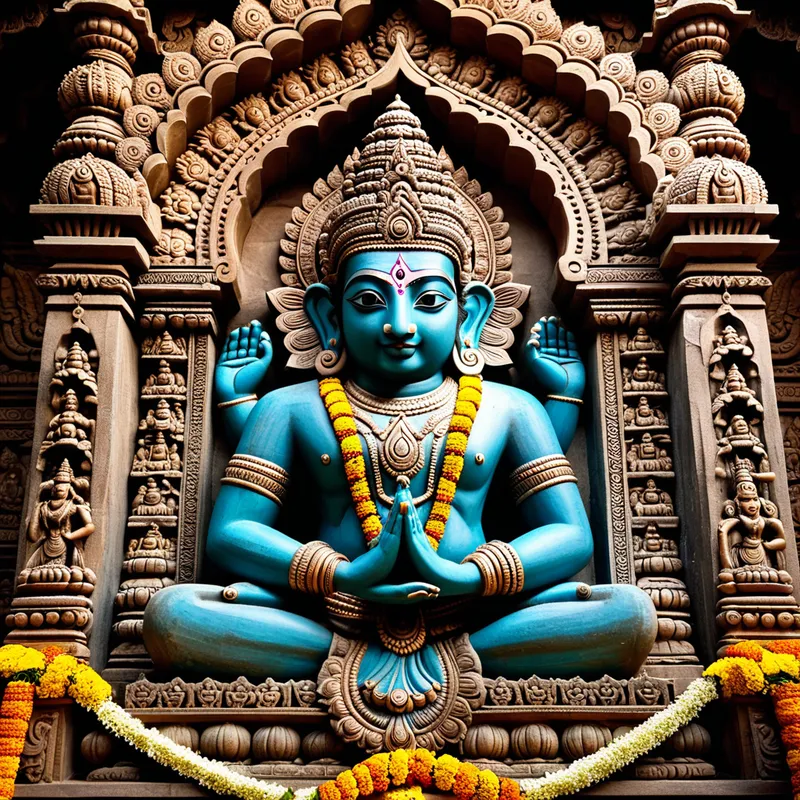
This is the living heart of the Dravidian world, not a fossilized legend but a rhythmic pulse within the Sangam tradition and later devotional (Bhakti) literature. The myth is the foundational narrative of the Meenakshi Amman Temple, one of the grandest architectural expressions of Tamil culture. It was passed down not just by priests, but by poets, dancers in the Bharatanatyam tradition, and generations of devotees who see the temple itself as the literal body of the myth.
Its societal function is multifaceted. It establishes Madurai as a sacred axis mundi, a center of the world. It validates the sovereignty of the feminine principle, with Meenakshi as the ruling deity, a powerful model of female autonomy and power that is then integrated into a sacred partnership. Most importantly, it provides the cosmological reason for the temple’s existence and its most stunning feature: the gopurams. These towers are the myth made manifest, a daily reminder that the divine is not abstract but immanent, its story literally surrounding and towering over the community.
Symbolic Architecture
The myth is a profound blueprint for psychic structure. Meenakshi, the three-breasted warrior queen, represents the raw, untamed, and sovereign power of the individual psyche—the anima in its most potent, undomesticated form. Her conquests symbolize the ego’s necessary, often aggressive, journey to establish its territory in the world. The third breast is the marker of this potent, self-sufficient state, a power that is complete in itself but oriented for a singular purpose.
The meeting at Kailasha is not a surrender, but a recognition. The separate self encounters the ground of all being.
Sundareshvara represents the transcendent principle, the still, silent center of consciousness (animus as pure awareness). He does not fight; he is. Their union signifies the integration of dynamic, worldly power with serene, transcendental awareness. The vanishing of the third breast is the alchemical moment where a power used for conquest transforms into a power used for creation and union. The gopurams, then, are the symbolic result of this inner marriage.
They are the psyche’s own architecture, rising from the marriage of conscious achievement and unconscious depth. Each statue on their faces represents a complex, a memory, an archetype, now organized into a coherent, upward-pointing whole.
The Dreamer's Resonance
To dream of such structures—towering, intricate gates or impossible towers covered in faces—is to experience the psyche in the act of self-organization. The dreamer is likely at a pivotal point where a long-held, singular identity (the warrior queen) is encountering a deeper, more encompassing aspect of the Self. The somatic feeling is often one of awe mixed with vertigo: the scale is overwhelming.
The countless figures on the dream-gopuram may feel like the “crowd” of one’s own internal parts, past selves, influences, and potentials. The dream’s focus is key: Is the dreamer struggling to find the entrance (resisting integration)? Are they climbing it (actively working toward synthesis)? Or are they simply gazing up, overwhelmed by its complexity (confronting the magnitude of their own psyche)? This dream pattern signals the construction of a new inner hierarchy, where disparate elements are being arranged not by the ego’s will, but by the centering force of a deeper, unifying principle—the divine marriage within.
Alchemical Translation
The individuation process mirrored here is the Coniunctio Oppositorum—the sacred marriage of opposites. For the modern individual, Meenakshi’s initial path is the necessary first half of life: building the ego, conquering territory (professional, personal), and developing a strong, independent identity. This is critical work. But the myth warns that this path, alone, leads to endless, repetitive campaigning—a life of conquest without meaning.
The alchemical translation occurs at the foot of Kailasha, the mountain of the Self. It is the moment one’s driven, achieving consciousness (Meenakshi) stops, looks inward, and recognizes its source in a vast, quiet awareness (Sundareshvara). The “third breast”—the symbol of a power defined solely by its ability to overcome external obstacles—dissolves. In its place arises a new, generative power born of relationship and wholeness.
The gopurams are the lasting monument of this inner alchemy. They represent the new personality structure that emerges: no longer a flat, single-minded drive, but a rich, multi-faceted, and vertically oriented Self. The countless sculptures are the integrated contents of one’s life—the joys, traumas, skills, and failures—all now sanctified, given a place in the sacred architecture, and oriented toward the transcendent.
To engage with this myth is to undertake the construction of your own inner gopuram. It is to allow the fierce independence of your personal journey to be wedded to the profound silence of your being, and from that union, to build a life that is not just a series of accomplishments, but a living temple, an intricate and soaring testament to wholeness.
Associated Symbols
Explore related symbols from the CaleaDream lexicon: