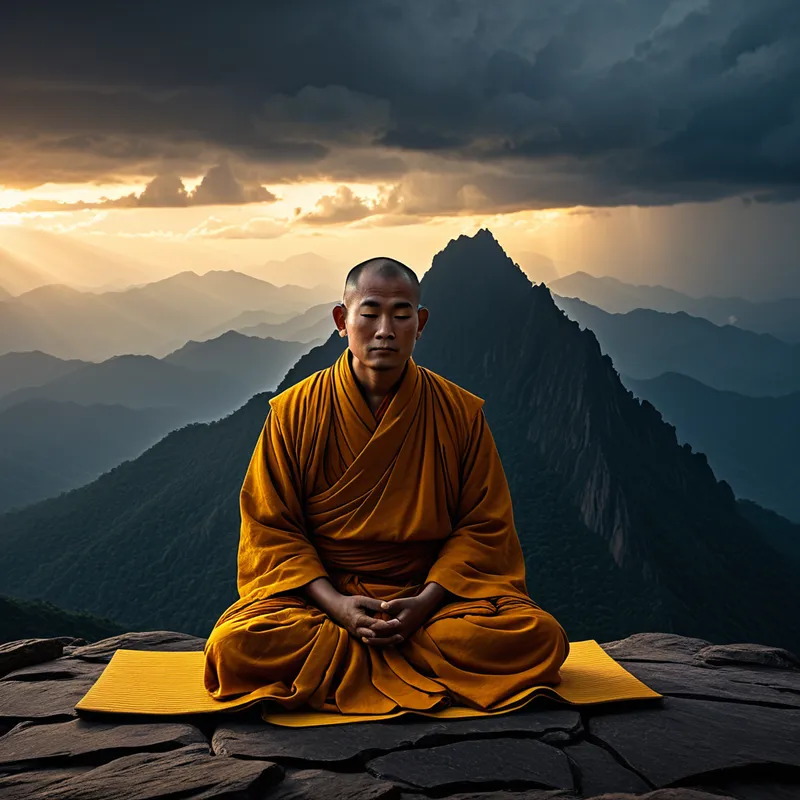
Meditating Monk Myth Meaning & Symbolism
A monk in deep meditation becomes a cosmic battleground, facing inner and outer demons to achieve a state of unshakeable peace and enlightenment.
The Tale of the Meditating Monk
Listen, then, to the tale not carved in stone, but whispered on the wind that scours the high places of the world.
There was a monk who sought the end of suffering. Not in books, nor in debates held in sun-dappled courtyards, but in the absolute silence of his own mind. He climbed beyond the last village, beyond the treeline, to a ledge of rock that hung between earth and sky—a place where clouds were his only visitors and the eagle’s cry the only scripture.
He sat. He folded his legs into the unmoving vajrasana, his spine a straight channel connecting the deep earth to the infinite heavens. His breath slowed, becoming finer than mist. His mind, that chattering flock of crows, began to settle, one by one, until a profound stillness descended. This was not the stillness of absence, but of potent, gathering presence. He became like the mountain itself: ancient, patient, immense.
This is when the cosmos took notice.
First came the temptations of the world, wearing familiar faces. The memory of a lost love appeared, her voice a sweet poison in the silence. Visions of royal feasts, of soft beds and warm fires, played against his closed eyelids. He did not stir. The mountain does not yearn for the valley.
Then, the realm of form grew angry. Mara, the personification of death, distraction, and desire, marshaled his legions. The sky darkened not with clouds, but with a host of nightmares. Fanged demons shrieked, raining arrows of doubt and spears of fear. Beautiful celestial maidens descended, their songs promising every earthly delight if he would but open his eyes. The ground shook and cracked beneath him. Winds howled, trying to pluck him from his perch.
Through the psychic storm, the monk remained. He had become the eye of the hurricane. He felt the tremors in the rock, heard the cacophony, sensed the seductions—but he did not engage. He simply witnessed. He touched the earth with his right hand, a gesture of unshakeable grounding. In that touch was a declaration: “I am here. This body is witness. This mind is clear.”
And as suddenly as it came, the onslaught ceased. The monstrous forms dissolved into wisps of shadow. The seductive visions faded like mist in sunrise. The demon-king Mara, defeated not by force, but by profound indifference, retreated.
In the crystalline silence that followed, the monk opened his eyes. He saw not just the valley below, but the intricate web of cause and effect that bound it. He saw the morning star, Venus, blazing in the violet dawn. And in that light, he saw the true nature of all things: impermanent, empty of separate self, and yet radiant with a peace that passes all understanding. He had not conquered an external enemy. He had dissolved the final internal barrier. He was awake.
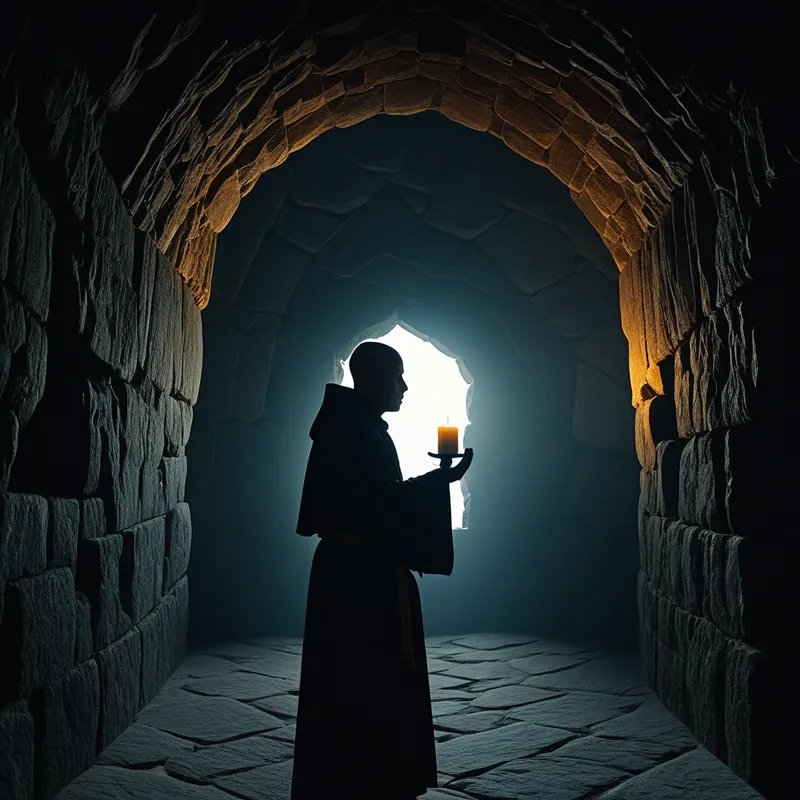
Cultural Origins & Context
This is not a single myth with one author, but a foundational archetype woven into the very fabric of Buddhist narrative, from the Buddha’s own night of enlightenment under the Bodhi tree to countless Jataka tales and biographies of revered monks and yogis. It is a master template for the spiritual journey.
Passed down orally for centuries before being committed to text in the Pali Canon and later Mahayana sutras, this story was told by teachers to disciples around flickering butter lamps. Its function was multifaceted: it was a map of the pitfalls on the path, a testament to the power of unwavering discipline (viriya), and a potent symbol of hope. It taught that the most formidable battles are fought in the privacy of one’s own heart-mind, and that victory is not annihilation of the “enemy,” but transcendence of the battlefield itself. In monastic communities, it served as both instruction and inspiration, a reminder that the goal—nirvana—was attainable through steadfast practice.
Symbolic Architecture
The myth is a precise blueprint of the psyche’s transformation. The monk represents the nascent, seeking consciousness—the ego that turns inward. The remote mountain peak is the isolated, purified awareness, withdrawn from the projections and complexities of the collective.
The meditation cushion is the alchemist’s crucible, and the practitioner’s own mind is the prima materia to be transmuted.
The sequential assaults—memories, sensual temptations, fears, and cosmic horrors—symbolize the contents of the personal and collective unconscious rising to be met and integrated. Mara</ab title> is not an external devil, but the totality of our psychological resistance: our clinging to identity, our fear of annihilation, our addiction to drama and sensation. The monk’s non-engagement is the key. It represents the development of upekkha and discerning awareness (prajna), which allows these psychic contents to arise and pass without capturing the self.
The final gesture, touching the earth (Bhumisparsha Mudra), is profoundly symbolic. It is the ultimate grounding. Enlightenment is not an escape from reality, but a deeper, more compassionate embodiment within it. The awakening is to the suchness of the here and now.
The Dreamer's Resonance
When this myth pattern surfaces in modern dreams, the dreamer is often in a critical phase of inner consolidation or confronting a profound existential fear. You may not dream of a literal monk, but of being in a vulnerable, still position (in a car, a room, your bed) while chaos erupts outside—a storm, an invasion, a cacophony of voices. The key somatic feeling is one of paralysis, but not of helplessness; it is a chosen, potent stillness.
This dream signals that the conscious ego is attempting to hold space while previously repressed or ignored aspects of the psyche (shadows, complexes, unprocessed trauma) surge into awareness. The psychological process is one of containment. The dream-ego is learning to be the silent witness, to not be identified with the inner turmoil. It is the psyche’s rehearsal for facing life’s overwhelming pressures without fragmentation. The resolution—if the stillness is maintained—is not the destruction of the chaos, but a dream shift where the chaos simply ceases to matter, revealing a new, serene landscape of the mind.

Alchemical Translation
For the modern individual, the myth models the complete process of individuation. Our “meditation” is any committed practice of self-observation—therapy, journaling, artistic creation, or sincere introspection. The “mountain” is the sacred space we carve out for this work, away from the noise of the persona and collective expectations.
The demons are not to be slain, but understood as disowned parts of the self, clamoring for recognition.
The initial temptations are the siren calls of our old identities and comforts. The subsequent fears and horrors are the shadow, the traumatic memories, and the terrifying freedom of authentic existence. The alchemical work is to sit through this “dark night of the soul” without reacting, without fleeing back into distraction or old narratives. This is the nigredo, the blackening, where all seems lost.
The non-engagement is the separatio—distinguishing the observing Self from the contents of consciousness. The final awakening is the albedo and rubedo: the whitening and reddening. It is the emergence of a new, grounded consciousness that has integrated the shadow. The individual touches the “earth” of their own embodied, humble reality. They are no longer a victim of their inner or outer world, but a compassionate, clear-minded participant. They have not become a god, but have finally become a fully human being, awake to the radiant, empty, interconnected nature of their own being and the world. The victory is peace.
Associated Symbols
Explore related symbols from the CaleaDream lexicon: