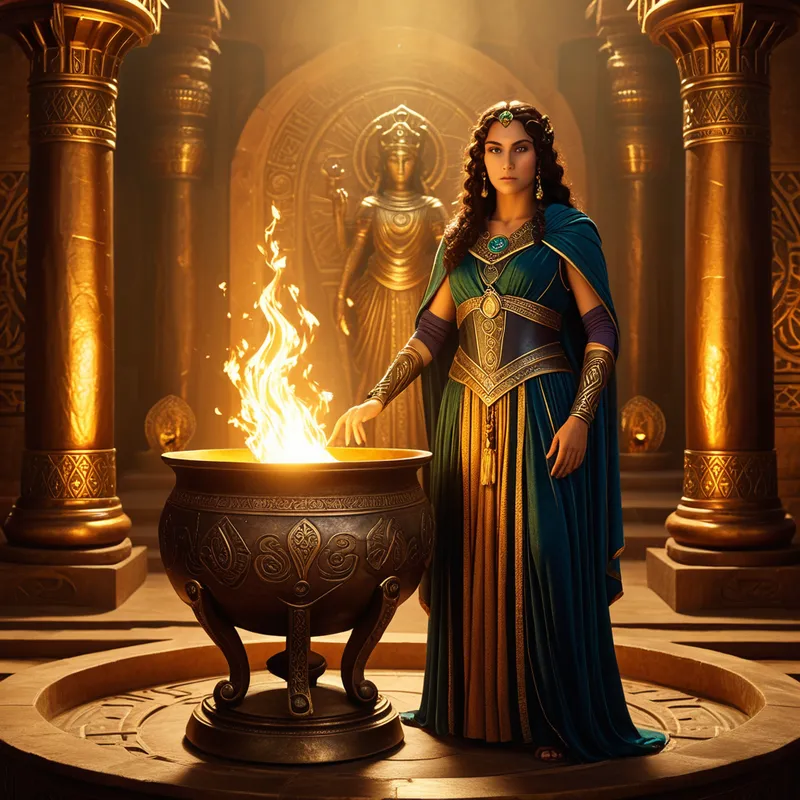
Medea's Pot Myth Meaning & Symbolism
A sorceress, betrayed, uses a magical cauldron to enact a terrible, transformative renewal, revealing the dual-edged nature of creation and destruction.
The Tale of Medea's Pot
Hear now the tale of the pot that did not cook, but unmade and remade. It begins not in a kitchen, but in the shattered heart of a woman who had given everything and received a king’s betrayal in return.
She was Medea, daughter of a sun god’s lineage, priestess of Hecate. For love of the golden-haired Jason, she had betrayed her father, butchered her brother, and fled her homeland. Now, in the court of Creon, she learned the final price. Jason would cast her aside, wedding the king’s young daughter to secure a throne. Exile was her sentence; despair, her cloak.
But within Medea’s breast, despair did not soften into grief—it hardened into a cold, crystalline resolve. If the world sought to break her, she would break the world first, and from its pieces forge a new and terrible justice. She sent a poisoned diadem and robe as a bridal gift, a fabric woven with sun-fire and death. As the young princess donned them, the garments clung and burned, a living funeral shroud, consuming her and the king who tried to protect her in a gruesome, royal pyre.
Yet this was but the prelude. The final act awaited in her chambers. Before her stood a great bronze pot, not of this city’s forges, but hauled from the deep places of Colchis. Into it she poured water from a sacred spring, then kindled beneath it a fire with enchanted logs that crackled with whispers. She sang, her voice not a melody but an invocation, calling upon the ancient powers that flow beneath the earth and stars—chthonic beings, the witness of Hecate, the raw stuff of life and un-life.
Then, she brought forth an old ram, its fleece matted, its eyes dim. With a ritual knife, she sacrificed it, cutting its body into pieces. These she placed gently into the steaming water of the pot. The brew bubbled, not with heat, but with a strange, phosphorescent light. She added herbs plucked at the dark of the moon, roots that knew no sun, stones that drank light. The air grew thick, charged with the scent of ozone and damp soil.
From the seething depths, a miracle of horror and wonder arose. A young lamb, wet and bleating, clambered over the lip of the pot, shaking life into its new limbs. The pot had not healed; it had dissolved the old form entirely and reconstituted it, fresh and vital. It was the ultimate alchemy: the reversal of time’s arrow, the promise of renewal snatched from the jaws of decay.
Medea’s eyes, reflecting the cauldron’s glow, held no joy in this miracle. It was a demonstration, a proof of concept for a darker work. She turned from the pot, her path set toward the nursery where her own sons, the children she bore Jason, lay sleeping. The pot’s magic promised rebirth, but in her hands, it became the final argument in a tragedy written in blood and fire—a testament that the power to create anew is born from the absolute willingness to destroy what is.
Cultural Origins & Context
The myth of Medea’s pot is a fragment of her larger, devastating story, most famously preserved in Euripides’s tragic play Medea (431 BCE) and in earlier epic cycles like the Argonautica. It is crucial to understand that this was not a comforting folk tale, but a piece of high literary and theatrical culture, performed for Athenian citizens at the City Dionysia. The pot scene, often occurring off-stage and reported by a messenger or chorus, served as a crucial narrative pivot.
Its function was multifaceted. For a society deeply concerned with the boundaries of nature (physis) and human craft (techne), Medea’s act was a profound transgression. She was the ultimate barbarian insider, using supernatural skill (mētis) to overturn the natural order of aging and death. The myth reinforced cultural anxieties about the dangerous, amoral power of foreign women and unchecked magical knowledge. Furthermore, it operated as a dark mirror to civic rituals. Where the polis had ceremonies to ensure fertility and continuity, Medea’s private ritual perverted that aim, using the symbolism of sacrificial renewal for a purpose of ultimate familial and social destruction.
Symbolic Architecture
At its core, the pot is the vas of alchemy, the sealed container where impossible change occurs. It represents the liminal space where opposites—life and death, creation and destruction, order and chaos—are forced into a violent, generative confrontation.
The cauldron does not ask if the transformation is good or evil; it only asks if the ingredients are offered with sufficient will.
Medea herself is the archetypal sorceress, the human agent who dares to wield this primal power. Her betrayal by Jason represents the shattering of the conscious persona—the agreed-upon identity of wife, mother, and ally. This shattering forces the latent, unconscious contents (her "barbarian" heritage, her connection to Hecate, her ruthless intellect) to erupt into consciousness with volcanic force. The pot is the tool of this erupted psyche. The dismemberment of the ram symbolizes the necessary deconstruction of the old, worn-out self (or situation) before renewal can be attempted. However, the myth tragically illustrates that the energy released by such a psychic rupture is raw and undirected; it can rejuvenate a lamb just as easily as it can motivate infanticide.
The Dreamer's Resonance
To dream of Medea’s pot is to dream of a psychic crisis point where radical, terrifying change feels both possible and imminent. The dreamer may find themselves beside a large, often ominous, cooking vessel, a boiler, or even a whirlpool that functions as the pot. There is a somatic sense of pressure, heat, and a churning in the gut—the "cauldron of the abdomen" where we literally digest experience.
This dream emerges when the psyche has reached an intolerable stasis, often following a profound betrayal or the collapse of a foundational life structure (a relationship, career, or identity). The unconscious is presenting the image of the pot as both a warning and a potential solution. The warning: the process of dissolution is underway, and it will be painful and messy. The potential: from this dissolution, a new vitality could be recovered. The dream asks the terrifying question: What in your life feels like the old, dying ram that must be ritualistically taken apart? And do you have the wisdom Medea lacked to guide the transformative energy toward renewal rather than annihilation?

Alchemical Translation
The individuation process, the journey toward psychological wholeness, requires its own pot. It demands a vessel—often the therapeutic container, a spiritual practice, or the crucible of a life crisis—strong enough to hold the seething conflict of opposites within us.
The first stage is always the nigredo: the blackening, the descent into the betrayal and rage that Medea embodies. This is not a failure, but the necessary fuel.
Medea’s fatal error was not in her power, but in her aim. Her magic was reactive, directed outward in vengeance, turning her children into mere instruments of her pain. The alchemical translation for the modern individual is to turn the cauldron’s power inward. The "dismemberment" becomes a conscious analysis and deconstruction of outworn complexes, childhood adaptations, and defensive identities. The "boiling" is the sustained, often uncomfortable, engagement with this material—the grief, anger, and shadow aspects we’d rather ignore.
The goal is not to produce a literal "new lamb" of a perfect self, but to achieve the albedo—the whitening, the cleansing insight that follows the black despair. This is the moment where the chaotic energy in the pot is clarified into a conscious understanding: "This pain is also a part of me, and from its substance, I can choose to create something new." The pot, then, symbolizes the disciplined, sacred space where we consent to our own dissolution, not to destroy others, but to reclaim the disowned power and vitality that betrayal and suffering had locked away. We learn to be both the sorceress and the ram, the destroyer and the reborn, stewarding the transformative fire toward integration rather than incineration.
Associated Symbols
Explore related symbols from the CaleaDream lexicon: