Medea's Cauldron Myth Meaning & Symbolism
The sorceress Medea uses a bronze cauldron and her arcane arts to rejuvenate the aged, symbolizing the psyche's terrifying power of radical transformation.
The Tale of Medea's Cauldron
Hear now the tale of the cauldron that did not cook, but unmade. It is a story not of hearth-fire, but of the cold, clear fire of the stars, wielded by a woman who walked the knife-edge between worlds.
The air in Iolcus was thick with the dust of regret. Aeson, once a king, now a husk, lay upon his bed, his breath a shallow whisper against the relentless tide of years. His son, Jason, had returned with glory and a terrible bride: Medea. She was not like the women of Greece. Her eyes held the depth of the Pontus Euxinus, and in her veins ran the ichor of Helios. She saw Jason’s anguish, the silent plea for a miracle not even the gods would grant.
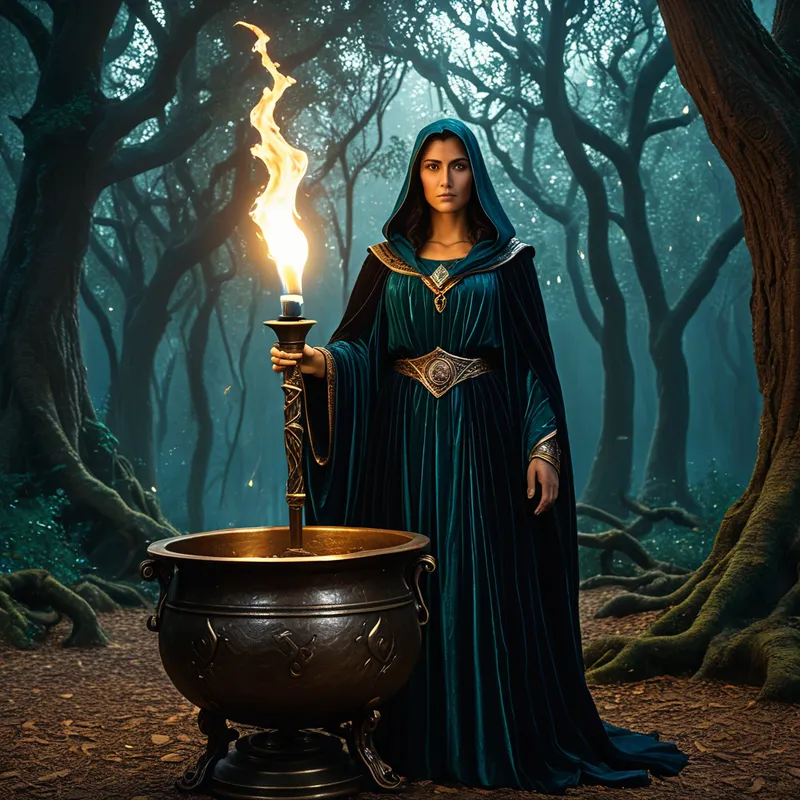
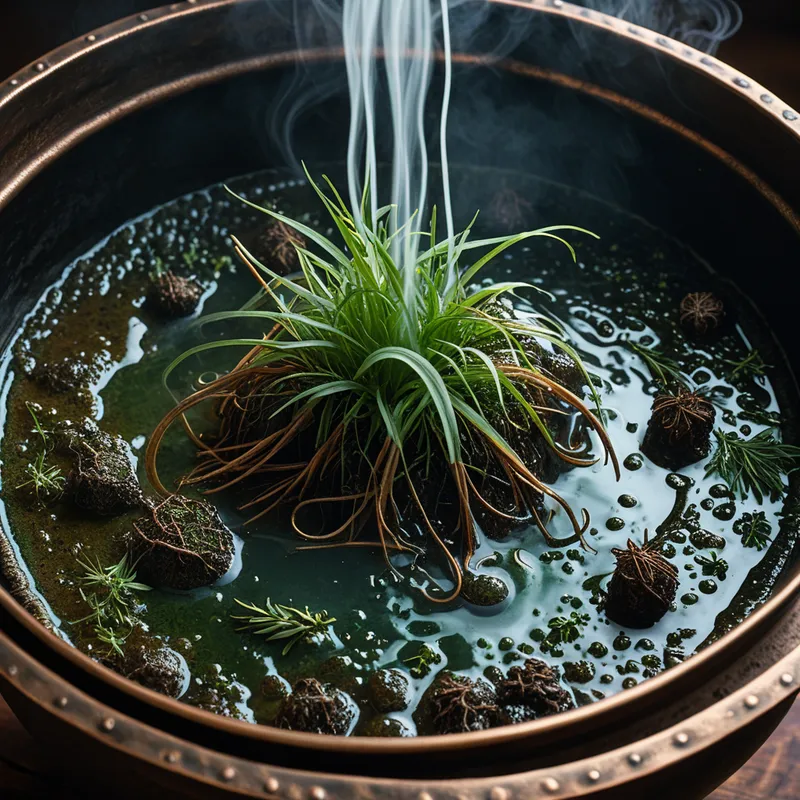
Medea did not pray to Zeus. She walked out under the moon, a shadow among the sacred oaks. She gathered what the earth yields in secret: roots that coil like serpents, bark from a tree struck by lightning, flowers that bloom only at midnight. She called for a cauldron, not of clay, but of bronze, thick and deep as a well. They built a fire of dry applewood, and the flames licked the metal until it glowed with a dull, hungry heat.
She filled it not with water, but with a broth of mysteries—the gathered herbs, wine, milk from a ewe that had never borne a lamb. Then, with a blade sharper than conscience, she slit the throat of a young ram, letting its life-blood arc into the brew. The liquid did not boil; it seethed, changing color from crimson to violet to a profound, impossible gold. The air grew heavy with a scent both sweet and foul, the perfume of life and decay intertwined.
With incantations in a tongue older than Greek, she called upon the chthonic powers, upon Hecate, her patron. The very ground seemed to listen. Then, she turned to the trembling, aged Aeson. With a touch both ruthless and tender, she drew a blade across his throat, draining the weary blood from his body, letting the years spill out upon the earth. The onlookers gasped, certain this was murder.
But Medea was not done. She lifted the light shell of the man and placed him into the cauldron. He sank beneath the golden, singing liquid. For a long, breathless moment, there was only the murmur of the strange brew. Then, a stirring. From the cauldron emerged not an old man, but a youth, strong-limbed and clear-eyed, blinking in wonder at a world made new. The cauldron had not healed; it had unmade and remade. It was a womb of bronze, a threshold where time itself was dissolved and reconsecrated.
Cultural Origins & Context
This potent episode is preserved for us in the epic poem Argonautica by Apollonius of Rhodes. It is a late, literary crystallization of a far older and more widespread archetype. The tale of Medea the rejuvenator exists in the liminal space between high epic and local folk belief, between the sanctioned myths of the Olympians and the whispered, practical magic of the hearth and the wild.
In the Greek world, Medea was always the ultimate outsider: a barbarian princess, a priestess of foreign powers, a woman whose knowledge came not from civic order but from a direct, terrifying lineage to the primal forces of the cosmos (Helios) and the underworld (Hecate). Her cauldron magic reflects this marginal, potent status. It is not the medicine of Asclepius, achieved through prayer and ritual purification. It is a raw, alchemical process that mirrors the cycles of nature—decay and rebirth, sacrifice and renewal—but accelerates them through will and arcane art. The story served as a cultural container for deep anxieties and fascinations: the terror of aging, the allure of forbidden knowledge, and the ambiguous power of the feminine, which could create and destroy life outside the bounds of patriarchal control.
Symbolic Architecture
The cauldron is the central symbol, a vessel of transformation. It is not a passive pot, but an active, magical space—a temenos or sacred precinct in miniature.
The cauldron represents the contained psyche, where the raw materials of experience—memory, trauma, identity—are subjected to the heat of consciousness to be broken down and reconstituted.
Medea herself is the archetypal alchemist. She does not work with inert matter, but with the very substance of life (blood, herbs, a human body). Her ritual is a brutal symmetry: the sacrifice of the lamb (innocent life) for the renewal of the man (burdened life). This speaks to a fundamental, often uncomfortable, psychological truth: profound change requires a sacrifice. An old self, an outworn identity, must "die" for a new one to be born. The act is not gentle; it is a surgical strike against the tyranny of time and habit.
The brew itself is a pharmakon—a substance that is both poison and cure. Its composition (blood, wine, milk, magical herbs) symbolizes the totality of existence: sacrifice, ecstasy, nourishment, and hidden knowledge. To enter it is to consent to a dissolution of the ego, a terrifying surrender to the transformative powers of the unconscious.
The Dreamer's Resonance
When this myth stirs in the modern dreamscape, it signals a psyche at the brink of radical, non-negotiable change. To dream of a cauldron, a transformative bath, or a vat of strange liquid is to encounter the unconscious's own laboratory.
The somatic feeling is often one of simultaneous dread and anticipation—a "point of no return." The dreamer may be the one plunged into the vessel, experiencing the dissolution of their familiar form, or they may be the reluctant alchemist, tasked with conducting a terrifying but necessary operation on some aspect of themselves or their life. This myth-pattern activates when old coping mechanisms, identities, or life structures have become like Aeson's aged body: drained of vitality, unable to support the soul's next journey. The dream is the psyche's announcement that a death-and-rebirth process has been initiated from within. The terror is real, for the outcome is never guaranteed; the process demands a sacrifice, and what emerges may be unfamiliar.

Alchemical Translation
For the individual on the path of individuation, Medea's Cauldron is the ultimate model for psychic transmutation. It maps the journey from leaden stagnation to golden renewal.
The first step is the Gathering. Like Medea under the moon, we must consciously collect the scattered fragments of our experience—the traumas (the lightning-struck bark), the neglected talents (the midnight-blooming flowers), the primal instincts (the serpentine roots). This is the prima materia, the base matter of the soul.
Next is the Containment. The bronze cauldron is the disciplined, conscious ego that can withstand the heat of this process. Without a strong vessel, the transformative fire would lead to psychosis, not renewal. We must create a sacred, bounded space for inner work—through therapy, art, meditation, or ritual.
Then comes the Sacrifice and Dissolution. This is the most difficult phase. We must willingly "slit the throat" of the old self—the outworn narratives, the comfortable victimhood, the ego-investments that keep us stagnant. This is the letting of blood, the surrender into the bubbling, unknown brew of the unconscious.
The fire under the cauldron is the heat of sustained attention and emotional honesty. It is what cooks the raw material of memory and pain into the elixir of wisdom.
Finally, the Emergence. After a period of symbolic death—of depression, confusion, or the dark night of the soul—a new configuration arises. It is not a return to a literal youth, but a recovery of psychic vitality, perspective, and authenticity. The rejuvenated Aeson is the integrated self, bearing the scars of the journey but infused with a second life, forged in the cauldron of deep, transformative work. The myth teaches that we are not merely healed; we are, at our core, alchemical beings, capable of turning the lead of our suffering into the gold of consciousness.
Associated Symbols
Explore related symbols from the CaleaDream lexicon: