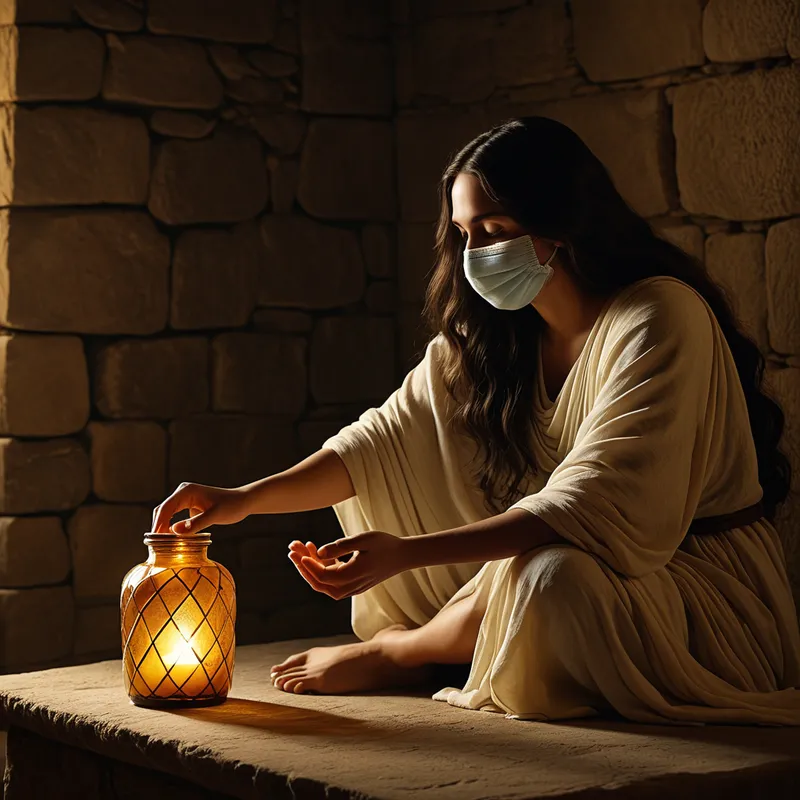
Mary Magdalene's perfume Myth Meaning & Symbolism
A woman anoints a prophet with costly perfume, a scandalous act of love that becomes a timeless symbol of sacred devotion and psychic transformation.
The Tale of Mary Magdalene’s perfume
The air in the house of Simon the Leper was thick with the scent of roasted lamb and murmured conversation. The honored guest reclined at the table, a quiet center in the storm of whispers that always followed him. He was the Messiah to some, a dangerous prophet to others. The room was a tapestry of watchful eyes and calculated respect.
Then, she entered. Not with fanfare, but with a gravity that stilled the room. Mary of Magdala carried not a dish for the table, but a vessel of cold, polished alabaster. It caught the low firelight, a tomb of precious treasure. The whispers turned to sharp inhalations. They knew what it was. Spikenard. A perfume worth a year’s wages, imported from the distant Himalayas, the life savings of a woman sealed in stone.
Without a word, she moved to the feet of the teacher. The act itself was a transgression—a woman, touching a rabbi in a room full of men. She did not kneel with servitude, but with the devastating focus of a priestess at an altar. A sharp crack echoed against the walls as she broke the jar’s slender neck. The sound was irrevocable, a point of no return.
And then, the scent. It did not whisper; it flooded. The rich, earthy, profoundly sweet aroma of the spikenard oil erupted into the space, drowning the smells of food and dust. It was the scent of mountains and [sacred groves](/myths/sacred-groves “Myth from Celtic culture.”/), of immense wealth rendered liquid. She poured it over his feet, the oil gleaming like liquid amber in the lamplight. Then, in an act of even more shocking intimacy, she loosened her hair—a woman’s glory, unveiled in public—and used it to wipe the perfume from his skin. The room was no longer still; it was electric with scandal. The fragrance was now in her hair, on his skin, in the very stones of the house, a permanent claim upon the moment.
The condemnation was immediate, led by [Judas Iscariot](/myths/judas-iscariot “Myth from Christian culture.”/). “Why this waste?” he hissed, cloaking greed in piety. “This could have been sold for a fortune and given to the poor!”
The teacher’s voice cut through the outrage, calm and final. “Leave her alone. Why do you trouble her? She has done a beautiful [thing](/myths/thing “Myth from Norse culture.”/) for me.” He saw not an economy, but an epistemology. “For you always have the poor with you, but you will not always have me.” He reframed her act from waste to prescient anointing. “She has anointed my body beforehand for burial.” In that moment, the perfume of extravagant love became the perfume of imminent sacrifice, and the woman with the shattered jar became the one who saw [the shadow](/myths/the-shadow “Myth from Jungian culture.”/) on the wall and dared to honor the man who would walk into it.

Cultural Origins & Context
This story, found in the Gospels of Matthew, Mark, and John, is a rare narrative jewel where the actions of a woman are central and hermeneutically explained by [Jesus](/myths/jesus “Myth from Christian culture.”/) himself. It exists in a culture where a woman’s testimony was legally invalid and her public actions heavily circumscribed. The telling of it was, therefore, inherently counter-cultural.
Scholars note the conflation of this Mary with the sinful woman in Luke’s Gospel and later, controversially, with the possessed woman Jesus healed. This fusion, solidified by Pope Gregory I in the 6th century, created the composite figure of [Mary Magdalene](/myths/mary-magdalene “Myth from Christian culture.”/) as the redeemed prostitute. This transformed her from a devoted disciple into the archetype of the penitent, a move that served a societal function: modeling contrition and the containment of female sexuality within the bounds of ecclesiastical authority. The perfume, in this reading, becomes the symbol of her former, sinful life, extravagantly spent in repentance. The story was passed down not just as history, but as a potent parable about the hierarchy of values: love over law, insight over economy, devotion over decorum.
Symbolic Architecture
At its [heart](/symbols/heart “Symbol: The heart symbolizes love, emotion, and the core of one’s existence, representing deep connections with others and self.”/), the myth is a profound clash of value systems. The perfume represents uncalculating love, a [currency](/symbols/currency “Symbol: Currency represents value exchange, personal worth, and societal power dynamics. It symbolizes resources, control, and the abstract systems governing human interaction.”/) of the [soul](/symbols/soul “Symbol: The soul represents the essence of a person, encompassing their spirit, identity, and connection to the universe.”/) that operates outside the ledgers of the practical world.
The alabaster jar is the sealed self. To break it is the crisis of devotion, where one’s most guarded treasure—identity, security, reputation—must be shattered to be truly given.
The spikenard is the essence itself: the concentrated [life](/symbols/life “Symbol: The symbol of ‘Life’ represents a journey of growth, interconnectedness, and existential meaning, encompassing both the joys and challenges that define human experience.”/)-force, the “[quintessence](/symbols/quintessence “Symbol: The fifth element or pure essence beyond earth, air, fire, and water, representing perfection, the divine, and the fundamental nature of reality.”/)” of the individual. It is not given in drops, but in a flood, symbolizing totality. The act of anointing the [feet](/symbols/feet “Symbol: Feet symbolize our foundation, stability, and the way we connect with the world around us, often reflecting our sense of direction and purpose.”/)—the lowest, most travel-worn, and humble part of the [body](/symbols/body “Symbol: The body in dreams often symbolizes the dreamer’s self-identity, personal health, and the relationship they have with their physical existence.”/)—is alchemical. It elevates the mundane (the dusty road) by consecrating it with the sacred (the priceless oil). This inverts worldly [hierarchy](/symbols/hierarchy “Symbol: A structured system of ranking or authority, often representing social order, power dynamics, and one’s position within groups or institutions.”/), suggesting the divine is met not only in glory but in humble, embodied service.
Judas’s objection represents the [persona](/symbols/persona “Symbol: The social mask or outward identity one presents to the world, often concealing the true self.”/) and the rational function in its [shadow](/symbols/shadow “Symbol: The ‘shadow’ embodies the unconscious, repressed aspects of the self and often represents fears or hidden emotions.”/) [aspect](/symbols/aspect “Symbol: A distinct feature, quality, or perspective of something, often representing a partial view of a larger whole.”/): critical, utilitarian, and secretly self-serving. It is the voice that pathologizes [ecstasy](/symbols/ecstasy “Symbol: A state of overwhelming joy, rapture, or intense emotional/spiritual transcendence, often involving a loss of self-awareness.”/) and monetizes [mystery](/symbols/mystery “Symbol: An enigmatic, unresolved element that invites curiosity and exploration, often representing the unknown or hidden aspects of existence.”/). Jesus’s [defense](/symbols/defense “Symbol: A protective mechanism or barrier against perceived threats, representing boundaries, security, and resistance to external or internal challenges.”/) validates the feeling function in its most profound form: the intelligence of the heart that recognizes a sacred [moment](/symbols/moment “Symbol: The symbol of a ‘moment’ embodies the significance of transient experiences that encapsulate emotional depth or pivotal transformations in life.”/) and responds with appropriate, radical excess.

The Dreamer’s Resonance
When this myth pattern surfaces in modern dreams, it often signals a profound somatic and psychological crossroads. To dream of holding a precious, sealed vessel indicates a talent, a memory, a capacity for love, or a part of the [psyche](/myths/psyche “Myth from Greek culture.”/) that one has kept in reserve, perhaps out of fear or a sense of unworthiness.
The dream may present a figure who represents an aspect of [the Self](/myths/the-self “Myth from Jungian culture.”/)—a guide, a lover, a spiritual principle, or even one’s own future potential—that demands this offering. The intense conflict in the dream, the voices of criticism (“This is a waste! Be practical!”), mirrors the internalized judgments of family, culture, or one’s own inner critic. The act of breaking the jar is the somatic feeling of release, of a defense mechanism cracking open. The overwhelming fragrance in the dream is the felt-sense of this release: a wave of emotion, a clarity of purpose, or a deep, soul-level rightness that permeates one’s being, even amidst the perceived “mess” of the offering. It is the psyche’s way of rehearsing a total commitment to its own deepest truth, against all internal and external logic.

Alchemical Translation
Psychically, this myth models the individuation process at its most critical juncture: the sacrifice of the valued thing to the transcendent function.
[The first stage](/myths/the-first-stage “Myth from Alchemical culture.”/) is Recognizing the Sacred (Jesus at the table). This is the emergence of a guiding inner principle, a call from the Self that feels numinous and demands a response beyond the ordinary. The second is The Offering of the [Quintessence](/myths/quintessence “Myth from Alchemical culture.”/) (Mary with the jar). This is [the ego](/myths/the-ego “Myth from Jungian culture.”/)’s conscious decision to surrender its most prized possession—a long-held identity, a cherished ambition, a safe worldview—to this higher principle. The breaking is non-negotiable; partial offerings will not suffice.
The alchemy occurs in the mingling: the highest value (perfume) touches the lowest reality (feet). This is the integration of spirit and matter, the divine and the human, the ideal and the flawed, within the individual.
The Scandal and Defense (Judas vs. Jesus) represents the inevitable inner conflict. The old, adaptive personality structure screams “waste!” It argues for security, social approval, and sensible personal economy. The new, emerging Self defends the act as “a beautiful thing,” necessary for the soul’s burial and rebirth. The [triumph](/myths/triumph “Myth from Roman culture.”/) is not in avoiding the conflict, but in allowing the voice of the Self to have the final, authoritative word. The result is a personality anointed—consecrated and given a new purpose—by its own deepest essence. The fragrance that fills the house is the transformed atmosphere of a life now oriented by love and meaning, a scent that, as the gospel says, fills the whole world.
Associated Symbols
Explore related symbols from the CaleaDream lexicon: