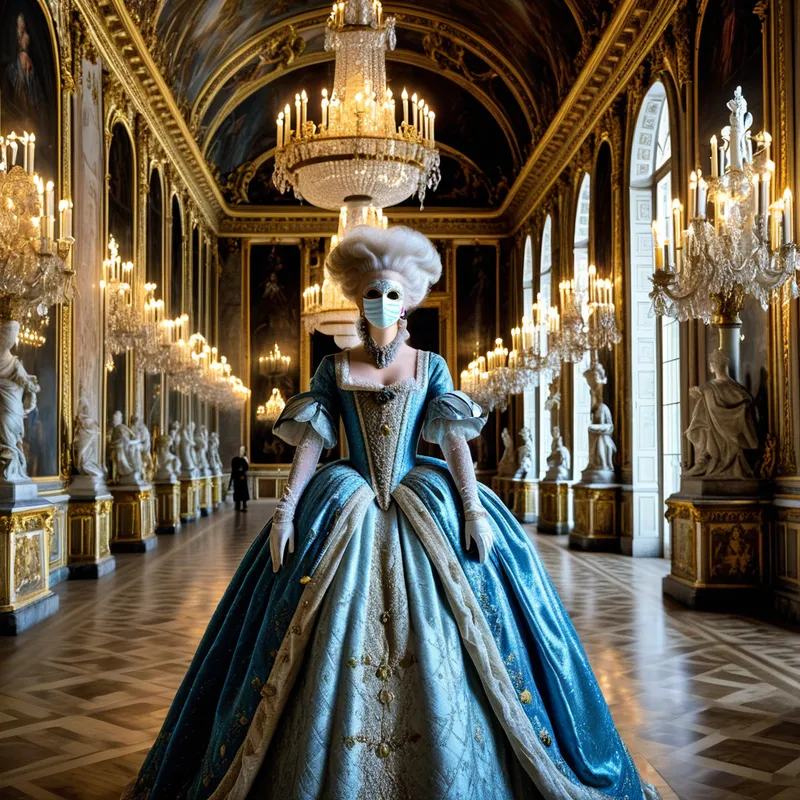
Marie Antoinette Myth Meaning & Symbolism
The story of a foreign queen transformed by history into a symbol of decadence, sacrifice, and the crumbling of an old world order.
The Tale of Marie Antoinette
Let us tell a tale not of a woman, but of a vessel. A story whispered by the stones of Versailles and screamed from the gutters of Paris. It begins in the gilded cage, a world of powdered wigs, rustling silk, and mirrors that reflected only privilege. Into this world came a child of fifteen, Marie Antoinette, a living treaty bound in satin. She was a foreign bloom transplanted to the most manicured and poisonous of gardens.
For years, she was a doll in a dollhouse, her every breath a public performance. The court watched, a thousand eyes like polished jet, judging her accent, her fertility, her very existence. In response, she built a world within the world. Behind the palace, she raised the Hameau de la Reine—a perfumed pastoral fantasy with clean sheep and milking stools, a stark, beautiful lie against the muddy reality of France. Here, she wore simple muslin, a queen playing at being a shepherdess, while the true shepherds starved.
Then came the whispers, slithering from pamphlets into the collective mind. They named her L'Autrichienne. They painted her as a monster of appetite: devouring cake while the people had no bread, gambling away fortunes, taking lovers in secret bowers. The fantasy of the Hameau curdled into a symbol of grotesque disconnect. The scandal of the Diamond Necklace Affair, though she was innocent, coated her in the indelible tar of decadence. She became the screen upon which a nation projected its rage, its fear, its hunger.
The gilded cage shattered. The mirrors of Versailles now reflected only the advancing shadows of the mob. The queen was stripped of her titles, her silks, her hair. The vessel that once held the divine right of kings was emptied, filled instead with the role of arch-villainess. In the cold, stone heart of the Conciergerie, the “Widow Capet” awaited her fate. The final act was not in a palace, but on a scaffold in the Place de la Révolution. Before the roaring sea of faces, she ascended the steps with a dignity that stunned her accusers. In that moment, the frivolous girl, the hated foreigner, the monstrous queen, dissolved. What remained was a profound and terrifying stillness. Then, the blade fell. And in its descent, a symbol was born, far more potent than the woman had ever been.

Cultural Origins & Context
This is a modern myth, forged not in antiquity but in the crucible of revolution and the relentless machinery of public opinion. Its primary bards were not poets but pamphleteers like Jean-Paul Marat, whose L’Ami du peuple dripped with vitriolic caricature. The myth was propagated through cheap, widely circulated engravings and salacious libelles—the social media of the 18th century—that painted the queen as a creature of unparalleled vice.
Its societal function was dual and devastating. First, it served a crucial political purpose: to dehumanize the monarchy. By transforming the queen into a personification of corruption, extravagance, and foreign interference, the revolutionaries could justify the unthinkable—regicide. She became the perfect scapegoat, a lightning rod for grievances that were systemic and vastly complex. Second, the myth served a deeper, psychological function for a culture in violent transition. It externalized the shadow of the Ancien Régime—its excess, its feminized weakness, its isolation from the “real” world—and placed it squarely upon one feminine figure. Her execution was not just the killing of a queen, but the ritual sacrifice of an old world and its values.
Symbolic Architecture
Psychologically, Marie Antoinette represents the ultimate Shadow of the Divine Feminine in the political sphere. She is the Ruler archetype inverted, corrupted by isolation and privilege into a figure of profound disconnection. The core symbols are stark in their polarity:
- The Cake/No Bread Dichotomy: This is the symbol of catastrophic empathy failure. It represents the psyche (or state) so insulated by its own reality tunnel that it becomes utterly blind to the suffering outside its walls. It is not merely cruelty, but a kind of ontological blindness.
The most dangerous prison is the one whose walls are made of one's own unexamined privilege; the inmate mistakes the cell for the entire world.
- The Petit Trianon & The Hameau: These are not just places, but symbols of the Regressive Fantasy. They represent the attempt to build a sanitized, aestheticized version of nature and simplicity while remaining utterly separate from its raw, demanding truth. It is the ego’s attempt to curate reality, to play at innocence while remaining in control.
- The Diamond Necklace: Beyond a piece of jewelry, it is the symbol of Projection crystallized. She was accused of coveting what she did not, becoming entangled in a web of deceit not of her making. The necklace embodies how desire, debt, and false narrative can become an inescapable, glittering trap.
- The Scaffold: This is the ultimate altar of Scapegoat Sacrifice. Her death served to purge the collective of its perceived sins (extravagance, weakness, foreignness). In her execution, the mob sought not just justice, but catharsis and a bloody baptism into a new age.
The Dreamer's Resonance
When this mythic pattern stirs in the modern dreamer, it often signals a profound confrontation with themes of false accusation, isolation, and the crumbling of a personal “kingdom.” To dream of being Marie Antoinette is not to dream of royalty, but to dream of being tragically, fatally misunderstood.
One might dream of hosting a lavish party where the guests’ faces are blurred with contempt, or of speaking in a room where no one hears your true words, only the distortions echoed back. These dreams point to a somatic experience of being carrying the projected shadow of a family system, workplace, or social circle. The dreamer may feel they are being punished for a crime they did not commit, or blamed for a systemic failure. The body may feel heavy, adorned in invisible, suffocating garments, or exposed and vulnerable on a high, public place.
Conversely, dreaming of confronting the Marie Antoinette figure—seeing her in her fantasy garden or judging her—may indicate the dreamer’s own need to confront where they themselves are insulated, disconnected, or living in a curated fantasy, blind to the true “hunger” in their own psyche or relationships. The dream is an invitation to step out of the hall of mirrors and feel the real weather.
Alchemical Translation
The alchemical journey modeled by this myth is not one of heroic conquest, but of devastating descent and paradoxical redemption through sacrifice. It is the path of the Orphan on a collective scale. The process begins in the Nigredo, the blackening: the identification with a gilded, false self (the Queen of France) that is utterly out of touch with the base, earthy reality (the people of France). The conflict, the scandal, the hatred, represent the necessary dissolution of this false persona.
The alchemy of the self begins when the palace you built becomes your prison, and the mob at your gate is the voice of your own neglected soul.
The long imprisonment and trial are the Albedo, the whitening—a brutal stripping away of all titles, adornments, and external identities. She is reduced to “Widow Capet,” a bare, essential state. This is a terrifying but crucial purification. The final, conscious walk to the scaffold represents the ultimate Rubedo, the reddening. It is not a triumph of the ego, but its surrender. In accepting the role of scapegoat with dignity, she transmutes the base lead of being a hated symbol into the gold of becoming a timeless, tragic archetype. The personal self is sacrificed for a symbolic truth.
For the modern individual, this myth does not counsel martyrdom, but profound self-examination. It asks: Where is my “Petit Trianon”? What reality am I insulating myself from with aesthetics, business, or fantasy? What collective shadow (of my family, my culture, my company) might I be carrying as a personal flaw? The alchemical work is to voluntarily descend from our insulated towers, to feel the genuine hunger—both in the world and within our own souls—and to allow our outdated, isolated identities to be dismantled. Only through that conscious sacrifice can we move from being a puppet of projection to an author of our own, more integrated destiny.
Associated Symbols
Explore related symbols from the CaleaDream lexicon: