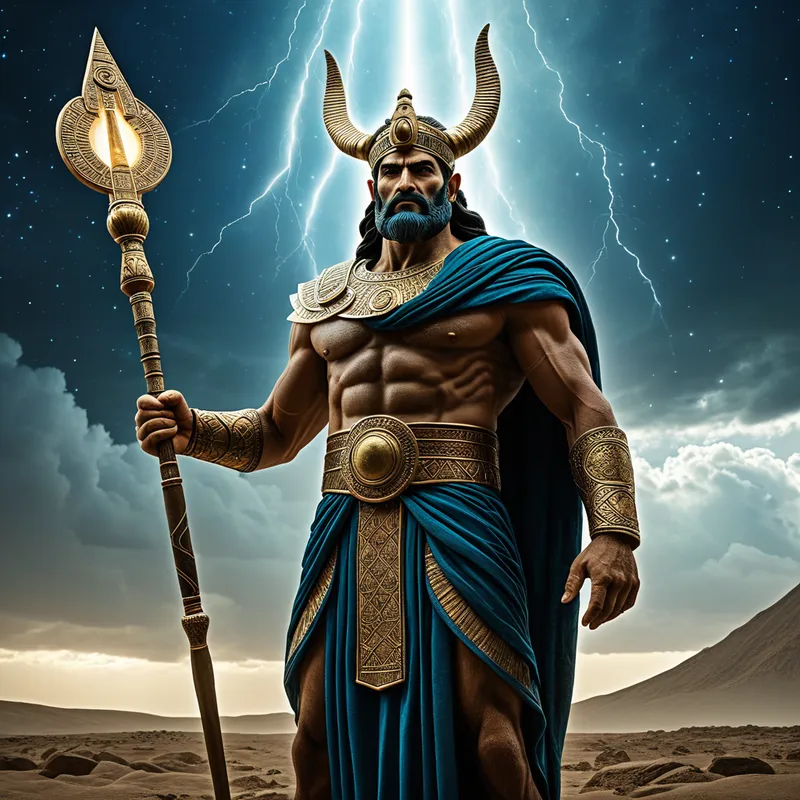
Marduk Myth Meaning & Symbolism
The god Marduk defeats primordial chaos, Tiamat, to establish cosmic order and become king, modeling the psyche's struggle for self-sovereignty.
The Tale of Marduk
Listen, and hear the tale from before time had a name. In the beginning, there was only the mingled waters: Apsu, the sweet, and Tiamat, the salt. From their union, generations were born—gods of silt and horizon, of sky and earth. But their clamor was a torment to Apsu, who plotted their destruction. The wise god Ea, hearing the plot, struck first. He wove a spell of profound sleep, dismantled Apsu, and upon his still waters built his own shining abode.
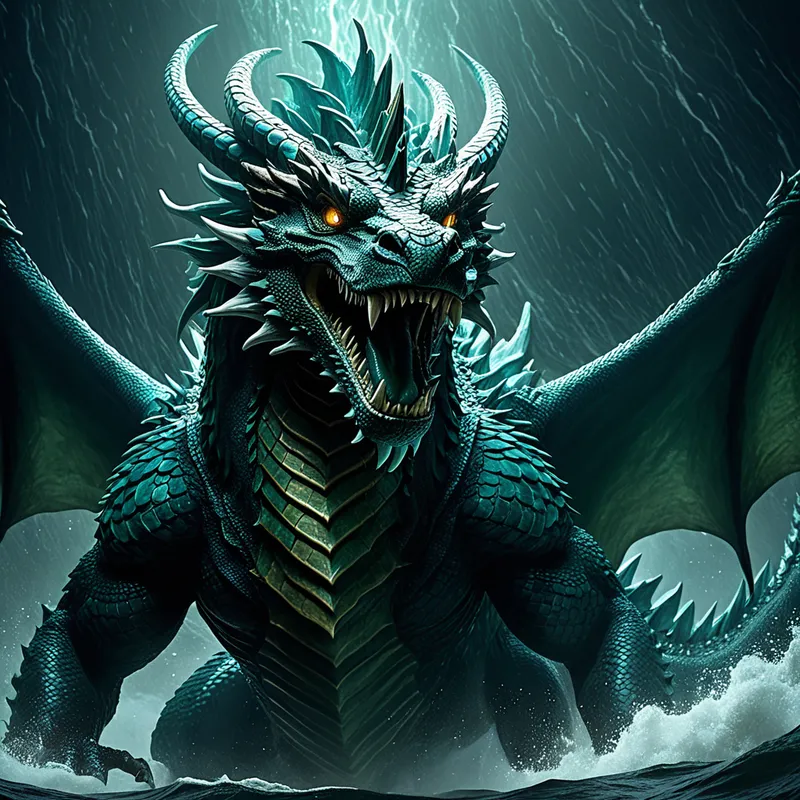
But in dismantling one chaos, a greater one was awakened. Tiamat, the great saltwater womb, raged at the murder of her consort. She birthed an army of monsters: venomous serpents with unblinking eyes, raging lion-demons, scorpion-men, and the mighty Mushussu-dragon. At their head, she placed Kingu, and to him she gave the Tablets of Destiny, the very power to command the cosmos. The younger gods trembled. Their light guttered before her oceanic fury. None dared face her.
In the deep chamber of Ea, a new light was kindled. Marduk was born, radiant and terrible. Four eyes saw all directions, four ears heard all sounds. Fire blazed from his lips when he spoke. When the desperate gods came to him, begging for a champion, he agreed—but on one condition: "If I am to be your avenger, to conquer Tiamat and preserve your lives, let me, by unanimous consent, decree the fates. Let my word be law, unalterable."
The gods assembled at a great feast. They tested his power. "Lord, command a constellation to vanish!" Marduk spoke a word, and a star vanished. "Command it to return!" He spoke again, and it was restored. Awe filled them. They clothed him in royal robes, gave him a scepter, a throne, and an invincible weapon. They proclaimed him king.
Then Marduk armed himself. He crafted a great bow, tipped arrows with lightning, filled his body with flashing flames, and fashioned a colossal net held by the four winds to ensnare Tiamat. Mounting his storm-chariot drawn by four devastating tempests, he advanced. He challenged the roaring abyss. Tiamat, howling, cast spells of primal magic, but Marduk loosed the Imhullu, the Evil Wind. It filled her, distending her jaws so she could not close them. He shot an arrow that pierced her heart, severed her arteries, and stood upon her carcass.
From her divided body, he made the world: her skull became the vault of heaven, her weeping eyes the sources of the Tigris and Euphrates, her tail the band of the Milky Way. From the blood of the defeated Kingu, he mixed clay with the blood of a slain god and fashioned humanity—to bear the labor of the gods, so the gods might be at rest. And the gods, in gratitude, built for him the great city of Babylon, with its temple Esagila at its heart. There, in the Ubshu-ukkinna, the king of gods and men decreed the destinies for the year to come.
Cultural Origins & Context
This myth, known as the Enuma Elish ("When on High"), is not merely a story. It is a cosmological charter, a political manifesto, and a sacred liturgy. Composed in Akkadian, it reached its definitive form in the second millennium BCE, intimately tied to the rise of the city of Babylon as the center of an empire. The myth was recited, and likely dramatically re-enacted, during the Akitu festival each spring. This was not entertainment; it was a vital act of world-renewal. The priestly recitation of Marduk's victory over Tiamat re-established cosmic and social order for the coming year. It legitimized the Babylonian king as Marduk's earthly regent and Babylon as the axis mundi, the very pivot of creation. The story was a living force, a narrative that actively maintained the relationship between the divine, the natural world, and the state.
Symbolic Architecture
At its core, the Enuma Elish maps the psyche's most fundamental drama: the emergence of conscious order from unconscious chaos. Tiamat is not "evil" in a moral sense; she is the primal, undifferentiated matrix—the womb of all potential, but also the devouring maw of formlessness. She represents the unconscious in its raw, overwhelming, and potentially annihilating aspect.
To create a self, one must first confront the formless deep from which it emerges. Sovereignty is won not by ignoring the chaos, but by engaging it, naming it, and structuring its immense power.
Marduk represents the archetypal force of the differentiating ego-consciousness. His four eyes and ears symbolize hyper-awareness, the capacity to perceive and orient. His demand for kingship before the battle is crucial: consciousness must be granted legitimate authority by the totality of the psyche (the assembly of gods) to undertake its defining task. His weapons—the net of the four winds and the evil wind—are instruments of discrimination and analysis, the ability to contain, dissect, and comprehend the swirling, emotional totality of Tiamat. His act of creation from her corpse is the ultimate alchemy: transforming the raw material of the unconscious into the structured cosmos of the conscious personality.
The Dreamer's Resonance
When this myth stirs in the modern dreamer, it often signals a profound internal shift. To dream of a vast, overwhelming, often watery or monstrous force threatening to engulf everything is to feel Tiamat's tide rising. This is the chaos of a life transition, a buried trauma surfacing, or a dissolution of old identity. It feels somatic—a tightening in the gut, a sense of drowning.
The appearance of a Marduk figure—perhaps as a radiant stranger, a powerful animal, or the dreamer themselves armed with a strange tool—marks the psyche's rallying of its own sovereign resources. The dream may involve constructing something from the defeated monster, or receiving a tablet or book of laws. This is the psyche in the act of re-creation, attempting to build new internal structures (habits, perspectives, boundaries) from the dissolved material of the old self. The process is rarely clean or gentle; it is a divine battle, felt as intense anxiety before a breakthrough.
Alchemical Translation
The individuation process modeled here is the journey to psychic sovereignty. We all begin in a kind of inner Apsu and Tiamat—a merged, unconscious state. The first emergence of ego (the younger gods) inevitably creates conflict with the primal state, which can react with a terrifying, regressive pull (Tiamat's monstrous brood). The temptation is to flee back into numbness or be consumed by chaotic emotion.
The king is not born; he is proclaimed. Consciousness must claim its right to rule, not through tyranny, but through a covenant with the deeper self, offering order in exchange for life.
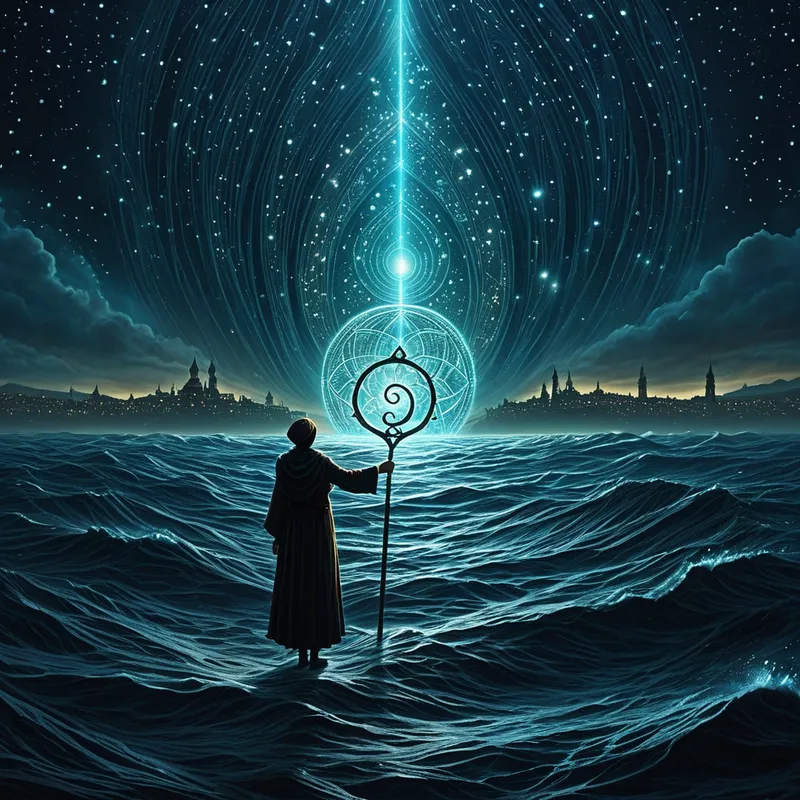
The "alchemical translation" requires one to become Marduk. We must consciously "arm ourselves"—not with literal weapons, but with the nets of discernment (the four winds) and the arrows of focused intent (the Imhullu wind that fills and immobilizes diffuse emotion). We must face the inner Tiamat, not to annihilate her, but to engage her creatively. Her defeat is her transformation. The new world built from her body is a more complex, resilient, and authentic personality structure. The founding of "Babylon"—the establishment of a stable, sacred center within the psyche where one can "decree the fates"—is the ultimate goal. It is the achieved state where consciousness, having integrated the power of the deep, rightfully sits as the wise ruler of its own internal universe.
Associated Symbols
Explore related symbols from the CaleaDream lexicon: