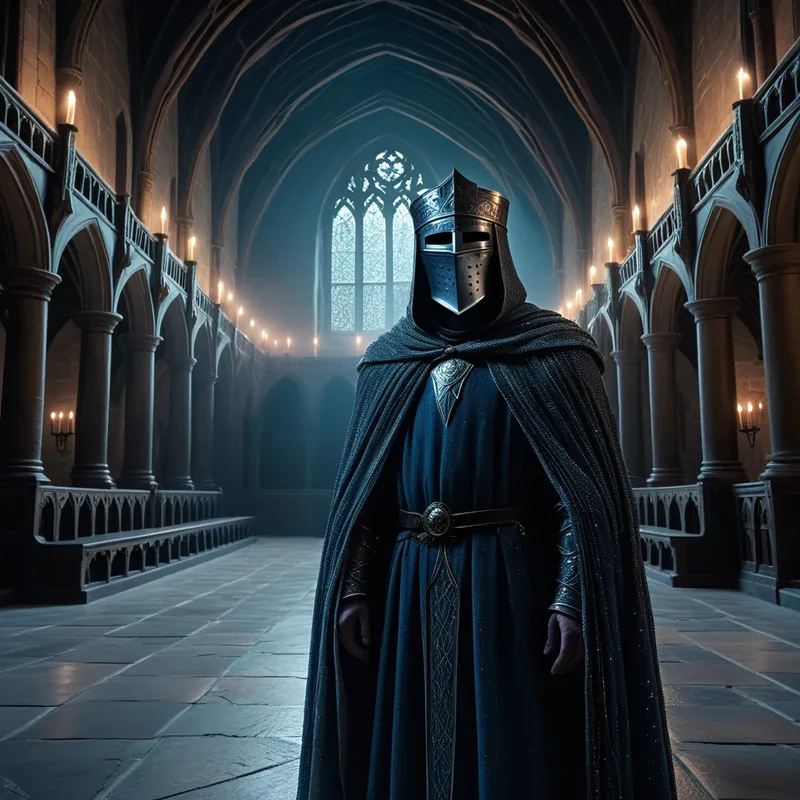
Mantle of Invisibility Myth Meaning & Symbolism
A magical cloak tests the fidelity of Arthur's court, revealing hidden truths and forcing a confrontation with the shadow self.
The Tale of Mantle of Invisibility
Hear now, and listen well, for the wind carries a whisper from the high halls of Camelot. It speaks not of shining steel or dragon’s fire, but of a subtler, colder magic—a test woven from silence and shadow.
The feast was at its height. The great hall roared with laughter, the firelight dancing on goblets of gold and silver, glinting from the Round Table. King Arthur presided, a sun amidst his planets of knights and their radiant ladies. Guinevere’s smile was the hall’s brightest jewel. Yet, into this blaze of confidence and camaraderie, a chill entered. Not through the door, but borne on the shoulders of a stranger.
She was an old woman, her cloak the grey of winter bark, her eyes pools of still water reflecting depths unseen. In her hands, she carried not a weapon, but a folded cloth. It was a mantle, but like no other. It seemed spun from the hour between dog and wolf, from the last sigh of dusk. It drank the torchlight, holding darkness within its folds.
“A gift, great king,” her voice rasped, cutting through the merriment. “A mantle of perfect making. But its virtue is a mirror, not a shield. Let any lady of your court who has been utterly faithful to her lord don this cloak. If her heart is pure in its devotion, it will fit her as a second skin, a garment of honor. But if she has strayed, even in thought… the cloth will betray her. It will not cover her. The truth will stand bare before all.”
A silence fell, heavy as stone. The fire crackled. The challenge hung in the air, a serpent in the garden of Logres. Arthur, bound by the laws of hospitality and the unspoken fear in his own heart, could not refuse. One by one, the proudest ladies of the land—dukes’ daughters, knights’ wives—stepped forward. With trembling hands, they took the mantle. And one by one, they failed. The fabric, which seemed ample, would shrink or twist; it would leave an arm exposed, a shoulder bare, a back uncovered. Each failure was a silent scream, a public undressing of private sin. The hall, once full of boast and song, became a gallery of shame, each imperfect drape of the magical cloth a confession whispered in linen.
Until at last, only one remained. A lady of lesser station, known for her quiet grace rather than her beauty or cunning. She approached the old woman and the silent king. The mantle was passed to her. She unfolded it, and with a calm that stilled the very air, she drew it around her shoulders. It settled. It flowed. It covered her completely, falling in perfect, generous folds. In that hall of revealed flaws, she stood alone, clothed in the dark fabric of fidelity.
The old woman nodded, a ghost of a smile on her lips. “The mantle is hers. And know this: the test was never hers alone.” With that, she was gone, as if made of the same mist as her gift. The mantle remained, a permanent, quiet judge in the corner of the court’s eye, a shadow cast by the brilliant but fragile light of Camelot itself.
Cultural Origins & Context
This haunting narrative, often titled The Mantle of Invisibility or The Mantle of Chastity Test, belongs not to the high chivalric romances of Chrétien de Troyes or Malory, but to the earlier, rougher soil of Celtic folklore and the vibrant tradition of Breton lais. These were narrative poems, often sung or recited, that flourished in the 12th and 13th centuries, existing alongside the more formalized Arthurian cycles. They were tales of the otherworld, where magic was not a system but a capricious, penetrating force that tested the very foundations of human society.
The story functions as a social and moral crucible. In a culture built upon the idealized codes of chivalry and courtly love—where public honor was paramount but private desire was a potent, often clandestine force—the mantle acts as an impossible arbiter. It externalizes the internal conflict. The tellers of this tale, likely bards moving between courts, were not merely entertainers; they were cultural diagnosticians. The story served as a cautionary mirror for aristocratic audiences, questioning the sustainability of their public ideals against private realities. It punctured the collective ego of the court, suggesting that the perfection of Logres was a beautiful fiction, vulnerable to a single thread of truth.
Symbolic Architecture
The Mantle is far more than a plot device; it is a perfect symbolic object, an artifact of the collective unconscious. It represents the inescapable gaze of Truth—not as an abstract concept, but as a palpable, enveloping force that reveals the shadow.
The cloak does not create the flaw; it merely refuses to collaborate in its concealment. It is the antithesis of persona, the social mask we wear.
The failed ladies symbolize the inevitable fragmentation of the idealized self. In a court dedicated to the image of the Hero, the Lover, and the Pure Queen, the mantle forces a confrontation with the shadow—the repressed infidelities, envies, and pride. Their exposure is not merely about marital fidelity, but about fidelity to one’s professed ideals. The single successful lady is not a symbol of moral superiority, but of wholeness. Her integrity is not a brittle perfection, but an alignment between her inner state and her outer appearance. She can “wear” the truth because she is it, in that moment. The old woman, the donor of the test, is an archetypal figure of the Crone or the Sovereignty Goddess, who comes not to destroy the court, but to initiate it into a more difficult, more authentic wisdom by shattering its illusions.

The Dreamer's Resonance
When this myth pattern stirs in the modern dreamscape, it signals a profound somatic and psychological process: the ego’s confrontation with a truth it has been actively clothing in denial. To dream of a cloak or garment that will not fit, that shrinks, tears, or becomes transparent, is to experience the psyche’s own “Mantle Test.”
The body in the dream often feels the visceral horror of exposure—the chill of air on suddenly bare skin, the heat of shame. This is the somatic signature of the shadow breaking into consciousness. The dream is not about literal infidelity, but about any fundamental misalignment between who we believe we are (our personal “Camelot”) and who we actually are in our hidden actions, neglected feelings, or unacknowledged motives. The dream forces a moment of naked self-assessment. Who, or what, in the dream is the “old woman” presenting this test? Often, it is a representation of the deeper Self, the guiding totality of the psyche, initiating a necessary, if painful, correction.
Alchemical Translation
The myth models the alchemical opus, the work of individuation, with stark clarity. Camelot represents the initial, conscious personality—brilliant, ordered, but based on a collective ideal. The arrival of the mantle is the nigredo, the blackening, the descent into the messy, shadowy material of the unconscious that tarnishes the gold of our self-image.
The process of becoming whole is not one of adding light, but of integrating the darkness that the light has cast.
Each failed attempt to don the mantle is a failed attempt at quick integration, a desire to simply “wear” wholeness as a new persona without doing the inner work. The final, successful wearing by the humble lady symbolizes the albedo, the whitening, which follows the blackening. It is not a return to naive purity, but the emergence of a conscious integrity born from having faced the shadow. The mantle, once a terrifying judge, becomes simply a garment—a part of the self, accepted and incorporated. For the modern individual, the myth instructs that the path to authenticity lies not in building a flawless castle of the self, but in having the courage to stand in the great hall of one’s own soul and allow the fabric of one’s truths—both light and dark—to finally, and fully, cover one. The invisibility the mantle offers is not the invisibility of hiding, but the invisibility of transparency, where nothing false stands between the soul and the world.
Associated Symbols
Explore related symbols from the CaleaDream lexicon: