Manticore Myth Meaning & Symbolism
A creature of lion, man, and scorpion, born from the earth's forgotten nightmares, that embodies the terrifying, devouring aspect of the unintegrated psyche.
The Tale of Manticore
Hear now, and let your blood grow still. In the forgotten places, where the sun’s hammer turns rock to glass and the wind carries only the whispers of the dead, it waits. It was not born of love or divine breath, but from the earth’s own swallowed screams, from the deep, silent hunger that gnaws at the roots of mountains.
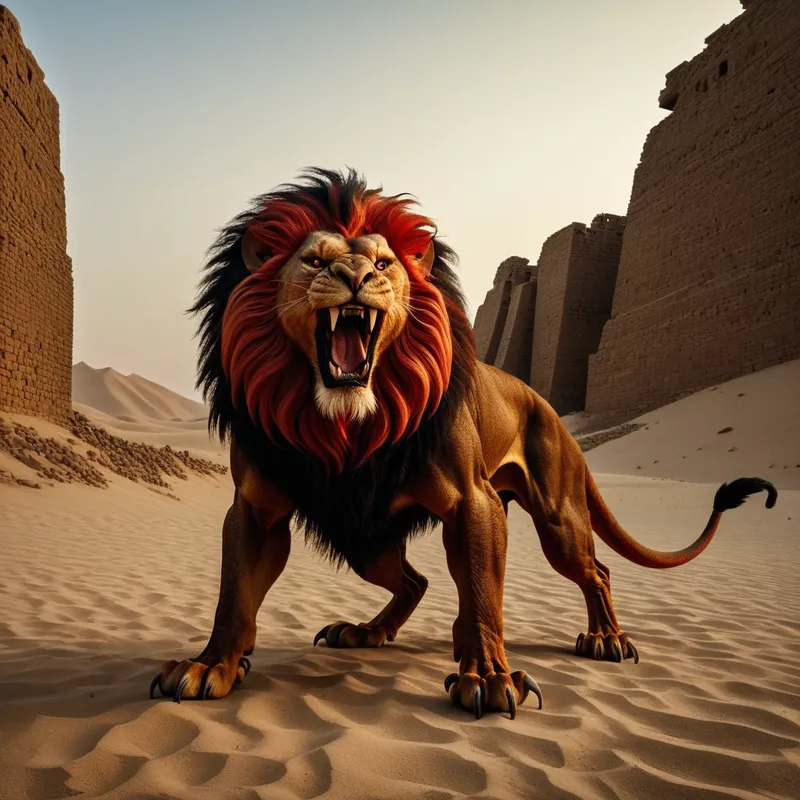
They say its coming is heralded by a sound—not a roar, but a low, fluting whistle that slips between the notes of the wind, a melody that calls not to the ear, but to the marrow. Then you see it, a ripple in the heat haze, a wrongness of form. It has the body of a lion, but the pelt is not gold; it is the crimson of old, spilled wine, of a heart’s last pulse. Its face is that of a man, yet it is a mask of pure appetite, the eyes holding a terrible, knowing intelligence. And when it opens its mouth to utter its siren-call, you see not the maw of a beast, but three precise, interlocking rows of teeth, like the gates of a bone-white city built only for consumption.
But its true horror is its tail. From the base of its spine sprouts not a lion’s tuft, but the segmented, armored length of a scorpion, tipped with a venomous sting. It moves with a dreadful, calculated grace, the lion’s limbs propelling it with thunderous power, the human face scanning the emptiness, the tail a poised and patient sentinel above.
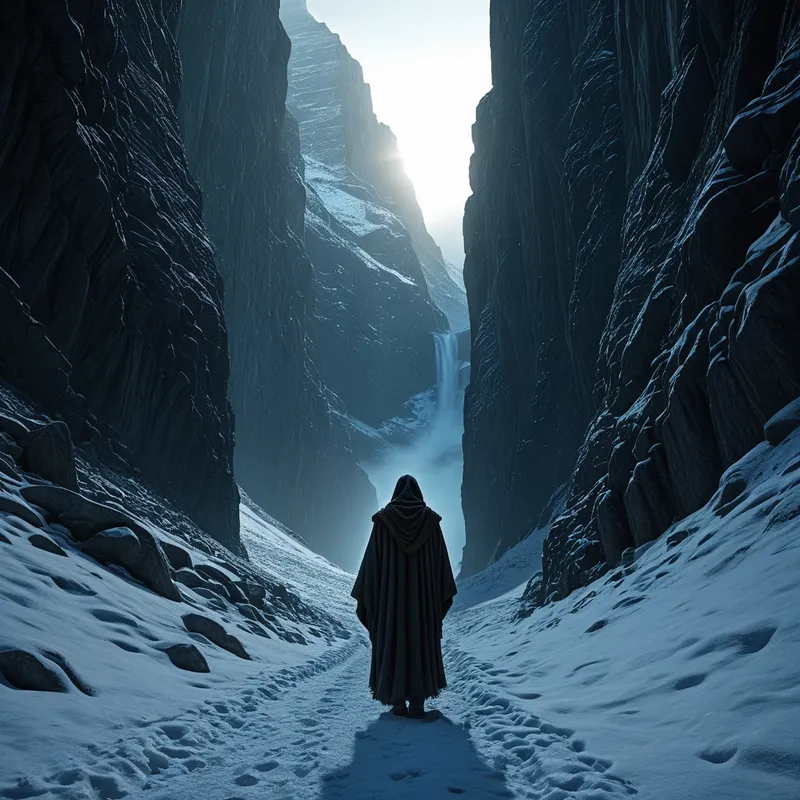
It does not hunt for sport or for hunger of the belly alone. It hunts for the essence. It seeks out the lone traveler, the exile, the one who carries within them a secret too heavy, a fear too sharp. It corners them in the wadis where no water flows, against cliffs that offer no handhold. There is no battle, for to fight is to acknowledge a peer. There is only the inevitable approach, the hypnotic whistle, and the final, enveloping shadow. It consumes everything—flesh, bone, the clothes, the tools. It leaves no trace. It is the absolute eraser, the end of story.
And so it walks the borderlands, a perfect, terrible fact. It is the answer to a question no one dares ask aloud: what becomes of that which the world, and the soul, wishes utterly to forget?
Cultural Origins & Context
The Manticore (from the Old Persian martiyakhvara, meaning “man-eater”) entered the Western imagination primarily through the works of the Greek physician Ctesias, who served in the Persian court of Artaxerxes II in the 4th century BCE. His accounts, mingling observation with hearsay, painted a picture of the fears that lurked at the edges of the expansive Achaemenid Empire.
This was not a myth told around hearths to teach virtue, but a traveler’s tale, a geographer’s warning scribbled in the margins of a map. It functioned as a narrative boundary marker. The civilized world of the polis and the royal road ended; beyond lay the Manticore, a embodiment of the alien, consuming wildness. In Persian lore, it was often associated with the deserts and remote mountains of India, a land already mythologized as a place of wonders and terrors. Its persistence through texts by Aristotle, Pliny, and into the medieval bestiaries speaks to its potency as a symbol of the ultimate predatory “other,” a creature that violated the natural order by synthesizing the king of beasts, the reasoning man, and the venomous arthropod into a single, dread purpose.
Symbolic Architecture
The Manticore is not a monster of chaos, but of a horrifying, hybridized order. Its symbolism is a triune architecture of the psyche’s most formidable aspects.
The Lion’s Body represents raw, sovereign instinct, the unmediated power of the animal soul. This is the force of life, but untamed and directed solely by hunger. The Human Face signifies the intellect, but here it is inverted—not used for creation or compassion, but as a lens to focus predation, to recognize fear and vulnerability in its prey. It is cognition in service of consumption. The Scorpion’s Tail embodies the secret, venomous sting, the delayed psychic poison—betrayal, hidden resentment, or a truth so toxic it paralyzes the soul.
The Manticore is the shadow of synthesis: where integration fails, a monstrous collage emerges.
Psychologically, it represents the complex that consumes. It is the devouring mother, the tyrannical father, the addictive pattern, or the core wound that eats all positive energy, leaving “no trace.” Its three rows of teeth symbolize the completeness of this consumption—physical, emotional, mental. Its whistle is the seductive call of the complex itself, which promises an end to struggle through surrender to oblivion.

The Dreamer's Resonance
To dream of the Manticore is to encounter the psyche’s own devouring endgame. It rarely appears in full form initially. One may dream only of its sound—that eerie, compelling whistle heard in a dream hallway or a vast landscape, triggering deep dread. Or one may see its shadow, immense and misshapen, falling across a familiar place.
Somatically, the dreamer may wake with a sense of paralysis, a metallic taste of fear, or a tightness in the gut—the body registering the psychic poison of the “sting” before the mind comprehends it. The dream often occurs during life phases where one feels utterly consumed—by work, by a relationship, by a grief or depression that eats away all other aspects of identity. The Manticore manifests when the individual’s psychic energy is being monolithically directed into a black hole of a complex, leaving the rest of the self starved and annihilated. The dream is a catastrophic warning from the unconscious: “The current path leads to total psychic consumption.”
Alchemical Translation
The alchemical journey does not ask us to slay the Manticore, for it is a part of our own substance. The work is one of discernment and reclamation. The first operation is Mortificatio—the recognition of what is being devoured. The traveler in the myth is the part of the ego that wanders into the territory of the complex. Its consumption is necessary; the old, naive identity must be dissolved.
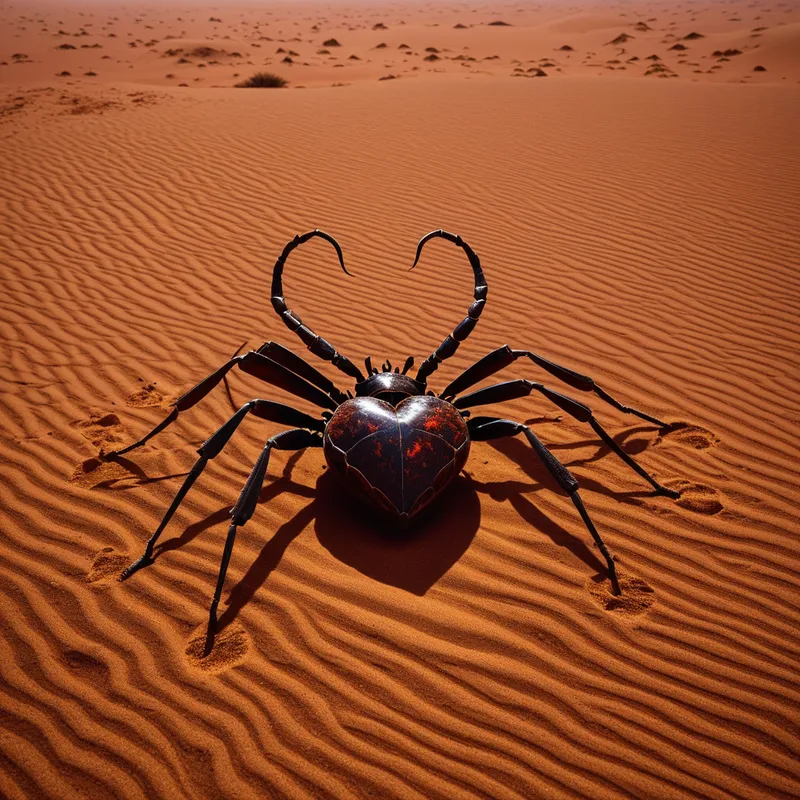
The second operation is Separatio. Here, the triune form of the Manticore is key. The task is to mentally separate the lion, the man, and the scorpion. What is the raw, powerful instinct (lion) that has been hijacked? What is the sharp intelligence (man) being used only for self-sabotage? What is the hidden poison (scorpion) that delivers the paralyzing blow? By separating them, we rob the complex of its synthesized, monstrous power.
The ultimate alchemy is to feed the complex not your whole self, but the specific, differentiated substance it demands, thereby transmuting the devourer into a guardian.
The final stage is Coagulatio—the solidification of a new consciousness. The reclaimed lion’s strength becomes grounded vitality. The reclaimed human face becomes clear self-reflection. The reclaimed scorpion’s venom, in homeopathic dose, becomes the protective boundary, the ability to say “no.” The orphaned parts, once organized into a monster of lack, are reintegrated. The Manticore, faced and analyzed, ceases to be an external terror lurking in wastelands. It becomes the fierce, composite guardian of the threshold between the conscious ego and the vast, potent wilderness of the Self, no longer whistling a call to oblivion, but standing silent, integrated, and whole.
Associated Symbols
Explore related symbols from the CaleaDream lexicon: